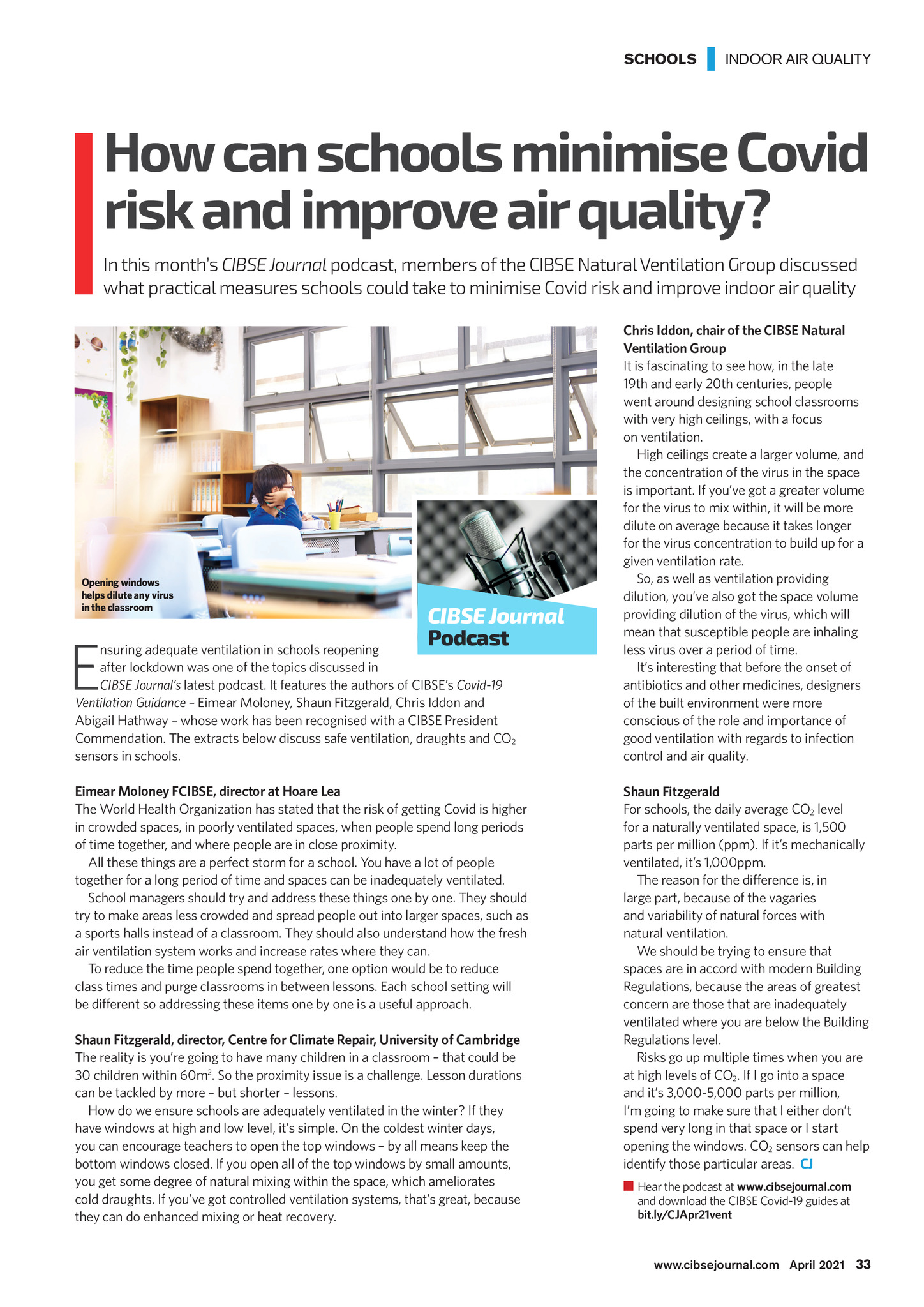
SCHOOLS | INDOOR AIR QUALITY How can schools minimise Covid risk and improve air quality? In this months CIBSE Journal podcast, members of the CIBSE Natural Ventilation Group discussed what practical measures schools could take to minimise Covid risk and improve indoor air quality Opening windows helps dilute any virus in the classroom E CIBSE Journal Podcast nsuring adequate ventilation in schools reopening after lockdown was one of the topics discussed in CIBSE Journals latest podcast. It features the authors of CIBSEs Covid-19 Ventilation Guidance Eimear Moloney, Shaun Fitzgerald, Chris Iddon and Abigail Hathway whose work has been recognised with a CIBSE President Commendation. The extracts below discuss safe ventilation, draughts and CO2 sensors in schools. Eimear Moloney FCIBSE, director at Hoare Lea The World Health Organization has stated that the risk of getting Covid is higher in crowded spaces, in poorly ventilated spaces, when people spend long periods of time together, and where people are in close proximity. All these things are a perfect storm for a school. You have a lot of people together for a long period of time and spaces can be inadequately ventilated. School managers should try and address these things one by one. They should try to make areas less crowded and spread people out into larger spaces, such as a sports halls instead of a classroom. They should also understand how the fresh air ventilation system works and increase rates where they can. To reduce the time people spend together, one option would be to reduce class times and purge classrooms in between lessons. Each school setting will be different so addressing these items one by one is a useful approach. Shaun Fitzgerald, director, Centre for Climate Repair, University of Cambridge The reality is youre going to have many children in a classroom that could be 30 children within 60m2. So the proximity issue is a challenge. Lesson durations can be tackled by more but shorter lessons. How do we ensure schools are adequately ventilated in the winter? If they have windows at high and low level, its simple. On the coldest winter days, you can encourage teachers to open the top windows by all means keep the bottom windows closed. If you open all of the top windows by small amounts, you get some degree of natural mixing within the space, which ameliorates cold draughts. If youve got controlled ventilation systems, thats great, because they can do enhanced mixing or heat recovery. Chris Iddon, chair of the CIBSE Natural Ventilation Group It is fascinating to see how, in the late 19th and early 20th centuries, people went around designing school classrooms with very high ceilings, with a focus on ventilation. High ceilings create a larger volume, and the concentration of the virus in the space is important. If youve got a greater volume for the virus to mix within, it will be more dilute on average because it takes longer for the virus concentration to build up for a given ventilation rate. So, as well as ventilation providing dilution, youve also got the space volume providing dilution of the virus, which will mean that susceptible people are inhaling less virus over a period of time. Its interesting that before the onset of antibiotics and other medicines, designers of the built environment were more conscious of the role and importance of good ventilation with regards to infection control and air quality. Shaun Fitzgerald For schools, the daily average CO2 level for a naturally ventilated space, is 1,500 parts per million (ppm). If its mechanically ventilated, its 1,000ppm. The reason for the difference is, in large part, because of the vagaries and variability of natural forces with natural ventilation. We should be trying to ensure that spaces are in accord with modern Building Regulations, because the areas of greatest concern are those that are inadequately ventilated where you are below the Building Regulations level. Risks go up multiple times when you are at high levels of CO2. If I go into a space and its 3,000-5,000 parts per million, Im going to make sure that I either dont spend very long in that space or I start opening the windows. CO2 sensors can help identify those particular areas. CJ Hear the podcast at www.cibsejournal.com and download the CIBSE Covid-19 guides at bit.ly/CJApr21vent www.cibsejournal.com April 2021 33 CIBSE April 21 pp33 Education Covid podcast Supp.indd 33 26/03/2021 15:33