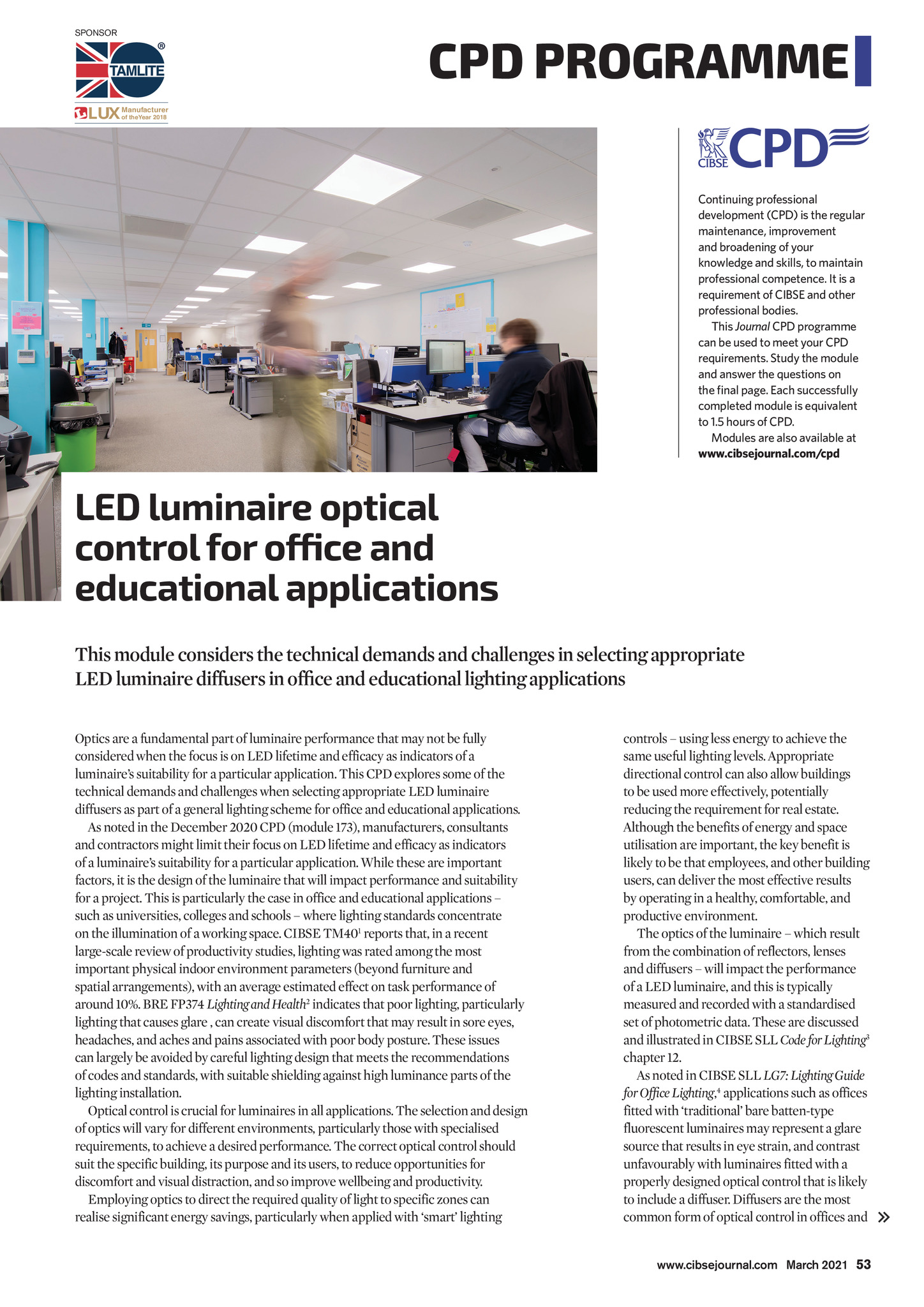
SPONSOR CPD PROGRAMME LUX Manufacturer of theYear 2018 Continuing professional development (CPD) is the regular maintenance, improvement and broadening of your knowledge and skills, to maintain professional competence. It is a requirement of CIBSE and other professional bodies. This Journal CPD programme can be used to meet your CPD requirements. Study the module and answer the questions on the final page. Each successfully completed module is equivalent to 1.5 hours of CPD. Modules are also available at www.cibsejournal.com/cpd LED luminaire optical control for office and educational applications This module considers the technical demands and challenges in selecting appropriate LED luminaire diffusers in office and educational lighting applications Optics are a fundamental part of luminaire performance that may not be fully considered when the focus is on LED lifetime and efficacy as indicators of a luminaires suitability for a particular application. This CPD explores some of the technical demands and challenges when selecting appropriate LED luminaire diffusers as part of a general lighting scheme for office and educational applications. As noted in the December 2020 CPD (module 173), manufacturers, consultants and contractors might limit their focus on LED lifetime and efficacy as indicators of a luminaires suitability for a particular application. While these are important factors, it is the design of the luminaire that will impact performance and suitability for a project. This is particularly the case in office and educational applications such as universities, colleges and schools where lighting standards concentrate on the illumination of a working space. CIBSE TM401 reports that, in a recent large-scale review of productivity studies, lighting was rated among the most important physical indoor environment parameters (beyond furniture and spatial arrangements), with an average estimated effect on task performance of around 10%. BRE FP374 Lighting and Health2 indicates that poor lighting, particularly lighting that causes glare , can create visual discomfort that may result in sore eyes, headaches, and aches and pains associated with poor body posture. These issues can largely be avoided by careful lighting design that meets the recommendations of codes and standards, with suitable shielding against high luminance parts of the lighting installation. Optical control is crucial for luminaires in all applications. The selection and design of optics will vary for different environments, particularly those with specialised requirements, to achieve a desired performance. The correct optical control should suit the specific building, its purpose and its users, to reduce opportunities for discomfort and visual distraction, and so improve wellbeing and productivity. Employing optics to direct the required quality of light to specific zones can realise significant energy savings, particularly when applied with smart lighting controls using less energy to achieve the same useful lighting levels. Appropriate directional control can also allow buildings to be used more effectively, potentially reducing the requirement for real estate. Although the benefits of energy and space utilisation are important, the key benefit is likely to be that employees, and other building users, can deliver the most effective results by operating in a healthy, comfortable, and productive environment. The optics of the luminaire which result from the combination of reflectors, lenses and diffusers will impact the performance of a LED luminaire, and this is typically measured and recorded with a standardised set of photometric data. These are discussed and illustrated in CIBSE SLL Code for Lighting3 chapter 12. As noted in CIBSE SLL LG7: Lighting Guide for Office Lighting,4 applications such as offices fitted with traditional bare batten-type fluorescent luminaires may represent a glare source that results in eye strain, and contrast unfavourably with luminaires fitted with a properly designed optical control that is likely to include a diffuser. Diffusers are the most common form of optical control in offices and www.cibsejournal.com March 2021 53 CIBSE March 21 pp53-56 CPD 176.indd 53 19/02/2021 15:41