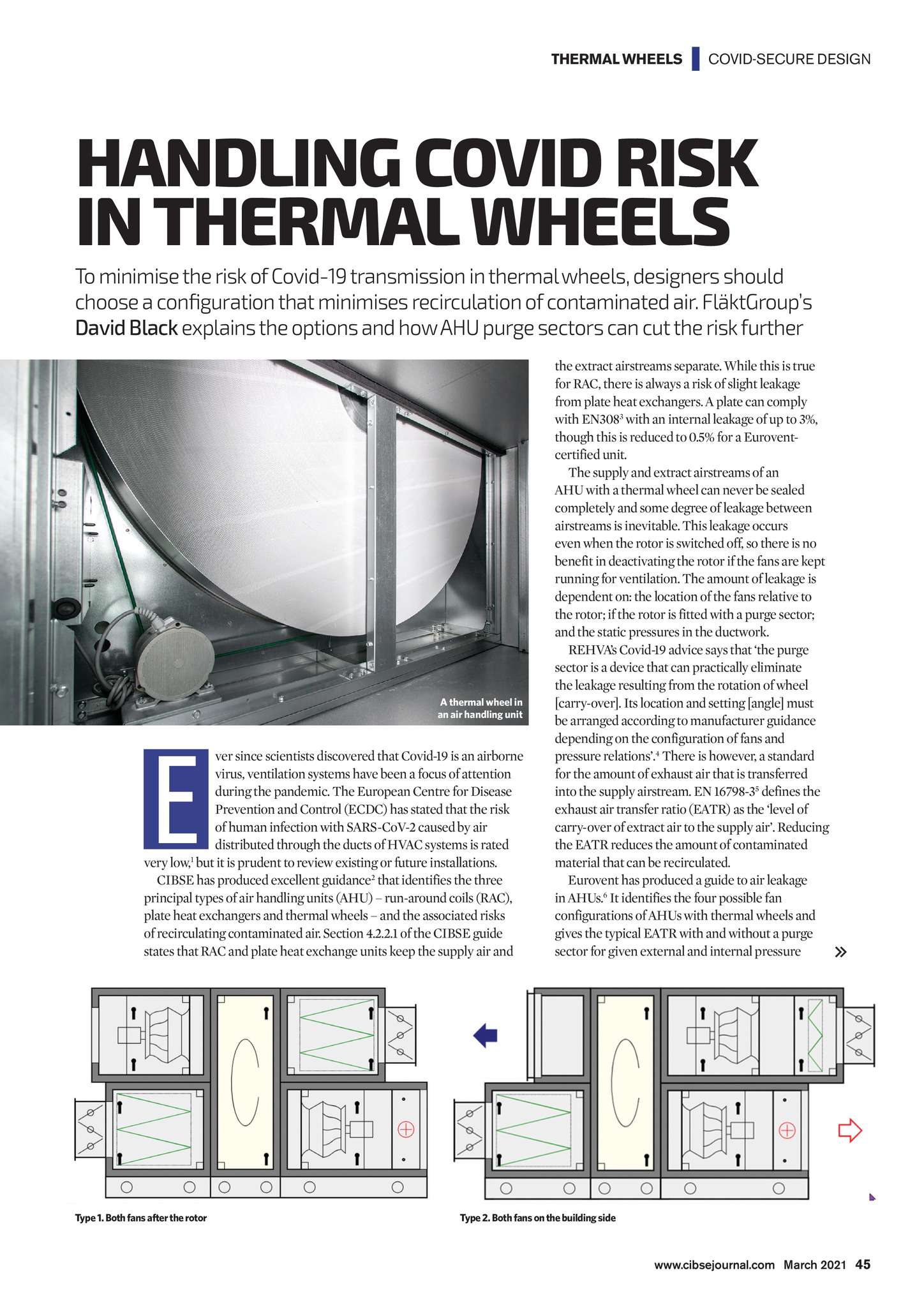
THERMAL WHEELS | COVID-SECURE DESIGN HANDLING COVID RISK IN THERMAL WHEELS To minimise the risk of Covid-19 transmission in thermal wheels, designers should choose a configuration that minimises recirculation of contaminated air. FlktGroups David Black explains the options and how AHU purge sectors can cut the risk further A thermal wheel in an air handling unit E ver since scientists discovered that Covid-19 is an airborne virus, ventilation systems have been a focus of attention during the pandemic. The European Centre for Disease Prevention and Control (ECDC) has stated that the risk of human infection with SARS-CoV-2 caused by air distributed through the ducts of HVAC systems is rated very low,1 but it is prudent to review existing or future installations. CIBSE has produced excellent guidance2 that identifies the three principal types of air handling units (AHU) run-around coils (RAC), plate heat exchangers and thermal wheels and the associated risks of recirculating contaminated air. Section 4.2.2.1 of the CIBSE guide states that RAC and plate heat exchange units keep the supply air and Type 1. Both fans after the rotor the extract airstreams separate. While this is true for RAC, there is always a risk of slight leakage from plate heat exchangers. A plate can comply with EN3083 with an internal leakage of up to 3%, though this is reduced to 0.5% for a Euroventcertified unit. The supply and extract airstreams of an AHU with a thermal wheel can never be sealed completely and some degree of leakage between airstreams is inevitable. This leakage occurs even when the rotor is switched off, so there is no benefit in deactivating the rotor if the fans are kept running for ventilation. The amount of leakage is dependent on: the location of the fans relative to the rotor; if the rotor is fitted with a purge sector; and the static pressures in the ductwork. REHVAs Covid-19 advice says that the purge sector is a device that can practically eliminate the leakage resulting from the rotation of wheel [carry-over]. Its location and setting [angle] must be arranged according to manufacturer guidance depending on the configuration of fans and pressure relations.4 There is however, a standard for the amount of exhaust air that is transferred into the supply airstream. EN 16798-35 defines the exhaust air transfer ratio (EATR) as the level of carry-over of extract air to the supply air. Reducing the EATR reduces the amount of contaminated material that can be recirculated. Eurovent has produced a guide to air leakage in AHUs.6 It identifies the four possible fan configurations of AHUs with thermal wheels and gives the typical EATR with and without a purge sector for given external and internal pressure Type 2. Both fans on the building side www.cibsejournal.com March 2021 45 CIBSE March 21 pp45-46 AHU Thermal Wheel Covid.indd 45 19/02/2021 15:31