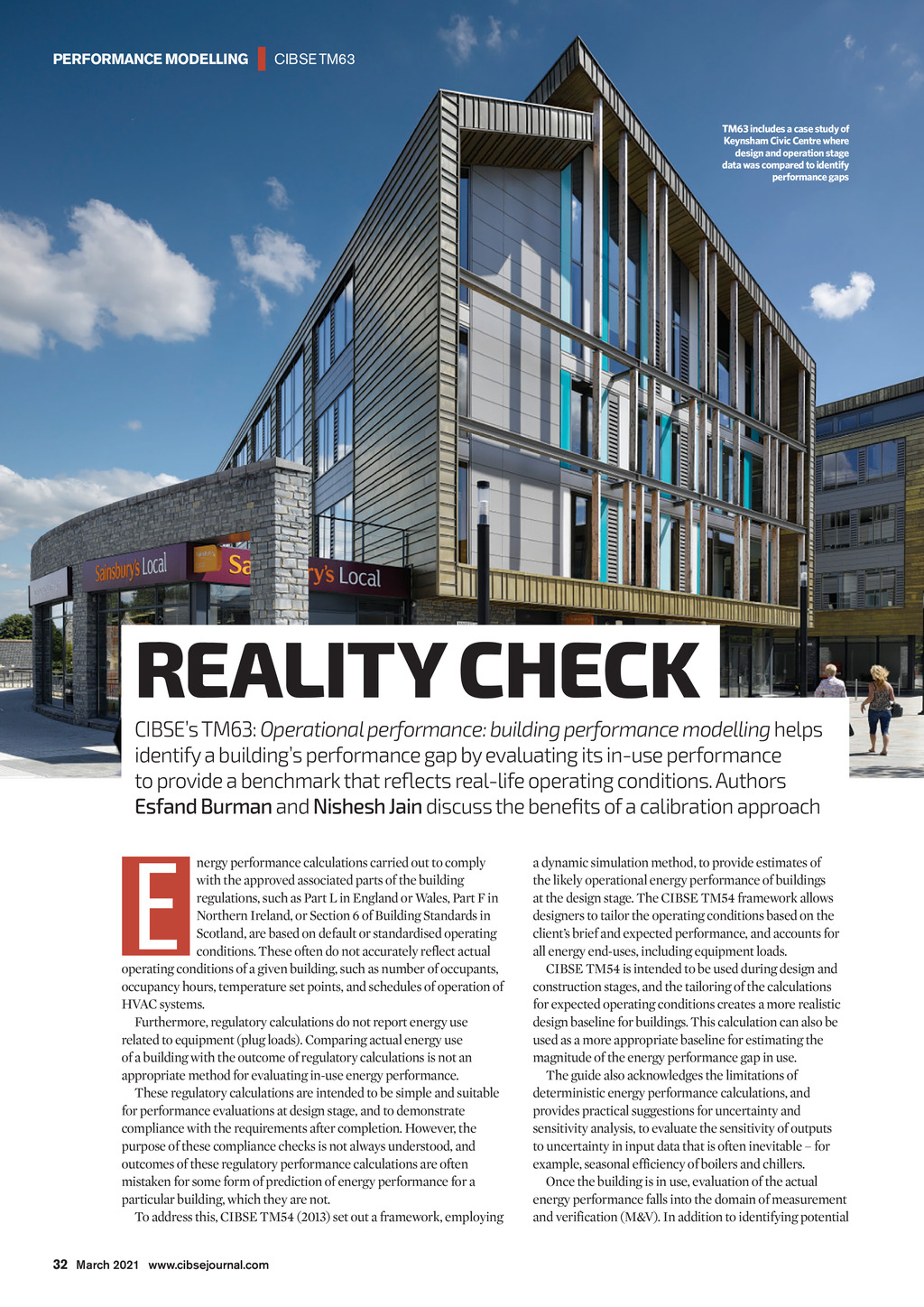
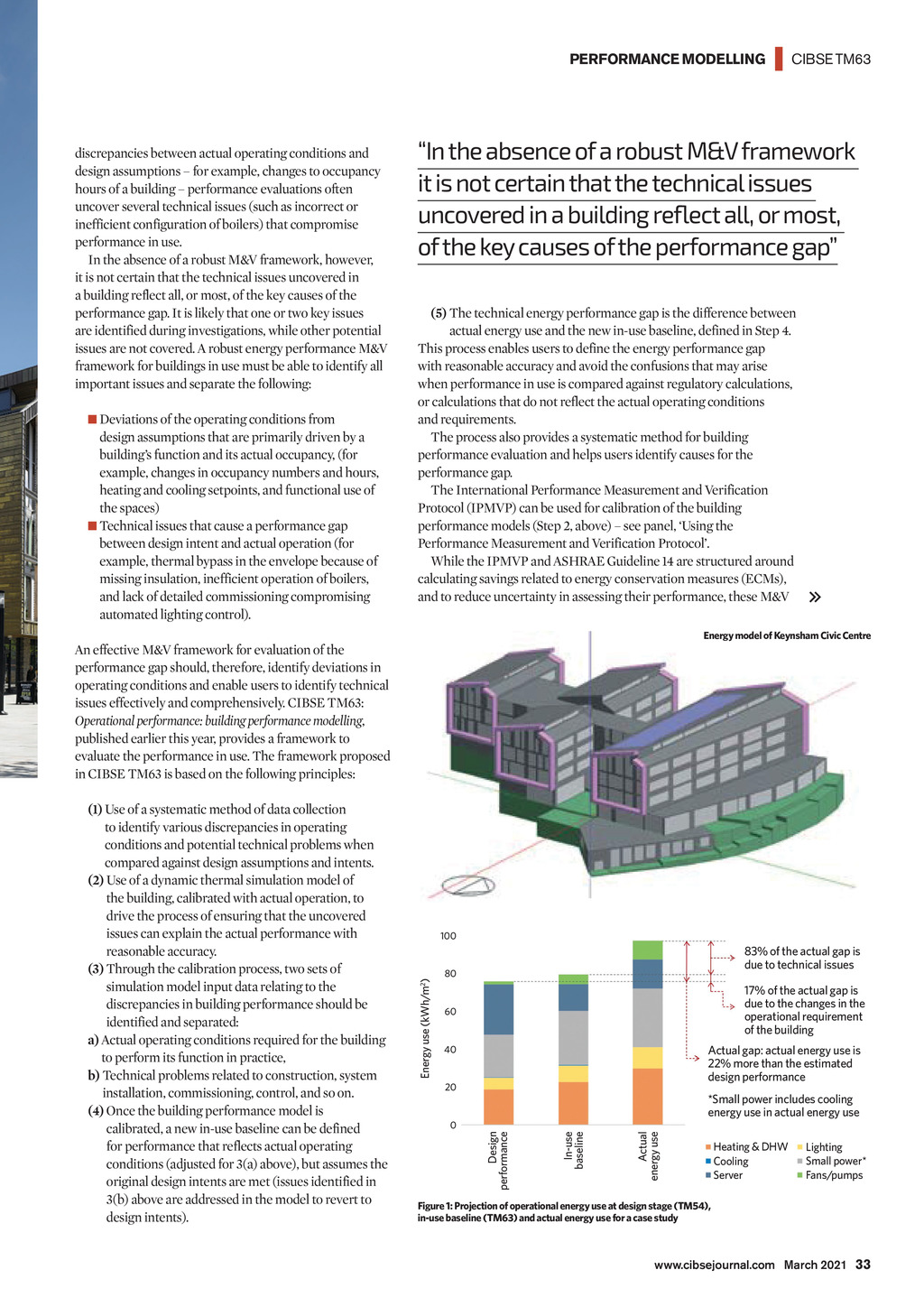


PERFORMANCE MODELLING | CIBSE TM63 TM63 includes a case study of Keynsham Civic Centre where design and operation stage data was compared to identify performance gaps REALITY CHECK CIBSEs TM63: Operational performance: building performance modelling helps identify a buildings performance gap by evaluating its in-use performance to provide a benchmark that reflects real-life operating conditions. Authors Esfand Burman and Nishesh Jain discuss the benefits of a calibration approach E nergy performance calculations carried out to comply with the approved associated parts of the building regulations, such as Part L in England or Wales, Part F in Northern Ireland, or Section 6 of Building Standards in Scotland, are based on default or standardised operating conditions. These often do not accurately reflect actual operating conditions of a given building, such as number of occupants, occupancy hours, temperature set points, and schedules of operation of HVAC systems. Furthermore, regulatory calculations do not report energy use related to equipment (plug loads). Comparing actual energy use of a building with the outcome of regulatory calculations is not an appropriate method for evaluating in-use energy performance. These regulatory calculations are intended to be simple and suitable for performance evaluations at design stage, and to demonstrate compliance with the requirements after completion. However, the purpose of these compliance checks is not always understood, and outcomes of these regulatory performance calculations are often mistaken for some form of prediction of energy performance for a particular building, which they are not. To address this, CIBSE TM54 (2013) set out a framework, employing a dynamic simulation method, to provide estimates of the likely operational energy performance of buildings at the design stage. The CIBSE TM54 framework allows designers to tailor the operating conditions based on the clients brief and expected performance, and accounts for all energy end-uses, including equipment loads. CIBSE TM54 is intended to be used during design and construction stages, and the tailoring of the calculations for expected operating conditions creates a more realistic design baseline for buildings. This calculation can also be used as a more appropriate baseline for estimating the magnitude of the energy performance gap in use. The guide also acknowledges the limitations of deterministic energy performance calculations, and provides practical suggestions for uncertainty and sensitivity analysis, to evaluate the sensitivity of outputs to uncertainty in input data that is often inevitable for example, seasonal efficiency of boilers and chillers. Once the building is in use, evaluation of the actual energy performance falls into the domain of measurement and verification (M&V). In addition to identifying potential 32 March 2021 www.cibsejournal.com CIBSE March 21 pp32-34 TM63.indd 32 19/02/2021 17:45