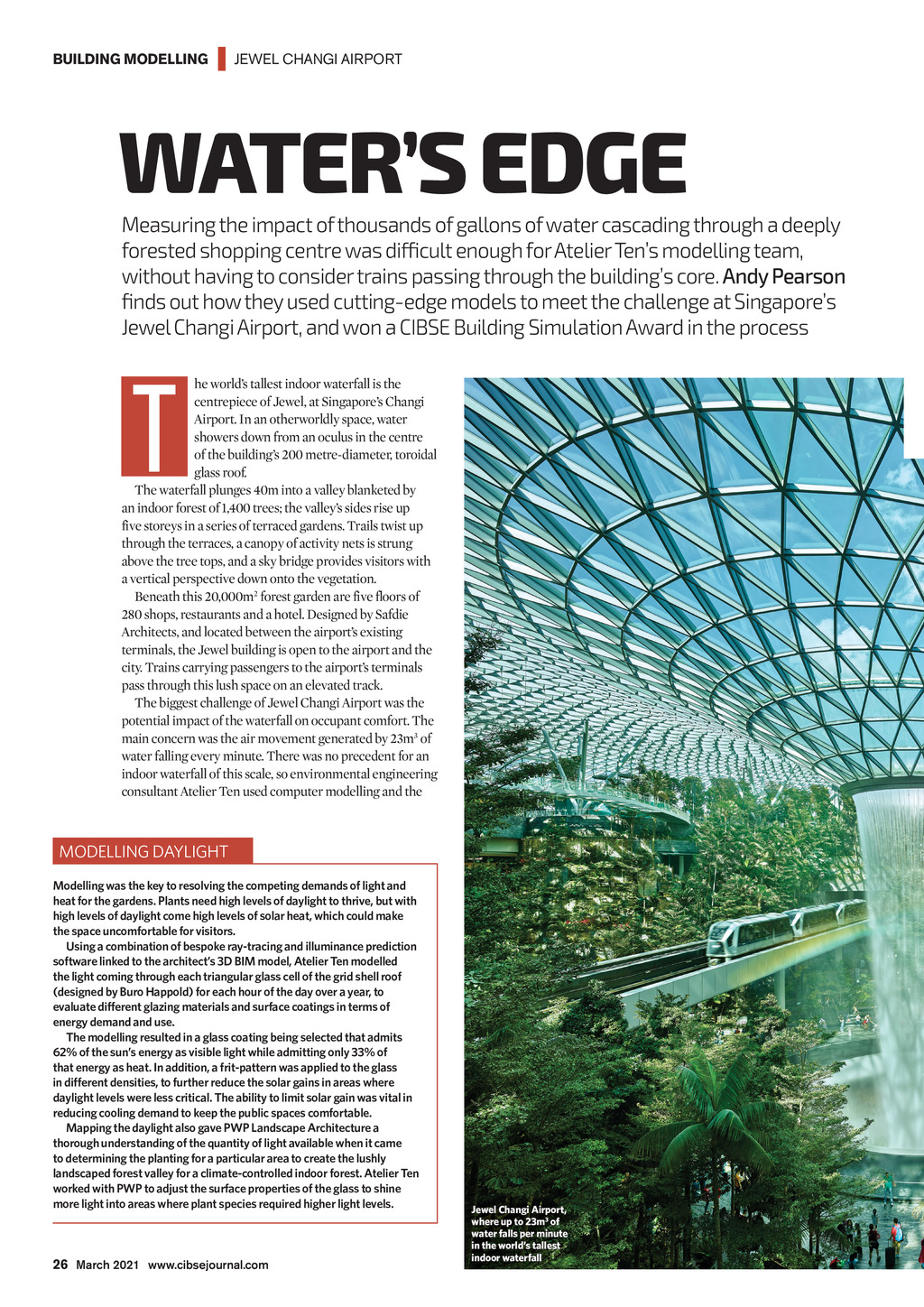
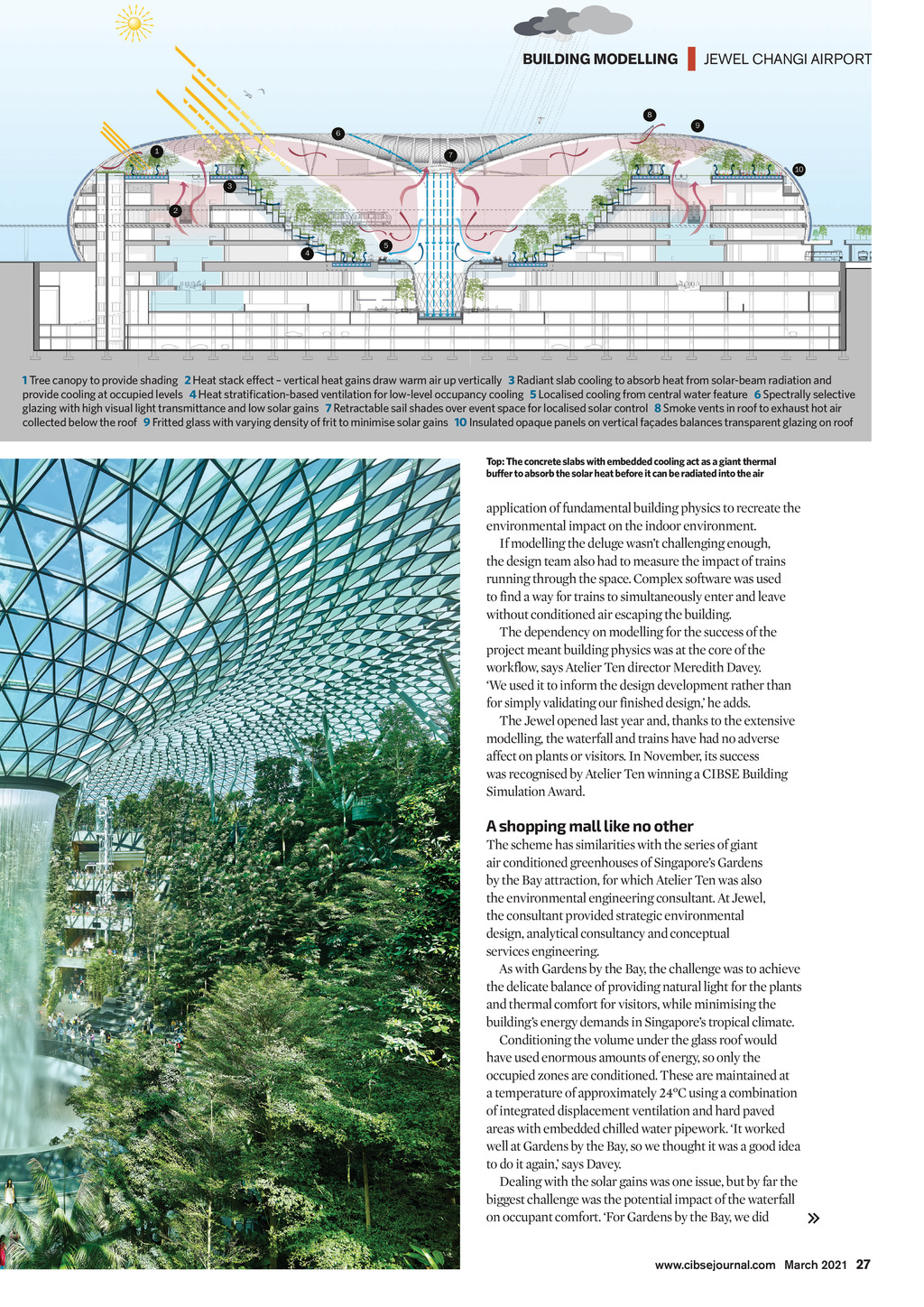


BUILDING MODELLING | JEWEL CHANGI AIRPORT WATERS EDGE Measuring the impact of thousands of gallons of water cascading through a deeply forested shopping centre was difficult enough for Atelier Tens modelling team, without having to consider trains passing through the buildings core. Andy Pearson finds out how they used cutting-edge models to meet the challenge at Singapores Jewel Changi Airport, and won a CIBSE Building Simulation Award in the process T he worlds tallest indoor waterfall is the centrepiece of Jewel, at Singapores Changi Airport. In an otherworldly space, water showers down from an oculus in the centre of the buildings 200 metre-diameter, toroidal glass roof. The waterfall plunges 40m into a valley blanketed by an indoor forest of 1,400 trees; the valleys sides rise up five storeys in a series of terraced gardens. Trails twist up through the terraces, a canopy of activity nets is strung above the tree tops, and a sky bridge provides visitors with a vertical perspective down onto the vegetation. Beneath this 20,000m2 forest garden are five floors of 280 shops, restaurants and a hotel. Designed by Safdie Architects, and located between the airports existing terminals, the Jewel building is open to the airport and the city. Trains carrying passengers to the airports terminals pass through this lush space on an elevated track. The biggest challenge of Jewel Changi Airport was the potential impact of the waterfall on occupant comfort. The main concern was the air movement generated by 23m3 of water falling every minute. There was no precedent for an indoor waterfall of this scale, so environmental engineering consultant Atelier Ten used computer modelling and the MODELLING DAYLIGHT Modelling was the key to resolving the competing demands of light and heat for the gardens. Plants need high levels of daylight to thrive, but with high levels of daylight come high levels of solar heat, which could make the space uncomfortable for visitors. Using a combination of bespoke ray-tracing and illuminance prediction software linked to the architects 3D BIM model, Atelier Ten modelled the light coming through each triangular glass cell of the grid shell roof (designed by Buro Happold) for each hour of the day over a year, to evaluate different glazing materials and surface coatings in terms of energy demand and use. The modelling resulted in a glass coating being selected that admits 62% of the suns energy as visible light while admitting only 33% of that energy as heat. In addition, a frit-pattern was applied to the glass in different densities, to further reduce the solar gains in areas where daylight levels were less critical. The ability to limit solar gain was vital in reducing cooling demand to keep the public spaces comfortable. Mapping the daylight also gave PWP Landscape Architecture a thorough understanding of the quantity of light available when it came to determining the planting for a particular area to create the lushly landscaped forest valley for a climate-controlled indoor forest. Atelier Ten worked with PWP to adjust the surface properties of the glass to shine more light into areas where plant species required higher light levels. 26 March 2021 www.cibsejournal.com CIBSE March 21 pp26-30 Jewel Changi.indd 26 Jewel Changi Airport, where up to 23m3 of water falls per minute in the worlds tallest indoor waterfall 19/02/2021 17:43