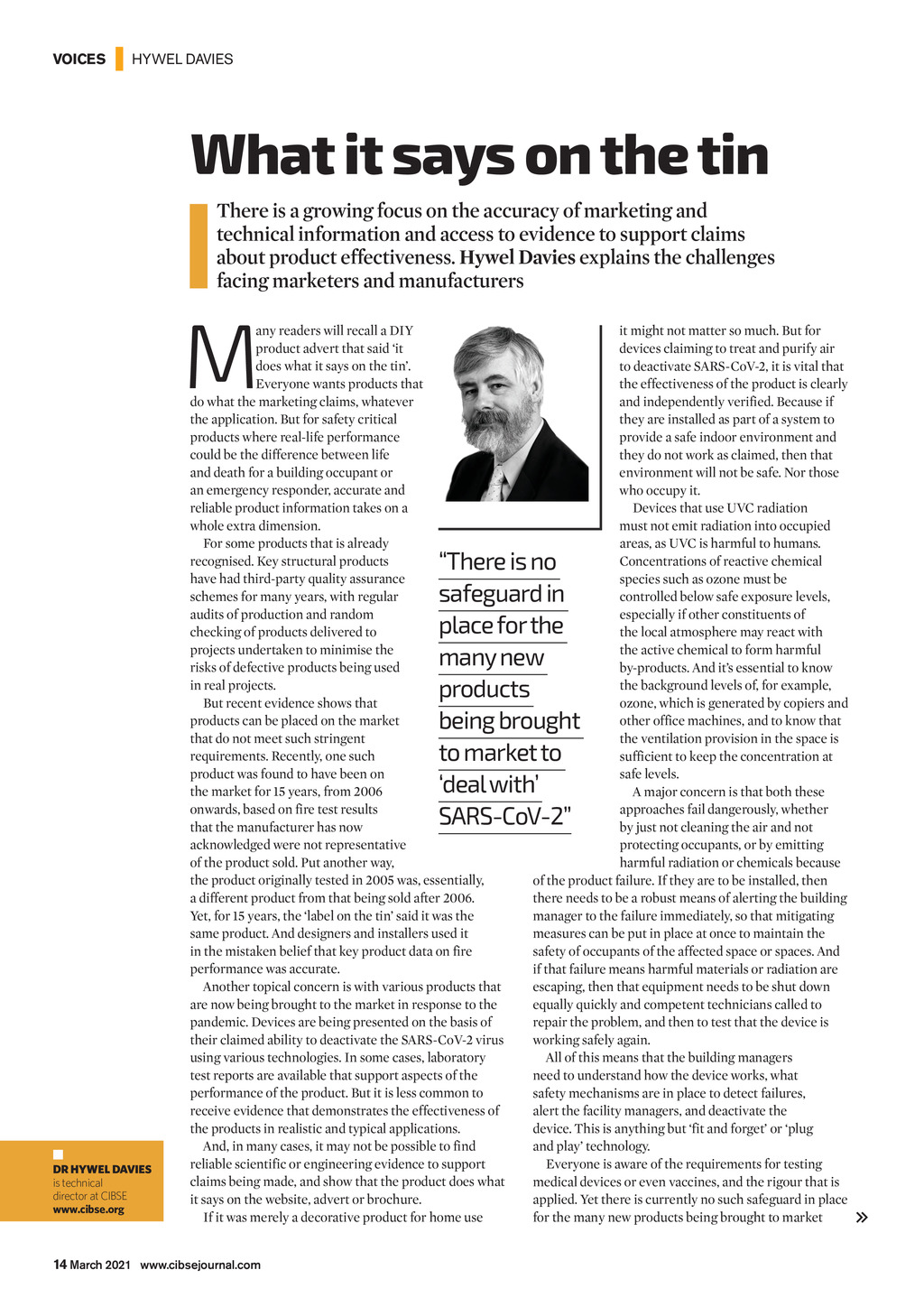


VOICES | HYWEL DAVIES What it says on the tin There is a growing focus on the accuracy of marketing and technical information and access to evidence to support claims about product effectiveness. Hywel Davies explains the challenges facing marketers and manufacturers M any readers will recall a DIY product advert that said it does what it says on the tin. Everyone wants products that do what the marketing claims, whatever the application. But for safety critical products where real-life performance could be the difference between life and death for a building occupant or an emergency responder, accurate and reliable product information takes on a whole extra dimension. For some products that is already recognised. Key structural products have had third-party quality assurance schemes for many years, with regular audits of production and random checking of products delivered to projects undertaken to minimise the risks of defective products being used in real projects. But recent evidence shows that products can be placed on the market that do not meet such stringent requirements. Recently, one such product was found to have been on the market for 15 years, from 2006 onwards, based on fire test results that the manufacturer has now acknowledged were not representative of the product sold. Put another way, the product originally tested in 2005 was, essentially, a different product from that being sold after 2006. Yet, for 15 years, the label on the tin said it was the same product. And designers and installers used it in the mistaken belief that key product data on fire performance was accurate. Another topical concern is with various products that are now being brought to the market in response to the pandemic. Devices are being presented on the basis of their claimed ability to deactivate the SARS-CoV-2 virus using various technologies. In some cases, laboratory test reports are available that support aspects of the performance of the product. But it is less common to receive evidence that demonstrates the effectiveness of the products in realistic and typical applications. And, in many cases, it may not be possible to find reliable scientific or engineering evidence to support claims being made, and show that the product does what it says on the website, advert or brochure. If it was merely a decorative product for home use it might not matter so much. But for devices claiming to treat and purify air to deactivate SARS-CoV-2, it is vital that the effectiveness of the product is clearly and independently verified. Because if they are installed as part of a system to provide a safe indoor environment and they do not work as claimed, then that environment will not be safe. Nor those who occupy it. Devices that use UVC radiation must not emit radiation into occupied areas, as UVC is harmful to humans. Concentrations of reactive chemical species such as ozone must be controlled below safe exposure levels, especially if other constituents of the local atmosphere may react with the active chemical to form harmful by-products. And its essential to know the background levels of, for example, ozone, which is generated by copiers and other office machines, and to know that the ventilation provision in the space is sufficient to keep the concentration at safe levels. A major concern is that both these approaches fail dangerously, whether by just not cleaning the air and not protecting occupants, or by emitting harmful radiation or chemicals because of the product failure. If they are to be installed, then there needs to be a robust means of alerting the building manager to the failure immediately, so that mitigating measures can be put in place at once to maintain the safety of occupants of the affected space or spaces. And if that failure means harmful materials or radiation are escaping, then that equipment needs to be shut down equally quickly and competent technicians called to repair the problem, and then to test that the device is working safely again. All of this means that the building managers need to understand how the device works, what safety mechanisms are in place to detect failures, alert the facility managers, and deactivate the device. This is anything but fit and forget or plug and play technology. Everyone is aware of the requirements for testing medical devices or even vaccines, and the rigour that is applied. Yet there is currently no such safeguard in place for the many new products being brought to market There is no safeguard in place for the many new products being brought to market to deal with SARS-CoV-2 DR HYWEL DAVIES is technical director at CIBSE www.cibse.org 14 March 2021 www.cibsejournal.com CIBSE March 21 pp14,16 Hywel v2.indd 14 19/02/2021 13:12