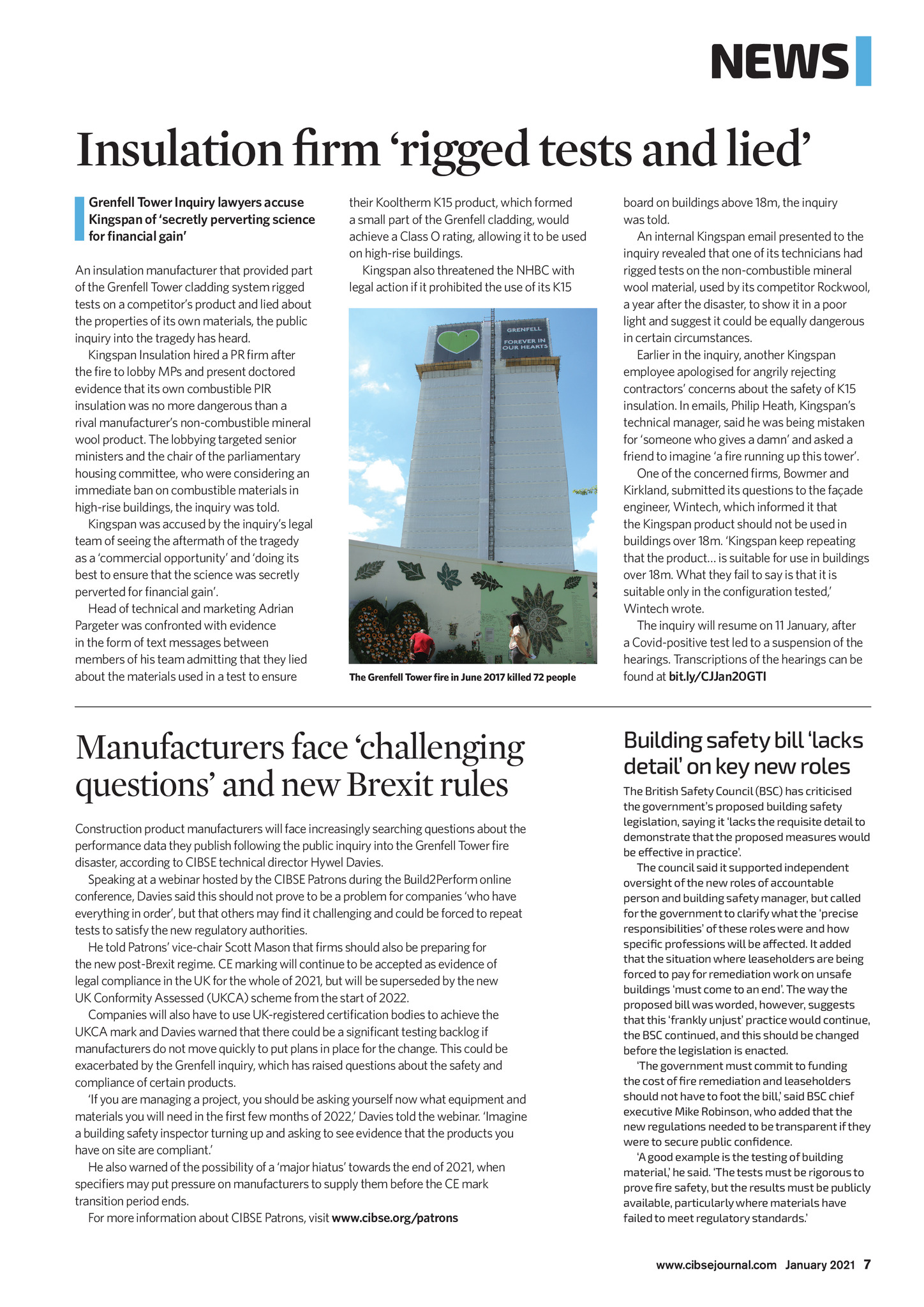
NEWS Insulation firm rigged tests and lied Grenfell Tower Inquiry lawyers accuse Kingspan of secretly perverting science for financial gain An insulation manufacturer that provided part of the Grenfell Tower cladding system rigged tests on a competitors product and lied about the properties of its own materials, the public inquiry into the tragedy has heard. Kingspan Insulation hired a PR firm after the fire to lobby MPs and present doctored evidence that its own combustible PIR insulation was no more dangerous than a rival manufacturers non-combustible mineral wool product. The lobbying targeted senior ministers and the chair of the parliamentary housing committee, who were considering an immediate ban on combustible materials in high-rise buildings, the inquiry was told. Kingspan was accused by the inquirys legal team of seeing the aftermath of the tragedy as a commercial opportunity and doing its best to ensure that the science was secretly perverted for financial gain. Head of technical and marketing Adrian Pargeter was confronted with evidence in the form of text messages between members of his team admitting that they lied about the materials used in a test to ensure their Kooltherm K15 product, which formed a small part of the Grenfell cladding, would achieve a Class O rating, allowing it to be used on high-rise buildings. Kingspan also threatened the NHBC with legal action if it prohibited the use of its K15 The Grenfell Tower fire in June 2017 killed 72 people Manufacturers face challenging questions and new Brexit rules Construction product manufacturers will face increasingly searching questions about the performance data they publish following the public inquiry into the Grenfell Tower fire disaster, according to CIBSE technical director Hywel Davies. Speaking at a webinar hosted by the CIBSE Patrons during the Build2Perform online conference, Davies said this should not prove to be a problem for companies who have everything in order, but that others may find it challenging and could be forced to repeat tests to satisfy the new regulatory authorities. He told Patrons vice-chair Scott Mason that firms should also be preparing for the new post-Brexit regime. CE marking will continue to be accepted as evidence of legal compliance in the UK for the whole of 2021, but will be superseded by the new UK Conformity Assessed (UKCA) scheme from the start of 2022. Companies will also have to use UK-registered certification bodies to achieve the UKCA mark and Davies warned that there could be a significant testing backlog if manufacturers do not move quickly to put plans in place for the change. This could be exacerbated by the Grenfell inquiry, which has raised questions about the safety and compliance of certain products. If you are managing a project, you should be asking yourself now what equipment and materials you will need in the first few months of 2022, Davies told the webinar. Imagine a building safety inspector turning up and asking to see evidence that the products you have on site are compliant. He also warned of the possibility of a major hiatus towards the end of 2021, when specifiers may put pressure on manufacturers to supply them before the CE mark transition period ends. For more information about CIBSE Patrons, visit www.cibse.org/patrons board on buildings above 18m, the inquiry was told. An internal Kingspan email presented to the inquiry revealed that one of its technicians had rigged tests on the non-combustible mineral wool material, used by its competitor Rockwool, a year after the disaster, to show it in a poor light and suggest it could be equally dangerous in certain circumstances. Earlier in the inquiry, another Kingspan employee apologised for angrily rejecting contractors concerns about the safety of K15 insulation. In emails, Philip Heath, Kingspans technical manager, said he was being mistaken for someone who gives a damn and asked a friend to imagine a fire running up this tower. One of the concerned firms, Bowmer and Kirkland, submitted its questions to the faade engineer, Wintech, which informed it that the Kingspan product should not be used in buildings over 18m. Kingspan keep repeating that the product is suitable for use in buildings over 18m. What they fail to say is that it is suitable only in the configuration tested, Wintech wrote. The inquiry will resume on 11 January, after a Covid-positive test led to a suspension of the hearings. Transcriptions of the hearings can be found at bit.ly/CJJan20GTI Building safety bill lacks detail on key new roles The British Safety Council (BSC) has criticised the governments proposed building safety legislation, saying it lacks the requisite detail to demonstrate that the proposed measures would be effective in practice. The council said it supported independent oversight of the new roles of accountable person and building safety manager, but called for the government to clarify what the precise responsibilities of these roles were and how specific professions will be affected. It added that the situation where leaseholders are being forced to pay for remediation work on unsafe buildings must come to an end. The way the proposed bill was worded, however, suggests that this frankly unjust practice would continue, the BSC continued, and this should be changed before the legislation is enacted. The government must commit to funding the cost of fire remediation and leaseholders should not have to foot the bill, said BSC chief executive Mike Robinson, who added that the new regulations needed to be transparent if they were to secure public confidence. A good example is the testing of building material, he said. The tests must be rigorous to prove fire safety, but the results must be publicly available, particularly where materials have failed to meet regulatory standards. www.cibsejournal.com January 2021 7 CIBSE Jan21 pp07 News.indd 7 18/12/2020 17:00