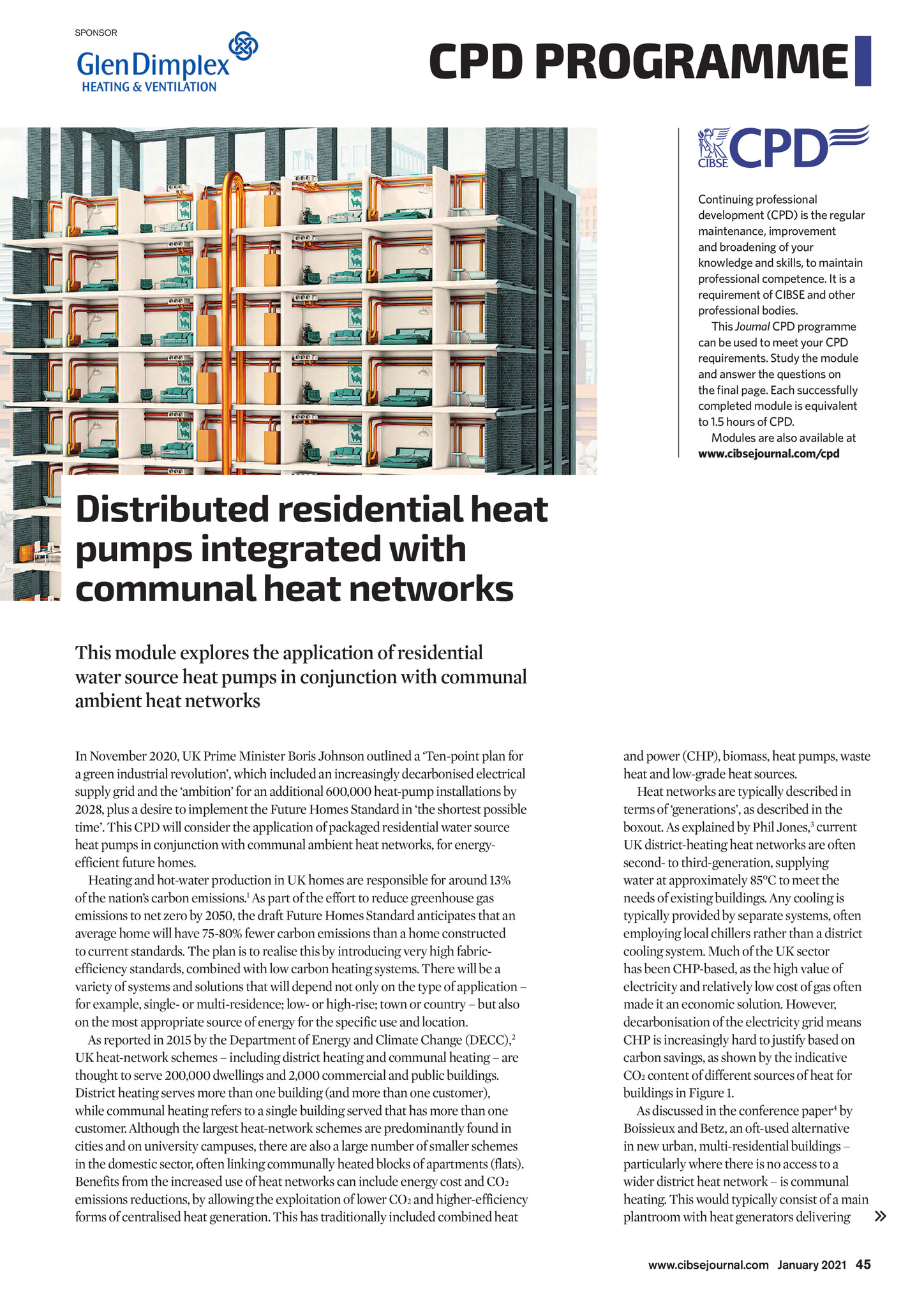

SPONSOR CPD PROGRAMME Continuing professional development (CPD) is the regular maintenance, improvement and broadening of your knowledge and skills, to maintain professional competence. It is a requirement of CIBSE and other professional bodies. This Journal CPD programme can be used to meet your CPD requirements. Study the module and answer the questions on the final page. Each successfully completed module is equivalent to 1.5 hours of CPD. Modules are also available at www.cibsejournal.com/cpd Distributed residential heat pumps integrated with communal heat networks This module explores the application of residential water source heat pumps in conjunction with communal ambient heat networks In November 2020, UK Prime Minister Boris Johnson outlined a Ten-point plan for a green industrial revolution, which included an increasingly decarbonised electrical supply grid and the ambition for an additional 600,000 heat-pump installations by 2028, plus a desire to implement the Future Homes Standard in the shortest possible time. This CPD will consider the application of packaged residential water source heat pumps in conjunction with communal ambient heat networks, for energyefficient future homes. Heating and hot-water production in UK homes are responsible for around 13% of the nations carbon emissions.1 As part of the effort to reduce greenhouse gas emissions to net zero by 2050, the draft Future Homes Standard anticipates that an average home will have 75-80% fewer carbon emissions than a home constructed to current standards. The plan is to realise this by introducing very high fabricefficiency standards, combined with low carbon heating systems. There will be a variety of systems and solutions that will depend not only on the type of application for example, single- or multi-residence; low- or high-rise; town or country but also on the most appropriate source of energy for the specific use and location. As reported in 2015 by the Department of Energy and Climate Change (DECC),2 UK heat-network schemes including district heating and communal heating are thought to serve 200,000 dwellings and 2,000 commercial and public buildings. District heating serves more than one building (and more than one customer), while communal heating refers to a single building served that has more than one customer. Although the largest heat-network schemes are predominantly found in cities and on university campuses, there are also a large number of smaller schemes in the domestic sector, often linking communally heated blocks of apartments (flats). Benefits from the increased use of heat networks can include energy cost and CO2 emissions reductions, by allowing the exploitation of lower CO2 and higher-efficiency forms of centralised heat generation. This has traditionally included combined heat and power (CHP), biomass, heat pumps, waste heat and low-grade heat sources. Heat networks are typically described in terms of generations, as described in the boxout. As explained by Phil Jones,3 current UK district-heating heat networks are often second- to third-generation, supplying water at approximately 85C to meet the needs of existing buildings. Any cooling is typically provided by separate systems, often employing local chillers rather than a district cooling system. Much of the UK sector has been CHP-based, as the high value of electricity and relatively low cost of gas often made it an economic solution. However, decarbonisation of the electricity grid means CHP is increasingly hard to justify based on carbon savings, as shown by the indicative CO2 content of different sources of heat for buildings in Figure 1. As discussed in the conference paper4 by Boissieux and Betz, an oft-used alternative in new urban, multi-residential buildings particularly where there is no access to a wider district heat network is communal heating. This would typically consist of a main plantroom with heat generators delivering www.cibsejournal.com January 2021 45 CIBSE Jan21 pp45-48 CPD 174 v3.indd 45 18/12/2020 14:59