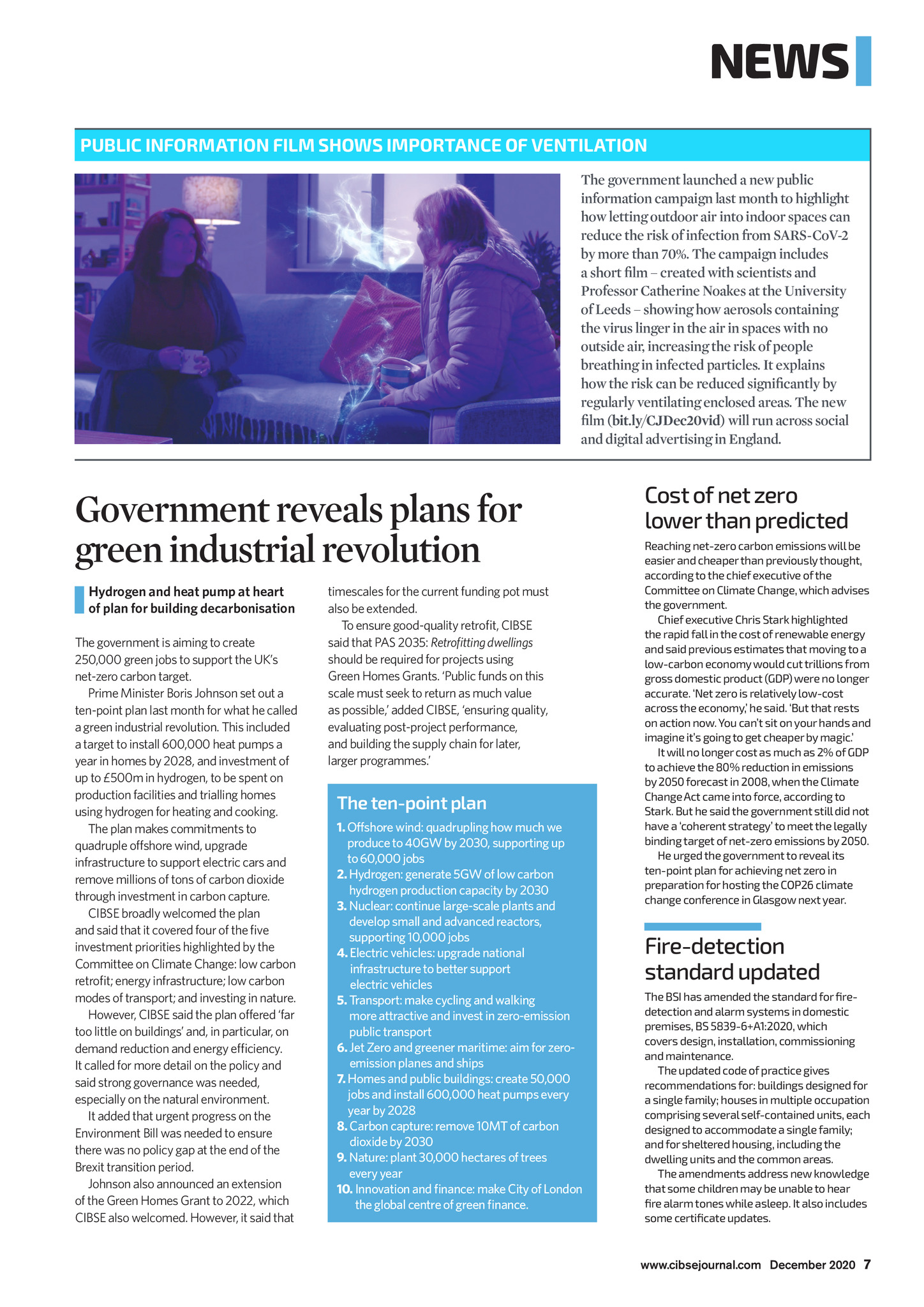

EWS PUBLIC INFORMATION FILM SHOWS IMPORTANCE OF VENTILATION The government launched a new public information campaign last month to highlight how letting outdoor air into indoor spaces can reduce the risk of infection from SARS-CoV-2 by more than 70%. The campaign includes a short film created with scientists and Professor Catherine Noakes at the University of Leeds showing how aerosols containing the virus linger in the air in spaces with no outside air, increasing the risk of people breathing in infected particles. It explains how the risk can be reduced significantly by regularly ventilating enclosed areas. The new film (bit.ly/CJDec20vid) will run across social and digital advertising in England. Government reveals plans for green industrial revolution ydrogen and heat pump at heart H of plan for building decarbonisation The government is aiming to create 250,000 green jobs to support the UKs net-zero carbon target. Prime Minister Boris Johnson set out a ten-point plan last month for what he called a green industrial revolution. This included a target to install 600,000 heat pumps a year in homes by 2028, and investment of up to 500m in hydrogen, to be spent on production facilities and trialling homes using hydrogen for heating and cooking. The plan makes commitments to quadruple offshore wind, upgrade infrastructure to support electric cars and remove millions of tons of carbon dioxide through investment in carbon capture. CIBSE broadly welcomed the plan and said that it covered four of the five investment priorities highlighted by the Committee on Climate Change: low carbon retrofit; energy infrastructure; low carbon modes of transport; and investing in nature. However, CIBSE said the plan offered far too little on buildings and, in particular, on demand reduction and energy efficiency. It called for more detail on the policy and said strong governance was needed, especially on the natural environment. It added that urgent progress on the Environment Bill was needed to ensure there was no policy gap at the end of the Brexit transition period. Johnson also announced an extension of the Green Homes Grant to 2022, which CIBSE also welcomed. However, it said that timescales for the current funding pot must also be extended. To ensure good-quality retrofit, CIBSE said that PAS 2035: Retrofitting dwellings should be required for projects using Green Homes Grants. Public funds on this scale must seek to return as much value as possible, added CIBSE, ensuring quality, evaluating post-project performance, and building the supply chain for later, larger programmes. The ten-point plan 1. Offshore wind: quadrupling how much we produce to 40GW by 2030, supporting up to 60,000 jobs 2. Hydrogen: generate 5GW of low carbon hydrogen production capacity by 2030 3. Nuclear: continue large-scale plants and develop small and advanced reactors, supporting 10,000 jobs 4. Electric vehicles: upgrade national infrastructure to better support electric vehicles 5. Transport: make cycling and walking more attractive and invest in zero-emission public transport 6. Jet Zero and greener maritime: aim for zeroemission planes and ships 7. Homes and public buildings: create 50,000 jobs and install 600,000 heat pumps every year by 2028 8. Carbon capture: remove 10MT of carbon dioxide by 2030 9. Nature: plant 30,000 hectares of trees every year 10. Innovation and finance: make City of London the global centre of green finance. Cost of net zero lower than predicted Reaching net-zero carbon emissions will be easier and cheaper than previously thought, according to the chief executive of the Committee on Climate Change, which advises the government. Chief executive Chris Stark highlighted the rapid fall in the cost of renewable energy and said previous estimates that moving to a low-carbon economy would cut trillions from gross domestic product (GDP) were no longer accurate. Net zero is relatively low-cost across the economy, he said. But that rests on action now. You cant sit on your hands and imagine its going to get cheaper by magic. It will no longer cost as much as 2% of GDP to achieve the 80% reduction in emissions by 2050 forecast in 2008, when the Climate Change Act came into force, according to Stark. But he said the government still did not have a coherent strategy to meet the legally binding target of net-zero emissions by 2050. He urged the government to reveal its ten-point plan for achieving net zero in preparation for hosting the COP26 climate change conference in Glasgow next year. Fire-detection standard updated The BSI has amended the standard for firedetection and alarm systems in domestic premises, BS 5839-6+A1:2020, which covers design, installation, commissioning and maintenance. The updated code of practice gives recommendations for: buildings designed for a single family; houses in multiple occupation comprising several self-contained units, each designed to accommodate a single family; and for sheltered housing, including the dwelling units and the common areas. The amendments address new knowledge that some children may be unable to hear fire alarm tones while asleep. It also includes some certificate updates. www.cibsejournal.com December 2020 7 CIBSE Dec20 pp7 News 2.indd 7 20/11/2020 13:09