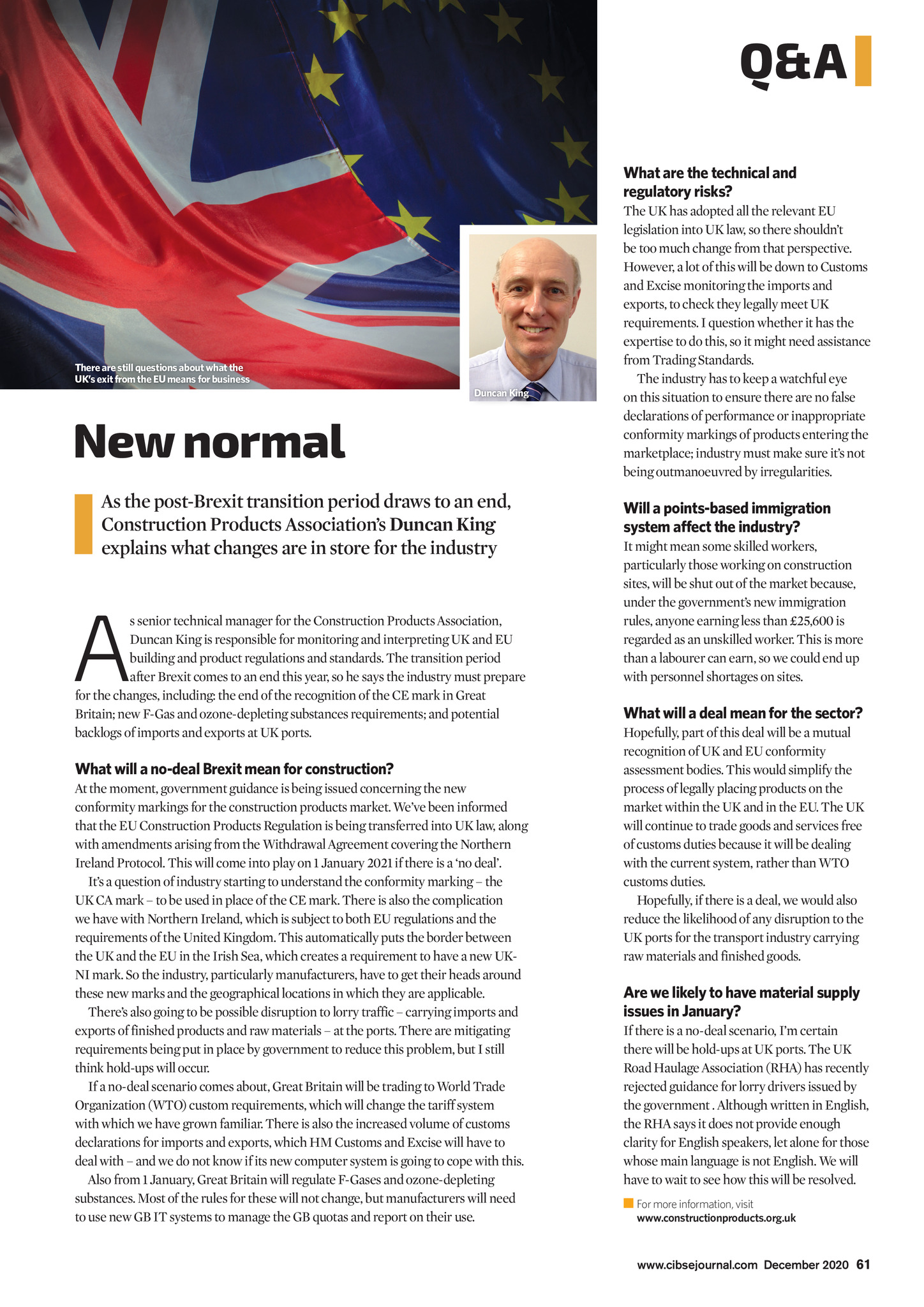
Q&A What are the technical and regulatory risks? There are still questions about what the UKs exit from the EU means for business Duncan King New normal As the post-Brexit transition period draws to an end, Construction Products Associations Duncan King explains what changes are in store for the industry A s senior technical manager for the Construction Products Association, Duncan King is responsible for monitoring and interpreting UK and EU building and product regulations and standards. The transition period after Brexit comes to an end this year, so he says the industry must prepare for the changes, including: the end of the recognition of the CE mark in Great Britain; new F-Gas and ozone-depleting substances requirements; and potential backlogs of imports and exports at UK ports. What will a no-deal Brexit mean for construction? At the moment, government guidance is being issued concerning the new conformity markings for the construction products market. Weve been informed that the EU Construction Products Regulation is being transferred into UK law, along with amendments arising from the Withdrawal Agreement covering the Northern Ireland Protocol. This will come into play on 1 January 2021 if there is a no deal. Its a question of industry starting to understand the conformity marking the UK CA mark to be used in place of the CE mark. There is also the complication we have with Northern Ireland, which is subject to both EU regulations and the requirements of the United Kingdom. This automatically puts the border between the UK and the EU in the Irish Sea, which creates a requirement to have a new UKNI mark. So the industry, particularly manufacturers, have to get their heads around these new marks and the geographical locations in which they are applicable. Theres also going to be possible disruption to lorry traffic carrying imports and exports of finished products and raw materials at the ports. There are mitigating requirements being put in place by government to reduce this problem, but I still think hold-ups will occur. If a no-deal scenario comes about, Great Britain will be trading to World Trade Organization (WTO) custom requirements, which will change the tariff system with which we have grown familiar. There is also the increased volume of customs declarations for imports and exports, which HM Customs and Excise will have to deal with and we do not know if its new computer system is going to cope with this. Also from 1 January, Great Britain will regulate F-Gases and ozone-depleting substances. Most of the rules for these will not change, but manufacturers will need to use new GB IT systems to manage the GB quotas and report on their use. The UK has adopted all the relevant EU legislation into UK law, so there shouldnt be too much change from that perspective. However, a lot of this will be down to Customs and Excise monitoring the imports and exports, to check they legally meet UK requirements. I question whether it has the expertise to do this, so it might need assistance from Trading Standards. The industry has to keep a watchful eye on this situation to ensure there are no false declarations of performance or inappropriate conformity markings of products entering the marketplace; industry must make sure its not being outmanoeuvred by irregularities. Will a points-based immigration system affect the industry? It might mean some skilled workers, particularly those working on construction sites, will be shut out of the market because, under the governments new immigration rules, anyone earning less than 25,600 is regarded as an unskilled worker. This is more than a labourer can earn, so we could end up with personnel shortages on sites. What will a deal mean for the sector? Hopefully, part of this deal will be a mutual recognition of UK and EU conformity assessment bodies. This would simplify the process of legally placing products on the market within the UK and in the EU. The UK will continue to trade goods and services free of customs duties because it will be dealing with the current system, rather than WTO customs duties. Hopefully, if there is a deal, we would also reduce the likelihood of any disruption to the UK ports for the transport industry carrying raw materials and finished goods. Are we likely to have material supply issues in January? If there is a no-deal scenario, Im certain there will be hold-ups at UK ports. The UK Road Haulage Association (RHA) has recently rejected guidance for lorry drivers issued by the government . Although written in English, the RHA says it does not provide enough clarity for English speakers, let alone for those whose main language is not English. We will have to wait to see how this will be resolved. For more information, visit www.constructionproducts.org.uk www.cibsejournal.com December 2020 61 CIBSE Dec20 pp61 Q&A.indd 61 20/11/2020 15:14