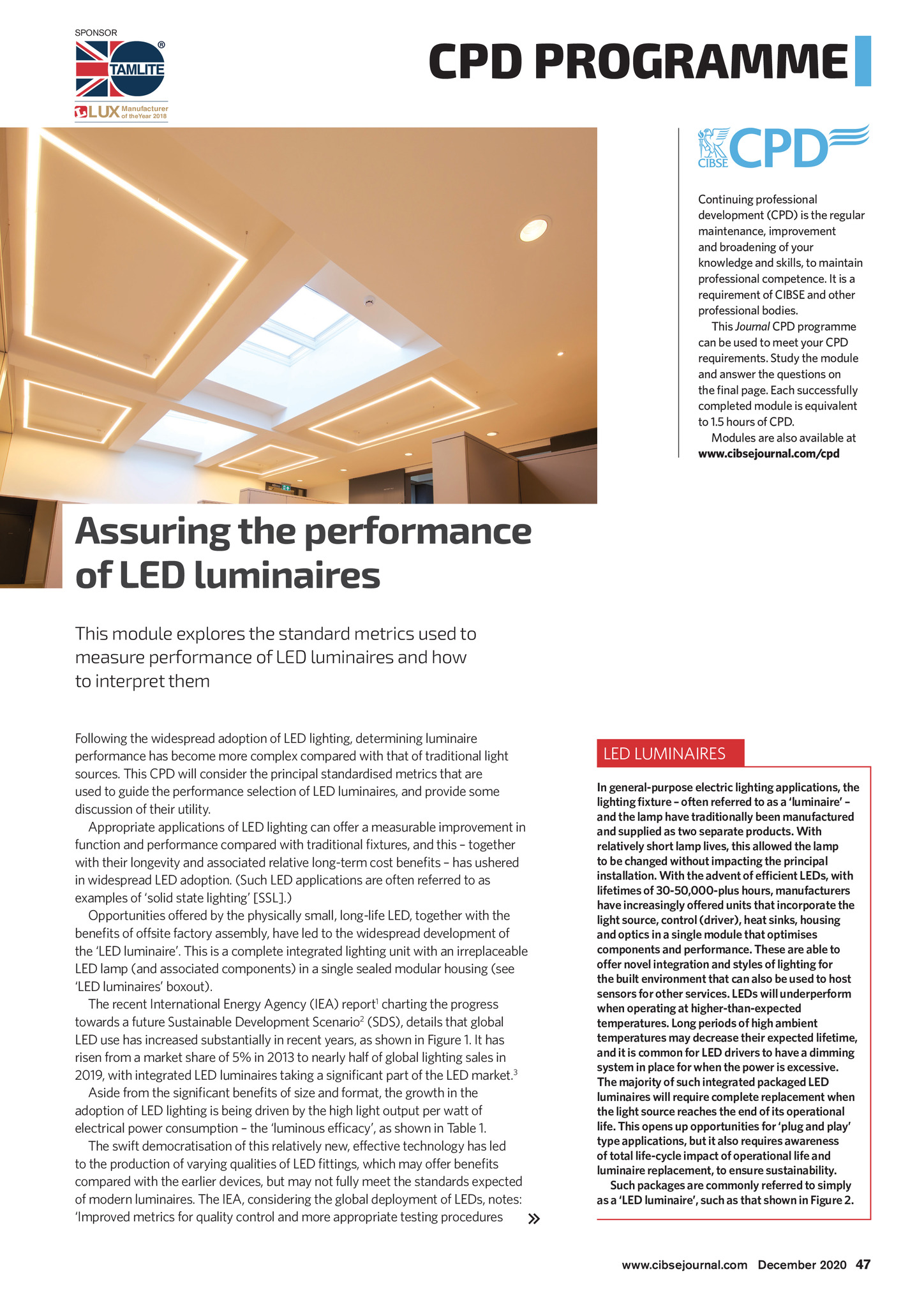
SPONSOR CPD PROGRAMME LUX Manufacturer of theYear 2018 Continuing professional development (CPD) is the regular maintenance, improvement and broadening of your knowledge and skills, to maintain professional competence. It is a requirement of CIBSE and other professional bodies. This Journal CPD programme can be used to meet your CPD requirements. Study the module and answer the questions on the final page. Each successfully completed module is equivalent to 1.5 hours of CPD. Modules are also available at www.cibsejournal.com/cpd Assuring the performance of LED luminaires This module explores the standard metrics used to measure performance of LED luminaires and how to interpret them Following the widespread adoption of LED lighting, determining luminaire performance has become more complex compared with that of traditional light sources. This CPD will consider the principal standardised metrics that are used to guide the performance selection of LED luminaires, and provide some discussion of their utility. Appropriate applications of LED lighting can offer a measurable improvement in function and performance compared with traditional fixtures, and this together with their longevity and associated relative long-term cost benefits has ushered in widespread LED adoption. (Such LED applications are often referred to as examples of solid state lighting [SSL].) Opportunities offered by the physically small, long-life LED, together with the benefits of offsite factory assembly, have led to the widespread development of the LED luminaire. This is a complete integrated lighting unit with an irreplaceable LED lamp (and associated components) in a single sealed modular housing (see LED luminaires boxout). The recent International Energy Agency (IEA) report1 charting the progress towards a future Sustainable Development Scenario2 (SDS), details that global LED use has increased substantially in recent years, as shown in Figure 1. It has risen from a market share of 5% in 2013 to nearly half of global lighting sales in 2019, with integrated LED luminaires taking a significant part of the LED market.3 Aside from the significant benefits of size and format, the growth in the adoption of LED lighting is being driven by the high light output per watt of electrical power consumption the luminous efficacy, as shown in Table 1. The swift democratisation of this relatively new, effective technology has led to the production of varying qualities of LED fittings, which may offer benefits compared with the earlier devices, but may not fully meet the standards expected of modern luminaires. The IEA, considering the global deployment of LEDs, notes: Improved metrics for quality control and more appropriate testing procedures LED LUMINAIRES In general-purpose electric lighting applications, the lighting fixture often referred to as a luminaire and the lamp have traditionally been manufactured and supplied as two separate products. With relatively short lamp lives, this allowed the lamp to be changed without impacting the principal installation. With the advent of efficient LEDs, with lifetimes of 30-50,000-plus hours, manufacturers have increasingly offered units that incorporate the light source, control (driver), heat sinks, housing and optics in a single module that optimises components and performance. These are able to offer novel integration and styles of lighting for the built environment that can also be used to host sensors for other services. LEDs will underperform when operating at higher-than-expected temperatures. Long periods of high ambient temperatures may decrease their expected lifetime, and it is common for LED drivers to have a dimming system in place for when the power is excessive. The majority of such integrated packaged LED luminaires will require complete replacement when the light source reaches the end of its operational life. This opens up opportunities for plug and play type applications, but it also requires awareness of total life-cycle impact of operational life and luminaire replacement, to ensure sustainability. Such packages are commonly referred to simply as a LED luminaire, such as that shown in Figure 2. www.cibsejournal.com December 2020 47 CIBSE DEC20 pp47-50 Supp CPD173 Tamlite v3.indd 47 20/11/2020 16:25