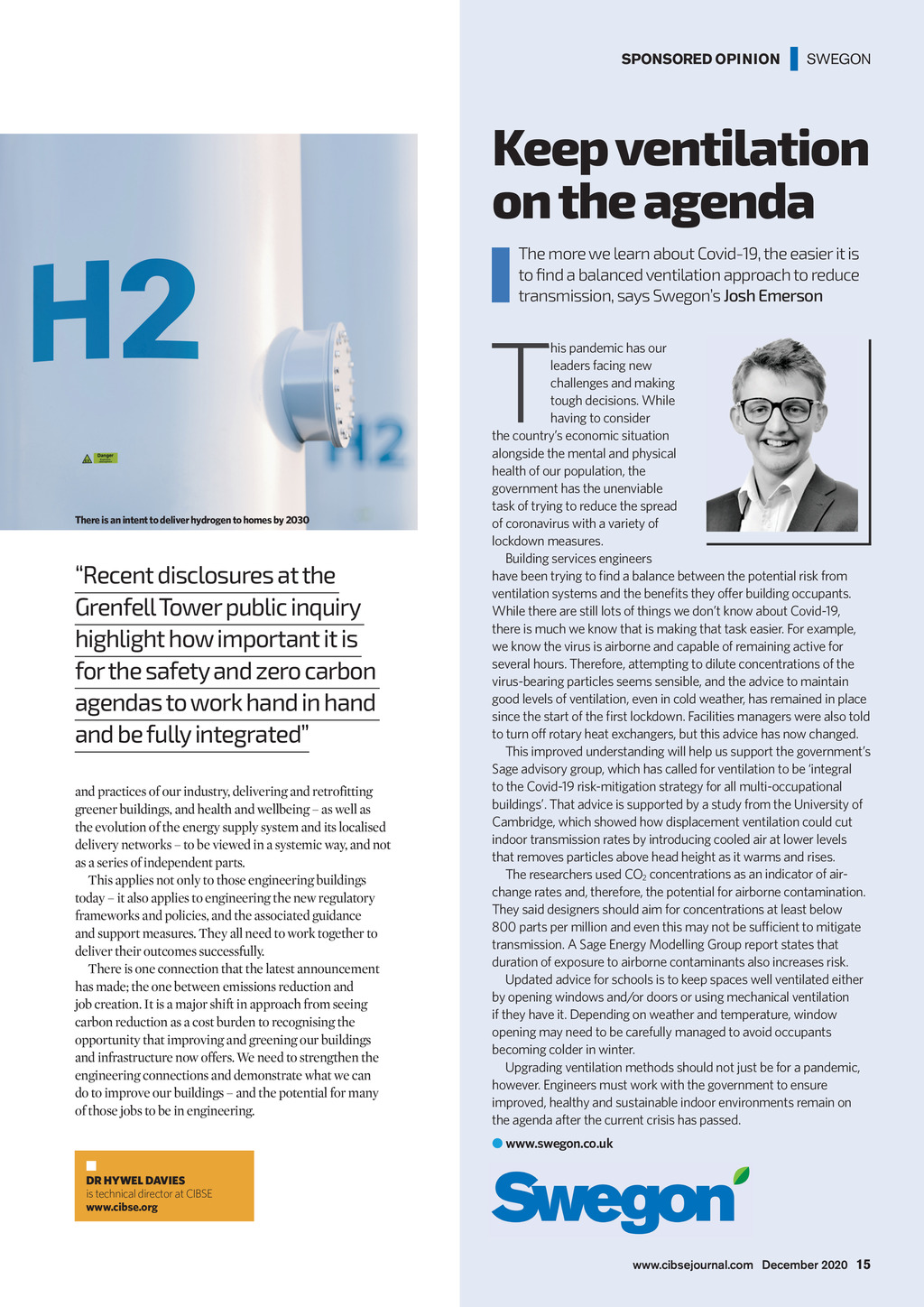

VOICES | HYWEL DAVIES Joining the dots We will emerge from lockdown to a sense of dj vu. Covid-19 has not changed targets to cut carbon emissions by 2050 or the need to improve building safety. Hywel Davies considers how these ambitions interact T he announcement, in midNovember, of the governments 10-point plan for a green industrial revolution set out ambitious goals to transform our energy, transport and built environment sectors, as the UK seeks to meet targets to eliminate net greenhouse gas emissions by 2050. The ambition to make our homes and public buildings greener, warmer and more energy efficient is explored in more detail on page 7, but other points in the plan will also affect our buildings. There is an intent to deliver hydrogen to homes by 2030, and the widely reported commitment to electric vehicles. Further points commit to offshore wind and JOIN OUR CPD WEBINAR REGISTER FREE AT: bit.ly/cibsewebinars AVAILABLE NOW ON DEMAND Staying in control of design to value pumping solutions Brought to you by: new nuclear generation, as well as carbon capture, innovation and finance. The plan offers funding to support further development of hydrogen, electric vehicles and carbon capture, and extends the Green Homes Grant for a year. Less clear is the overall direction of travel. More electric vehicles will require many more chargepoints, as the plan acknowledges, but they will also affect other systems, including supply to homes that need chargepoints and reinforcement of local networks to handle charging infrastructure safely. We need appropriate standards for the charging systems. We may also need changes to Building Regulations, to address provision of chargepoints and try to minimise installation of stranded assets in the form of equipment that becomes obsolete as the technology evolves. This, in turn, demands new guidance on delivering all electric buildings, eliminating fossil fuels, and delivering all heating and hot water using electric sources, whether Grid connected or onsite renewables. The CIBSE Knowledge Management Committee is already considering how our guidance needs to evolve in response. Extending the Green Homes Grant is welcome news in principle but it needs to be managed carefully, as it also interacts with other points in the plan. It is important that we make the connections between these points and other policy developments. The building-safety agenda seeks to deliver homes that are safe for all occupants. Recent disclosures at the Grenfell Tower public inquiry highlight how important it is for the safety and zero carbon agendas to work hand in hand and be fully integrated. There is also heightened awareness of the importance of ventilation, further highlighted by the latest government video on ventilation at home. However, while ventilation is important for reducing levels of infectious material in the air, it is also critical to the performance of our buildings, diluting odours and emissions from some of the contents of our homes and workplaces, controlling moisture content, and maintaining thermal comfort. Delivering safer buildings needs us to connect various policies, each of which is important in their own right, but when taken together and truly integrated can deliver more than just the sum of the parts. That is a greater challenge, especially when working across different government departments and agencies. It presents an engineering challenge that Journal readers are well suited to address the challenge of engineering integrated systems. There is an urgent need for our work on building safety, changing the culture 14 December 2020 www.cibsejournal.com CIBSE Dec20 pp14-15 Hywel - Patron.indd 14 20/11/2020 16:11