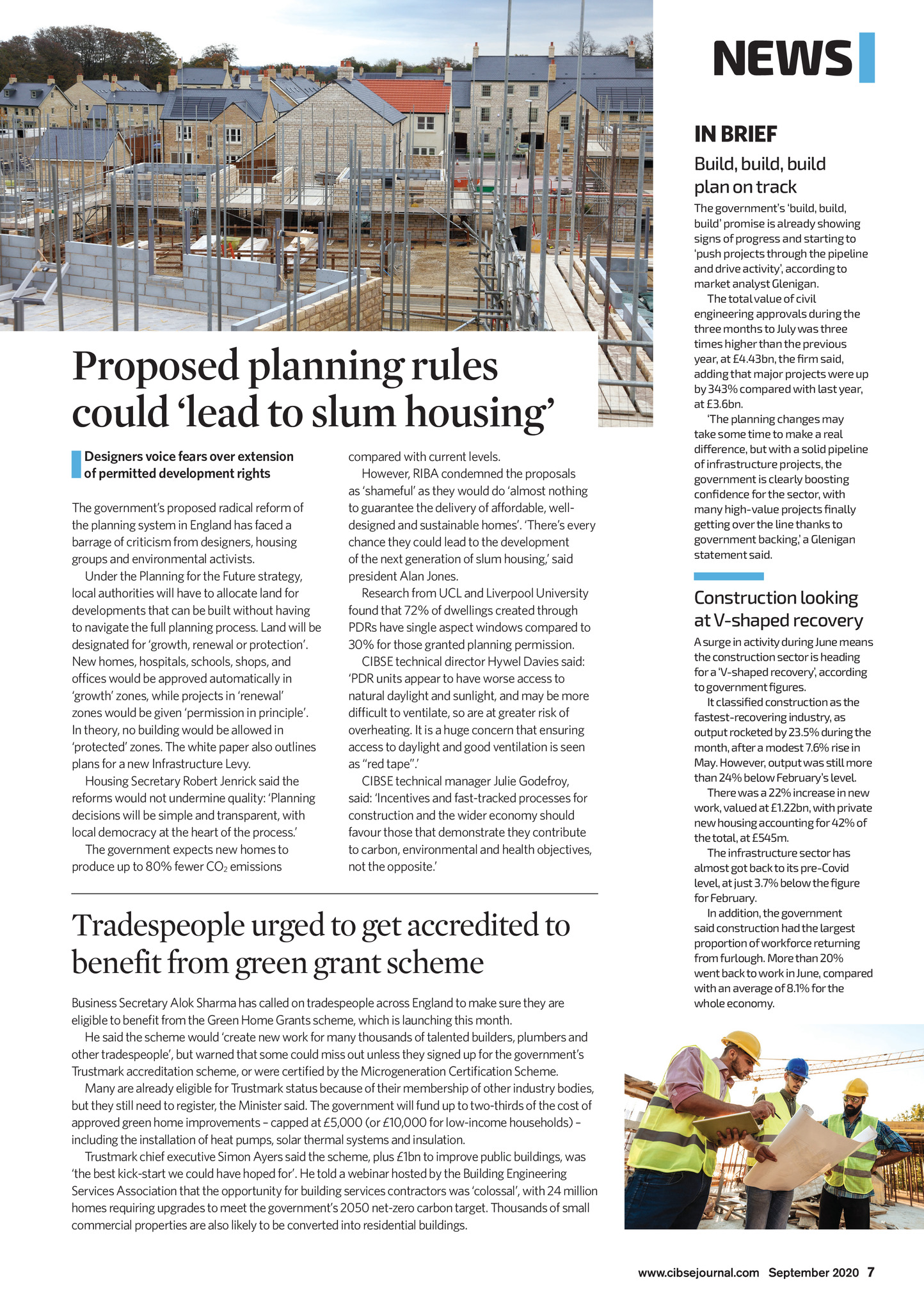

EWS IN BRIEF Build, build, build plan on track Proposed planning rules could lead to slum housing Designers voice fears over extension of permitted development rights The governments proposed radical reform of the planning system in England has faced a barrage of criticism from designers, housing groups and environmental activists. Under the Planning for the Future strategy, local authorities will have to allocate land for developments that can be built without having to navigate the full planning process. Land will be designated for growth, renewal or protection. New homes, hospitals, schools, shops, and offices would be approved automatically in growth zones, while projects in renewal zones would be given permission in principle. In theory, no building would be allowed in protected zones. The white paper also outlines plans for a new Infrastructure Levy. Housing Secretary Robert Jenrick said the reforms would not undermine quality: Planning decisions will be simple and transparent, with local democracy at the heart of the process. The government expects new homes to produce up to 80% fewer CO2 emissions compared with current levels. However, RIBA condemned the proposals as shameful as they would do almost nothing to guarantee the delivery of affordable, welldesigned and sustainable homes. Theres every chance they could lead to the development of the next generation of slum housing, said president Alan Jones. Research from UCL and Liverpool University found that 72% of dwellings created through PDRs have single aspect windows compared to 30% for those granted planning permission. CIBSE technical director Hywel Davies said: PDR units appear to have worse access to natural daylight and sunlight, and may be more difficult to ventilate, so are at greater risk of overheating. It is a huge concern that ensuring access to daylight and good ventilation is seen as red tape. CIBSE technical manager Julie Godefroy, said: Incentives and fast-tracked processes for construction and the wider economy should favour those that demonstrate they contribute to carbon, environmental and health objectives, not the opposite. Tradespeople urged to get accredited to benefit from green grant scheme Business Secretary Alok Sharma has called on tradespeople across England to make sure they are eligible to benefit from the Green Home Grants scheme, which is launching this month. He said the scheme would create new work for many thousands of talented builders, plumbers and other tradespeople, but warned that some could miss out unless they signed up for the governments Trustmark accreditation scheme, or were certified by the Microgeneration Certification Scheme. Many are already eligible for Trustmark status because of their membership of other industry bodies, but they still need to register, the Minister said. The government will fund up to two-thirds of the cost of approved green home improvements capped at 5,000 (or 10,000 for low-income households) including the installation of heat pumps, solar thermal systems and insulation. Trustmark chief executive Simon Ayers said the scheme, plus 1bn to improve public buildings, was the best kick-start we could have hoped for. He told a webinar hosted by the Building Engineering Services Association that the opportunity for building services contractors was colossal, with 24 million homes requiring upgrades to meet the governments 2050 net-zero carbon target. Thousands of small commercial properties are also likely to be converted into residential buildings. The governments build, build, build promise is already showing signs of progress and starting to push projects through the pipeline and drive activity, according to market analyst Glenigan. The total value of civil engineering approvals during the three months to July was three times higher than the previous year, at 4.43bn, the firm said, adding that major projects were up by 343% compared with last year, at 3.6bn. The planning changes may take some time to make a real difference, but with a solid pipeline of infrastructure projects, the government is clearly boosting confidence for the sector, with many high-value projects finally getting over the line thanks to government backing, a Glenigan statement said. Construction looking at V-shaped recovery A surge in activity during June means the construction sector is heading for a V-shaped recovery, according to government figures. It classified construction as the fastest-recovering industry, as output rocketed by 23.5% during the month, after a modest 7.6% rise in May. However, output was still more than 24% below Februarys level. There was a 22% increase in new work, valued at 1.22bn, with private new housing accounting for 42% of the total, at 545m. The infrastructure sector has almost got back to its pre-Covid level, at just 3.7% below the figure for February. In addition, the government said construction had the largest proportion of workforce returning from furlough. More than 20% went back to work in June, compared with an average of 8.1% for the whole economy. www.cibsejournal.com September 2020 7 CIBSE September 2020 p07 News.indd 7 21/08/2020 14:36