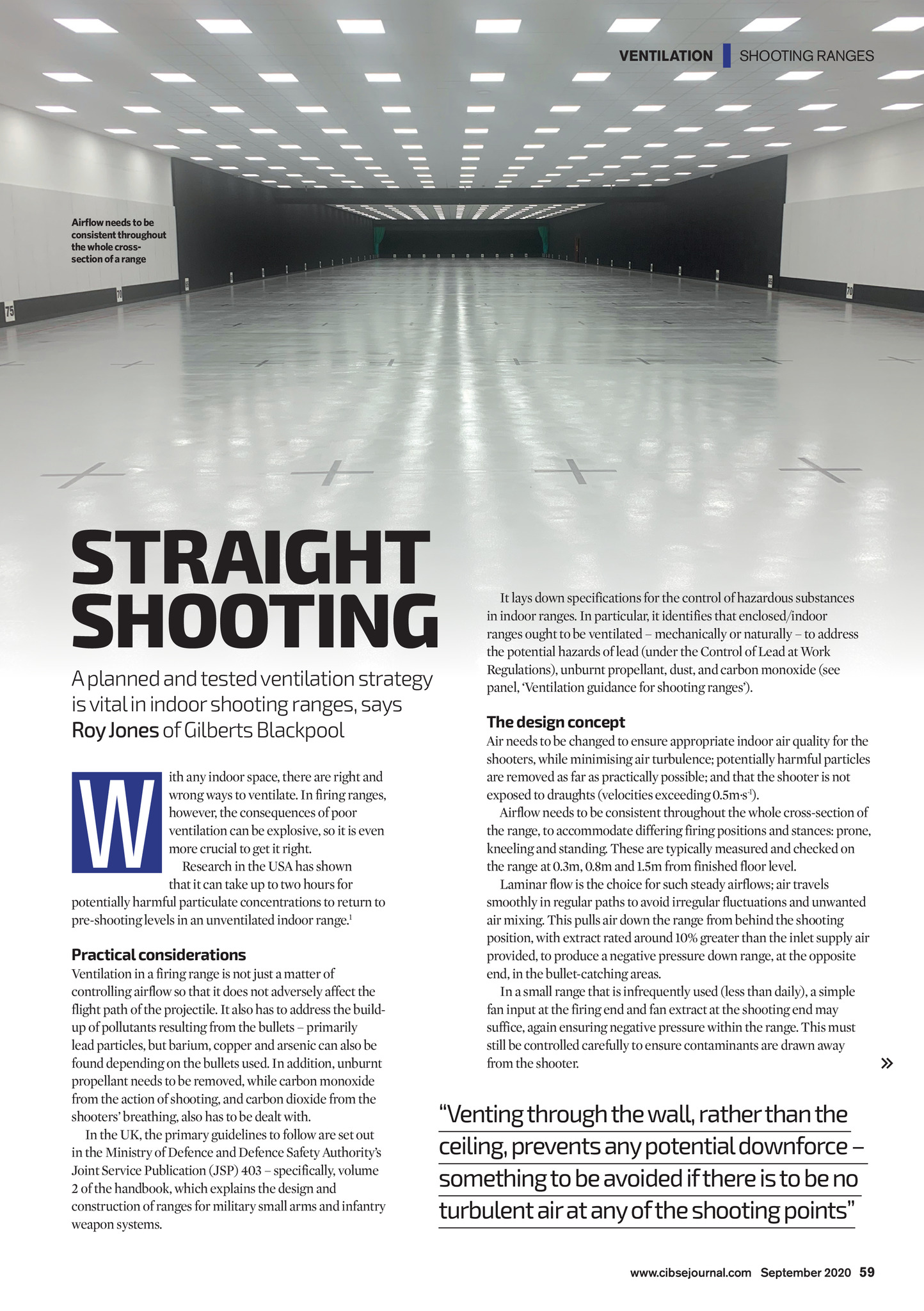

VENTILATION | SHOOTING RANGES Airflow needs to be consistent throughout the whole crosssection of a range STRAIGHT SHOOTING A planned and tested ventilation strategy is vital in indoor shooting ranges, says Roy Jones of Gilberts Blackpool W ith any indoor space, there are right and wrong ways to ventilate. In firing ranges, however, the consequences of poor ventilation can be explosive, so it is even more crucial to get it right. Research in the USA has shown that it can take up to two hours for potentially harmful particulate concentrations to return to pre-shooting levels in an unventilated indoor range.1 Practical considerations Ventilation in a firing range is not just a matter of controlling airflow so that it does not adversely affect the flight path of the projectile. It also has to address the buildup of pollutants resulting from the bullets primarily lead particles, but barium, copper and arsenic can also be found depending on the bullets used. In addition, unburnt propellant needs to be removed, while carbon monoxide from the action of shooting, and carbon dioxide from the shooters breathing, also has to be dealt with. In the UK, the primary guidelines to follow are set out in the Ministry of Defence and Defence Safety Authoritys Joint Service Publication (JSP) 403 specifically, volume 2 of the handbook, which explains the design and construction of ranges for military small arms and infantry weapon systems. It lays down specifications for the control of hazardous substances in indoor ranges. In particular, it identifies that enclosed/indoor ranges ought to be ventilated mechanically or naturally to address the potential hazards of lead (under the Control of Lead at Work Regulations), unburnt propellant, dust, and carbon monoxide (see panel, Ventilation guidance for shooting ranges). The design concept Air needs to be changed to ensure appropriate indoor air quality for the shooters, while minimising air turbulence; potentially harmful particles are removed as far as practically possible; and that the shooter is not exposed to draughts (velocities exceeding 0.5m.s-1). Airflow needs to be consistent throughout the whole cross-section of the range, to accommodate differing firing positions and stances: prone, kneeling and standing. These are typically measured and checked on the range at 0.3m, 0.8m and 1.5m from finished floor level. Laminar flow is the choice for such steady airflows; air travels smoothly in regular paths to avoid irregular fluctuations and unwanted air mixing. This pulls air down the range from behind the shooting position, with extract rated around 10% greater than the inlet supply air provided, to produce a negative pressure down range, at the opposite end, in the bullet-catching areas. In a small range that is infrequently used (less than daily), a simple fan input at the firing end and fan extract at the shooting end may suffice, again ensuring negative pressure within the range. This must still be controlled carefully to ensure contaminants are drawn away from the shooter. Venting through the wall, rather than the ceiling, prevents any potential downforce something to be avoided if there is to be no turbulent air at any of the shooting points www.cibsejournal.com September 2020 59 CIBSE September 2020 pp59-60 Shooting range.indd 59 21/08/2020 15:27