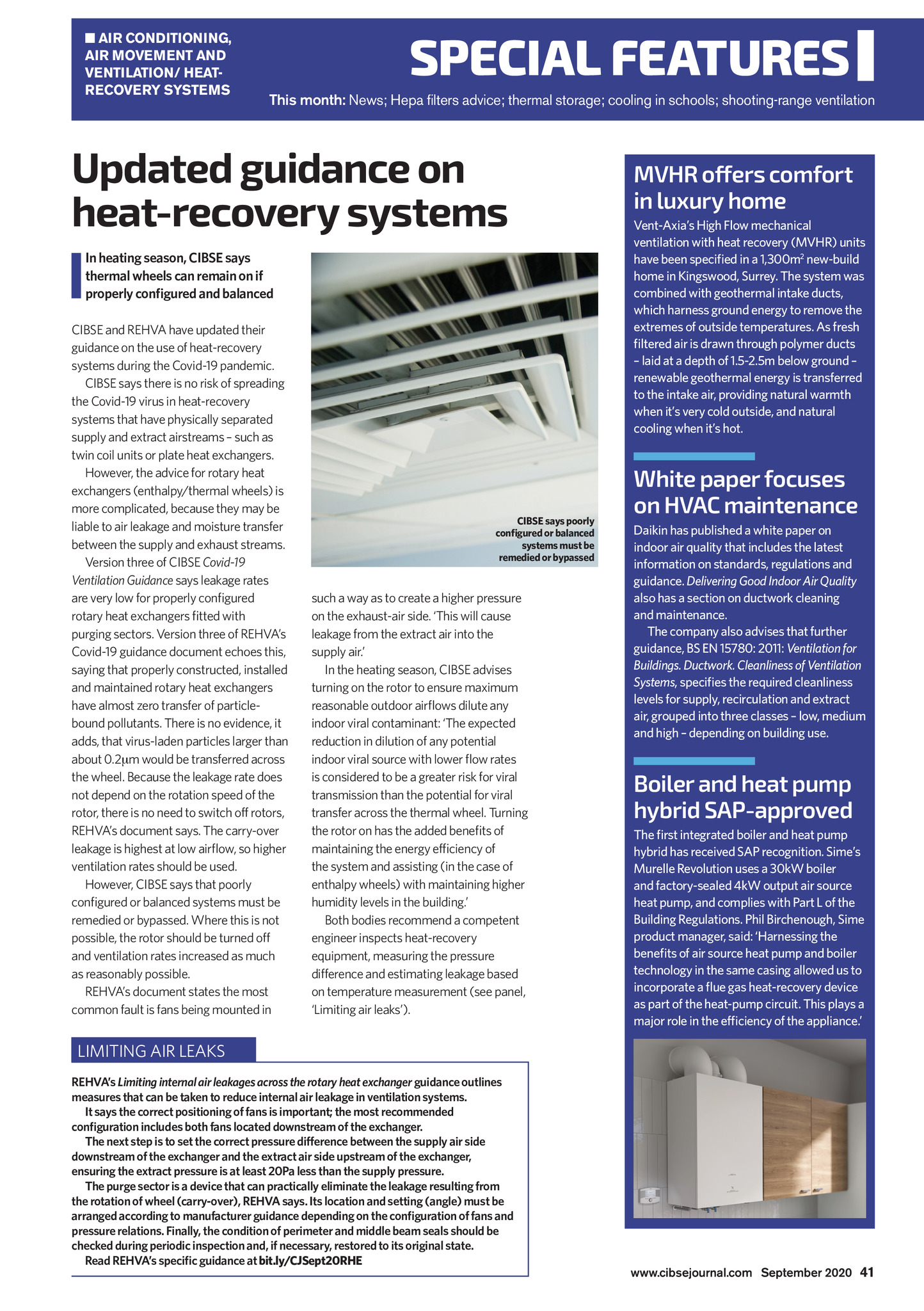
AIR CONDITIONING, AIR MOVEMENT AND VENTILATION/ HEATRECOVERY SYSTEMS SPECIAL FEATURES This month: News; Hepa filters advice; thermal storage; cooling in schools; shooting-range ventilation Updated guidance on heat-recovery systems In heating season, CIBSE says thermal wheels can remain on if properly configured and balanced CIBSE and REHVA have updated their guidance on the use of heat-recovery systems during the Covid-19 pandemic. CIBSE says there is no risk of spreading the Covid-19 virus in heat-recovery systems that have physically separated supply and extract airstreams such as twin coil units or plate heat exchangers. However, the advice for rotary heat exchangers (enthalpy/thermal wheels) is more complicated, because they may be liable to air leakage and moisture transfer between the supply and exhaust streams. Version three of CIBSE Covid-19 Ventilation Guidance says leakage rates are very low for properly configured rotary heat exchangers fitted with purging sectors. Version three of REHVAs Covid-19 guidance document echoes this, saying that properly constructed, installed and maintained rotary heat exchangers have almost zero transfer of particlebound pollutants. There is no evidence, it adds, that virus-laden particles larger than about 0.2m would be transferred across the wheel. Because the leakage rate does not depend on the rotation speed of the rotor, there is no need to switch off rotors, REHVAs document says. The carry-over leakage is highest at low airflow, so higher ventilation rates should be used. However, CIBSE says that poorly configured or balanced systems must be remedied or bypassed. Where this is not possible, the rotor should be turned off and ventilation rates increased as much as reasonably possible. REHVAs document states the most common fault is fans being mounted in CIBSE says poorly configured or balanced systems must be remedied or bypassed such a way as to create a higher pressure on the exhaust-air side. This will cause leakage from the extract air into the supply air. In the heating season, CIBSE advises turning on the rotor to ensure maximum reasonable outdoor airflows dilute any indoor viral contaminant: The expected reduction in dilution of any potential indoor viral source with lower flow rates is considered to be a greater risk for viral transmission than the potential for viral transfer across the thermal wheel. Turning the rotor on has the added benefits of maintaining the energy efficiency of the system and assisting (in the case of enthalpy wheels) with maintaining higher humidity levels in the building. Both bodies recommend a competent engineer inspects heat-recovery equipment, measuring the pressure difference and estimating leakage based on temperature measurement (see panel, Limiting air leaks). MVHR offers comfort in luxury home Vent-Axias High Flow mechanical ventilation with heat recovery (MVHR) units have been specified in a 1,300m2 new-build home in Kingswood, Surrey. The system was combined with geothermal intake ducts, which harness ground energy to remove the extremes of outside temperatures. As fresh filtered air is drawn through polymer ducts laid at a depth of 1.5-2.5m below ground renewable geothermal energy is transferred to the intake air, providing natural warmth when its very cold outside, and natural cooling when its hot. White paper focuses on HVAC maintenance Daikin has published a white paper on indoor air quality that includes the latest information on standards, regulations and guidance. Delivering Good Indoor Air Quality also has a section on ductwork cleaning and maintenance. The company also advises that further guidance, BS EN 15780: 2011: Ventilation for Buildings. Ductwork. Cleanliness of Ventilation Systems, specifies the required cleanliness levels for supply, recirculation and extract air, grouped into three classes low, medium and high depending on building use. Boiler and heat pump hybrid SAP-approved The first integrated boiler and heat pump hybrid has received SAP recognition. Simes Murelle Revolution uses a 30kW boiler and factory-sealed 4kW output air source heat pump, and complies with Part L of the Building Regulations. Phil Birchenough, Sime product manager, said: Harnessing the benefits of air source heat pump and boiler technology in the same casing allowed us to incorporate a flue gas heat-recovery device as part of the heat-pump circuit. This plays a major role in the efficiency of the appliance. LIMITING AIR LEAKS REHVAs Limiting internal air leakages across the rotary heat exchanger guidance outlines measures that can be taken to reduce internal air leakage in ventilation systems. It says the correct positioning of fans is important; the most recommended configuration includes both fans located downstream of the exchanger. The next step is to set the correct pressure difference between the supply air side downstream of the exchanger and the extract air side upstream of the exchanger, ensuring the extract pressure is at least 20Pa less than the supply pressure. The purge sector is a device that can practically eliminate the leakage resulting from the rotation of wheel (carry-over), REHVA says. Its location and setting (angle) must be arranged according to manufacturer guidance depending on the configuration of fans and pressure relations. Finally, the condition of perimeter and middle beam seals should be checked during periodic inspection and, if necessary, restored to its original state. Read REHVAs specific guidance at bit.ly/CJSept20RHE CIBSE September 2020 p41-42 Heat rec news.indd 41 www.cibsejournal.com September 2020 41 21/08/2020 14:59