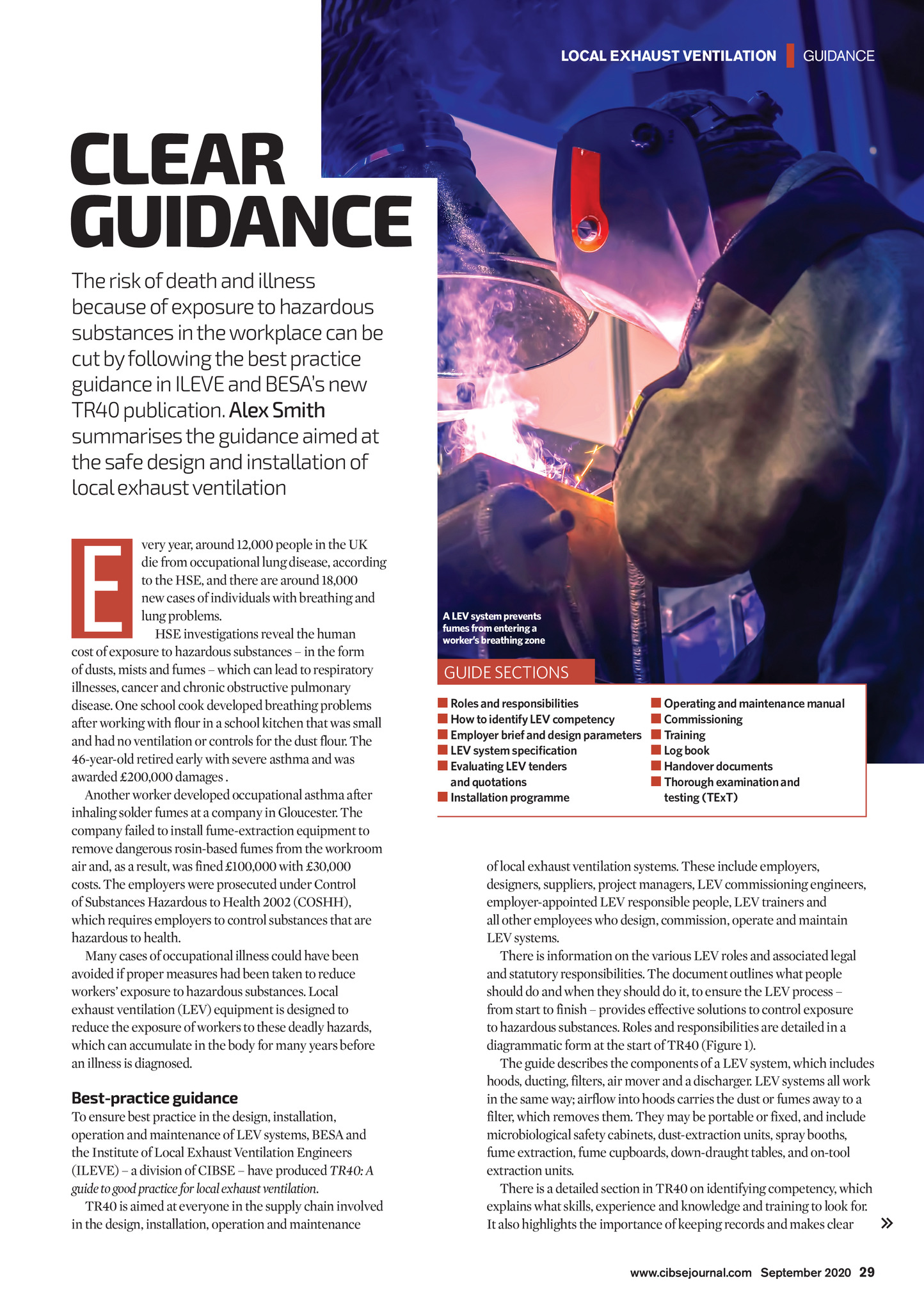
LOCAL EXHAUST VENTILATION | GUIDANCE CLEAR GUIDANCE The risk of death and illness because of exposure to hazardous substances in the workplace can be cut by following the best practice guidance in ILEVE and BESAs new TR40 publication. Alex Smith summarises the guidance aimed at the safe design and installation of local exhaust ventilation E very year, around 12,000 people in the UK die from occupational lung disease, according to the HSE, and there are around 18,000 new cases of individuals with breathing and lung problems. HSE investigations reveal the human cost of exposure to hazardous substances in the form of dusts, mists and fumes which can lead to respiratory illnesses, cancer and chronic obstructive pulmonary disease. One school cook developed breathing problems after working with flour in a school kitchen that was small and had no ventilation or controls for the dust flour. The 46-year-old retired early with severe asthma and was awarded 200,000 damages . Another worker developed occupational asthma after inhaling solder fumes at a company in Gloucester. The company failed to install fume-extraction equipment to remove dangerous rosin-based fumes from the workroom air and, as a result, was fined 100,000 with 30,000 costs. The employers were prosecuted under Control of Substances Hazardous to Health 2002 (COSHH), which requires employers to control substances that are hazardous to health. Many cases of occupational illness could have been avoided if proper measures had been taken to reduce workers exposure to hazardous substances. Local exhaust ventilation (LEV) equipment is designed to reduce the exposure of workers to these deadly hazards, which can accumulate in the body for many years before an illness is diagnosed. Best-practice guidance To ensure best practice in the design, installation, operation and maintenance of LEV systems, BESA and the Institute of Local Exhaust Ventilation Engineers (ILEVE) a division of CIBSE have produced TR40: A guide to good practice for local exhaust ventilation. TR40 is aimed at everyone in the supply chain involved in the design, installation, operation and maintenance A LEV system prevents fumes from entering a workers breathing zone GUIDE SECTIONS Roles and responsibilities How to identify LEV competency Employer brief and design parameters LEV system specification Evaluating LEV tenders and quotations Installation programme Operating and maintenance manual Commissioning Training Log book Handover documents Thorough examination and testing (TExT) of local exhaust ventilation systems. These include employers, designers, suppliers, project managers, LEV commissioning engineers, employer-appointed LEV responsible people, LEV trainers and all other employees who design, commission, operate and maintain LEV systems. There is information on the various LEV roles and associated legal and statutory responsibilities. The document outlines what people should do and when they should do it, to ensure the LEV process from start to finish provides effective solutions to control exposure to hazardous substances. Roles and responsibilities are detailed in a diagrammatic form at the start of TR40 (Figure 1). The guide describes the components of a LEV system, which includes hoods, ducting, filters, air mover and a discharger. LEV systems all work in the same way; airflow into hoods carries the dust or fumes away to a filter, which removes them. They may be portable or fixed, and include microbiological safety cabinets, dust-extraction units, spray booths, fume extraction, fume cupboards, down-draught tables, and on-tool extraction units. There is a detailed section in TR40 on identifying competency, which explains what skills, experience and knowledge and training to look for. It also highlights the importance of keeping records and makes clear www.cibsejournal.com September 2020 29 CIBSE September 2020 p29-30 TR40 Guide.indd 29 21/08/2020 14:51