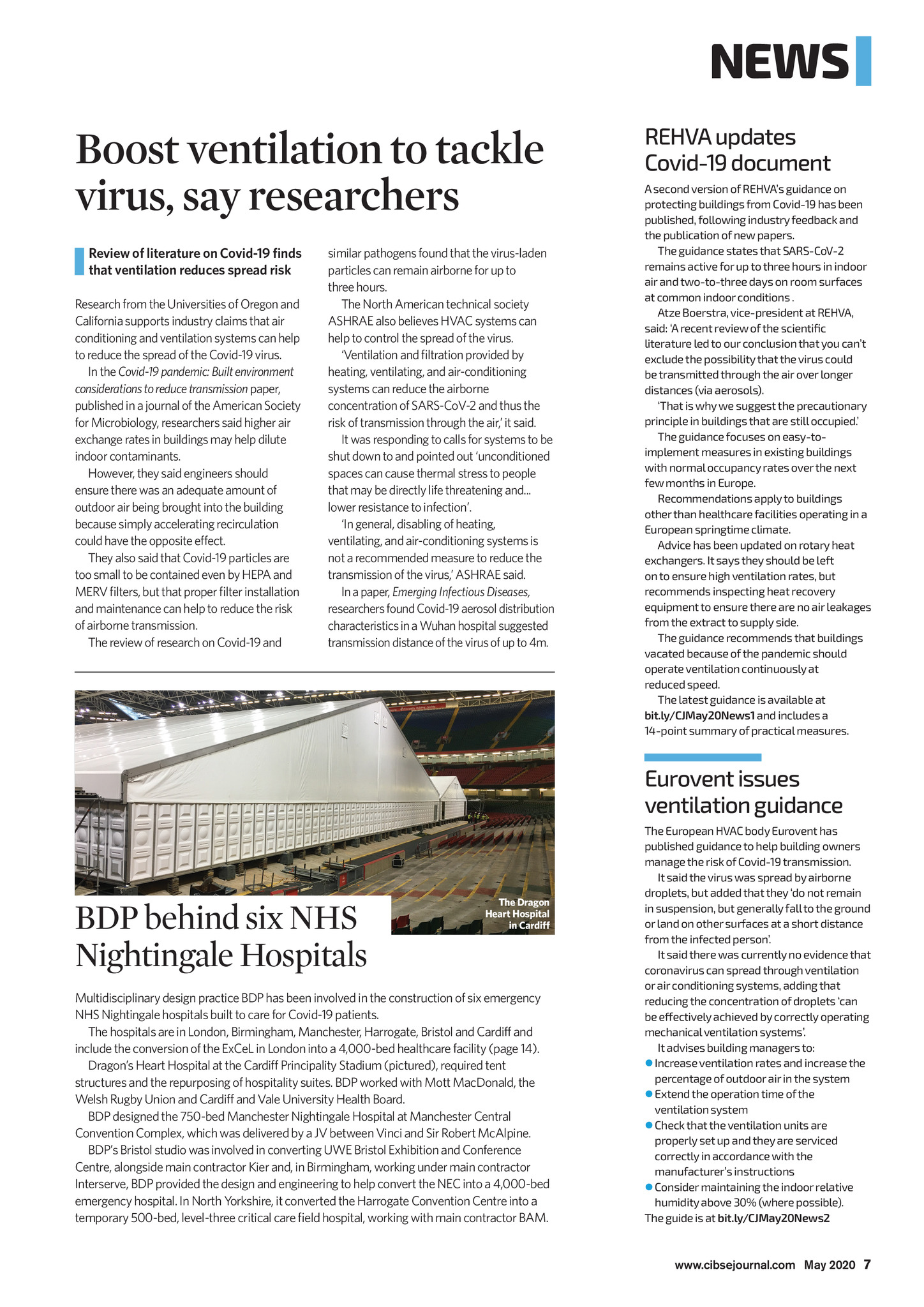
EWS Boost ventilation to tackle virus, say researchers Review of literature on Covid-19 finds that ventilation reduces spread risk Research from the Universities of Oregon and California supports industry claims that air conditioning and ventilation systems can help to reduce the spread of the Covid-19 virus. In the Covid-19 pandemic: Built environment considerations to reduce transmission paper, published in a journal of the American Society for Microbiology, researchers said higher air exchange rates in buildings may help dilute indoor contaminants. However, they said engineers should ensure there was an adequate amount of outdoor air being brought into the building because simply accelerating recirculation could have the opposite effect. They also said that Covid-19 particles are too small to be contained even by HEPA and MERV filters, but that proper filter installation and maintenance can help to reduce the risk of airborne transmission. The review of research on Covid-19 and similar pathogens found that the virus-laden particles can remain airborne for up to three hours. The North American technical society ASHRAE also believes HVAC systems can help to control the spread of the virus. Ventilation and filtration provided by heating, ventilating, and air-conditioning systems can reduce the airborne concentration of SARS-CoV-2 and thus the risk of transmission through the air, it said. It was responding to calls for systems to be shut down to and pointed out unconditioned spaces can cause thermal stress to people that may be directly life threatening and... lower resistance to infection. In general, disabling of heating, ventilating, and air-conditioning systems is not a recommended measure to reduce the transmission of the virus, ASHRAE said. In a paper, Emerging Infectious Diseases, researchers found Covid-19 aerosol distribution characteristics in a Wuhan hospital suggested transmission distance of the virus of up to 4m. REHVA updates Covid-19 document A second version of REHVAs guidance on protecting buildings from Covid-19 has been published, following industry feedback and the publication of new papers. The guidance states that SARS-CoV-2 remains active for up to three hours in indoor air and two-to-three days on room surfaces at common indoor conditions . Atze Boerstra, vice-president at REHVA, said: A recent review of the scientific literature led to our conclusion that you cant exclude the possibility that the virus could be transmitted through the air over longer distances (via aerosols). That is why we suggest the precautionary principle in buildings that are still occupied. The guidance focuses on easy-toimplement measures in existing buildings with normal occupancy rates over the next few months in Europe. Recommendations apply to buildings other than healthcare facilities operating in a European springtime climate. Advice has been updated on rotary heat exchangers. It says they should be left on to ensure high ventilation rates, but recommends inspecting heat recovery equipment to ensure there are no air leakages from the extract to supply side. The guidance recommends that buildings vacated because of the pandemic should operate ventilation continuously at reduced speed. The latest guidance is available at bit.ly/CJMay20News1 and includes a 14-point summary of practical measures. Eurovent issues ventilation guidance BDP behind six NHS Nightingale Hospitals The Dragon Heart Hospital in Cardiff Multidisciplinary design practice BDP has been involved in the construction of six emergency NHS Nightingale hospitals built to care for Covid-19 patients. The hospitals are in London, Birmingham, Manchester, Harrogate, Bristol and Cardiff and include the conversion of the ExCeL in London into a 4,000-bed healthcare facility (page 14). Dragons Heart Hospital at the Cardiff Principality Stadium (pictured), required tent structures and the repurposing of hospitality suites. BDP worked with Mott MacDonald, the Welsh Rugby Union and Cardiff and Vale University Health Board. BDP designed the 750-bed Manchester Nightingale Hospital at Manchester Central Convention Complex, which was delivered by a JV between Vinci and Sir Robert McAlpine. BDPs Bristol studio was involved in converting UWE Bristol Exhibition and Conference Centre, alongside main contractor Kier and, in Birmingham, working under main contractor Interserve, BDP provided the design and engineering to help convert the NEC into a 4,000-bed emergency hospital. In North Yorkshire, it converted the Harrogate Convention Centre into a temporary 500-bed, level-three critical care field hospital, working with main contractor BAM. The European HVAC body Eurovent has published guidance to help building owners manage the risk of Covid-19 transmission. It said the virus was spread by airborne droplets, but added that they do not remain in suspension, but generally fall to the ground or land on other surfaces at a short distance from the infected person. It said there was currently no evidence that coronavirus can spread through ventilation or air conditioning systems, adding that reducing the concentration of droplets can be effectively achieved by correctly operating mechanical ventilation systems. It advises building managers to: l Increase ventilation rates and increase the percentage of outdoor air in the system l Extend the operation time of the ventilation system l Check that the ventilation units are properly set up and they are serviced correctly in accordance with the manufacturers instructions l Consider maintaining the indoor relative humidity above 30% (where possible). The guide is at bit.ly/CJMay20News2 www.cibsejournal.com May 2020 7 CIBSE May 20 pp07 News.indd 7 24/04/2020 19:23