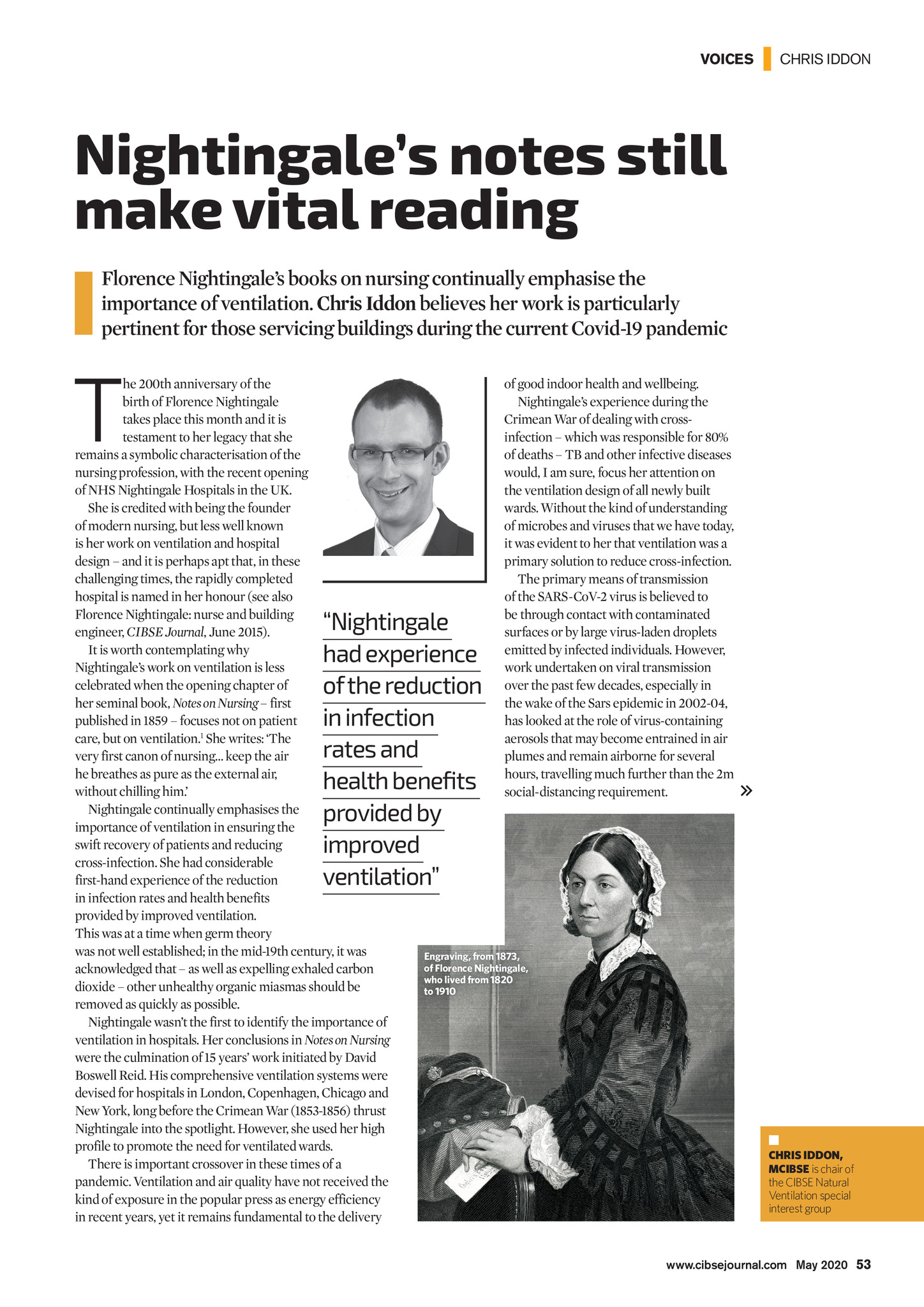
VOICES | CHRIS IDDON Nightingales notes still make vital reading Florence Nightingales books on nursing continually emphasise the importance of ventilation. Chris Iddon believes her work is particularly pertinent for those servicing buildings during the current Covid-19 pandemic T he 200th anniversary of the birth of Florence Nightingale takes place this month and it is testament to her legacy that she remains a symbolic characterisation of the nursing profession, with the recent opening of NHS Nightingale Hospitals in the UK. She is credited with being the founder of modern nursing, but less well known is her work on ventilation and hospital design and it is perhaps apt that, in these challenging times, the rapidly completed hospital is named in her honour (see also Florence Nightingale: nurse and building engineer, CIBSE Journal, June 2015). It is worth contemplating why Nightingales work on ventilation is less celebrated when the opening chapter of her seminal book, Notes on Nursing first published in 1859 focuses not on patient care, but on ventilation.1 She writes: The very first canon of nursing keep the air he breathes as pure as the external air, without chilling him. Nightingale continually emphasises the importance of ventilation in ensuring the swift recovery of patients and reducing cross-infection. She had considerable first-hand experience of the reduction in infection rates and health benefits provided by improved ventilation. This was at a time when germ theory was not well established; in the mid-19th century, it was acknowledged that as well as expelling exhaled carbon dioxide other unhealthy organic miasmas should be removed as quickly as possible. Nightingale wasnt the first to identify the importance of ventilation in hospitals. Her conclusions in Notes on Nursing were the culmination of 15 years work initiated by David Boswell Reid. His comprehensive ventilation systems were devised for hospitals in London, Copenhagen, Chicago and New York, long before the Crimean War (1853-1856) thrust Nightingale into the spotlight. However, she used her high profile to promote the need for ventilated wards. There is important crossover in these times of a pandemic. Ventilation and air quality have not received the kind of exposure in the popular press as energy efficiency in recent years, yet it remains fundamental to the delivery Nightingale had experience of the reduction in infection rates and health benefits provided by improved ventilation of good indoor health and wellbeing. Nightingales experience during the Crimean War of dealing with crossinfection which was responsible for 80% of deaths TB and other infective diseases would, I am sure, focus her attention on the ventilation design of all newly built wards. Without the kind of understanding of microbes and viruses that we have today, it was evident to her that ventilation was a primary solution to reduce cross-infection. The primary means of transmission of the SARS-CoV-2 virus is believed to be through contact with contaminated surfaces or by large virus-laden droplets emitted by infected individuals. However, work undertaken on viral transmission over the past few decades, especially in the wake of the Sars epidemic in 2002-04, has looked at the role of virus-containing aerosols that may become entrained in air plumes and remain airborne for several hours, travelling much further than the 2m social-distancing requirement. Engraving, from 1873, of Florence Nightingale, who lived from 1820 to 1910 CHRIS IDDON, MCIBSE is chair of the CIBSE Natural Ventilation special interest group www.cibsejournal.com May 2020 53 CIBSE May20 pp53-54 Chris Iddon.indd 53 24/04/2020 16:39