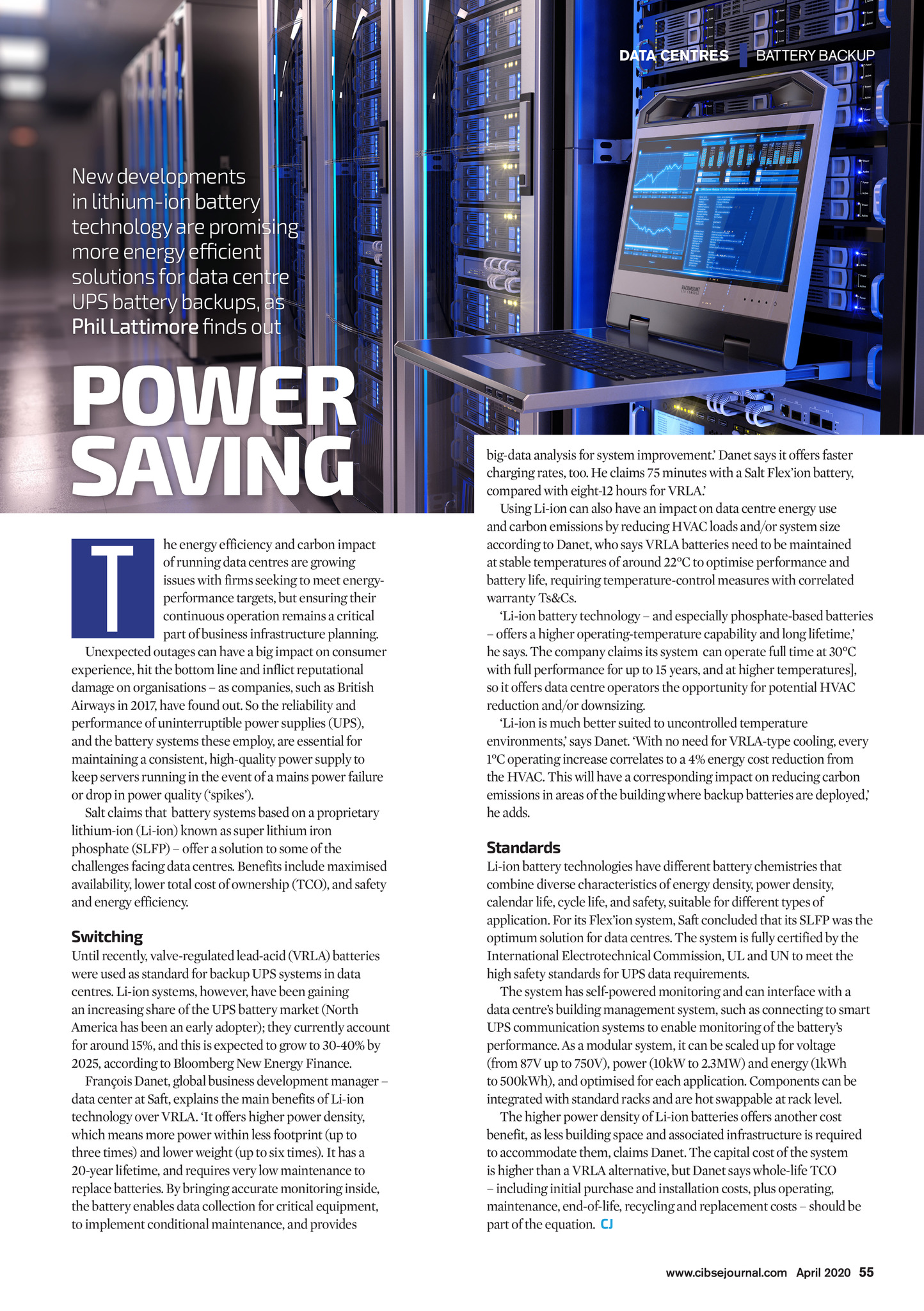
DATA CENTRES | BATTERY BACKUP New developments in lithium-ion battery technology are promising more energy efficient solutions for data centre UPS battery backups, as Phil Lattimore finds out POWER SAVING T he energy efficiency and carbon impact of running data centres are growing issues with firms seeking to meet energyperformance targets, but ensuring their continuous operation remains a critical part of business infrastructure planning. Unexpected outages can have a big impact on consumer experience, hit the bottom line and inflict reputational damage on organisations as companies, such as British Airways in 2017, have found out. So the reliability and performance of uninterruptible power supplies (UPS), and the battery systems these employ, are essential for maintaining a consistent, high-quality power supply to keep servers running in the event of a mains power failure or drop in power quality (spikes). Salt claims that battery systems based on a proprietary lithium-ion (Li-ion) known as super lithium iron phosphate (SLFP) offer a solution to some of the challenges facing data centres. Benefits include maximised availability, lower total cost of ownership (TCO), and safety and energy efficiency. Switching Until recently, valve-regulated lead-acid (VRLA) batteries were used as standard for backup UPS systems in data centres. Li-ion systems, however, have been gaining an increasing share of the UPS battery market (North America has been an early adopter); they currently account for around 15%, and this is expected to grow to 30-40% by 2025, according to Bloomberg New Energy Finance. Franois Danet, global business development manager data center at Saft, explains the main benefits of Li-ion technology over VRLA. It offers higher power density, which means more power within less footprint (up to three times) and lower weight (up to six times). It has a 20-year lifetime, and requires very low maintenance to replace batteries. By bringing accurate monitoring inside, the battery enables data collection for critical equipment, to implement conditional maintenance, and provides big-data analysis for system improvement. Danet says it offers faster charging rates, too. He claims 75 minutes with a Salt Flexion battery, compared with eight-12 hours for VRLA. Using Li-ion can also have an impact on data centre energy use and carbon emissions by reducing HVAC loads and/or system size according to Danet, who says VRLA batteries need to be maintained at stable temperatures of around 22C to optimise performance and battery life, requiring temperature-control measures with correlated warranty Ts&Cs. Li-ion battery technology and especially phosphate-based batteries offers a higher operating-temperature capability and long lifetime, he says. The company claims its system can operate full time at 30C with full performance for up to 15 years, and at higher temperatures], so it offers data centre operators the opportunity for potential HVAC reduction and/or downsizing. Li-ion is much better suited to uncontrolled temperature environments, says Danet. With no need for VRLA-type cooling, every 1C operating increase correlates to a 4% energy cost reduction from the HVAC. This will have a corresponding impact on reducing carbon emissions in areas of the building where backup batteries are deployed, he adds. Standards Li-ion battery technologies have different battery chemistries that combine diverse characteristics of energy density, power density, calendar life, cycle life, and safety, suitable for different types of application. For its Flexion system, Saft concluded that its SLFP was the optimum solution for data centres. The system is fully certified by the International Electrotechnical Commission, UL and UN to meet the high safety standards for UPS data requirements. The system has self-powered monitoring and can interface with a data centres building management system, such as connecting to smart UPS communication systems to enable monitoring of the batterys performance. As a modular system, it can be scaled up for voltage (from 87V up to 750V), power (10kW to 2.3MW) and energy (1kWh to 500kWh), and optimised for each application. Components can be integrated with standard racks and are hot swappable at rack level. The higher power density of Li-ion batteries offers another cost benefit, as less building space and associated infrastructure is required to accommodate them, claims Danet. The capital cost of the system is higher than a VRLA alternative, but Danet says whole-life TCO including initial purchase and installation costs, plus operating, maintenance, end-of-life, recycling and replacement costs should be part of the equation. CJ www.cibsejournal.com April 2020 55 CIBSE Apr20 pp55 Data centre.indd 55 20/03/2020 16:29