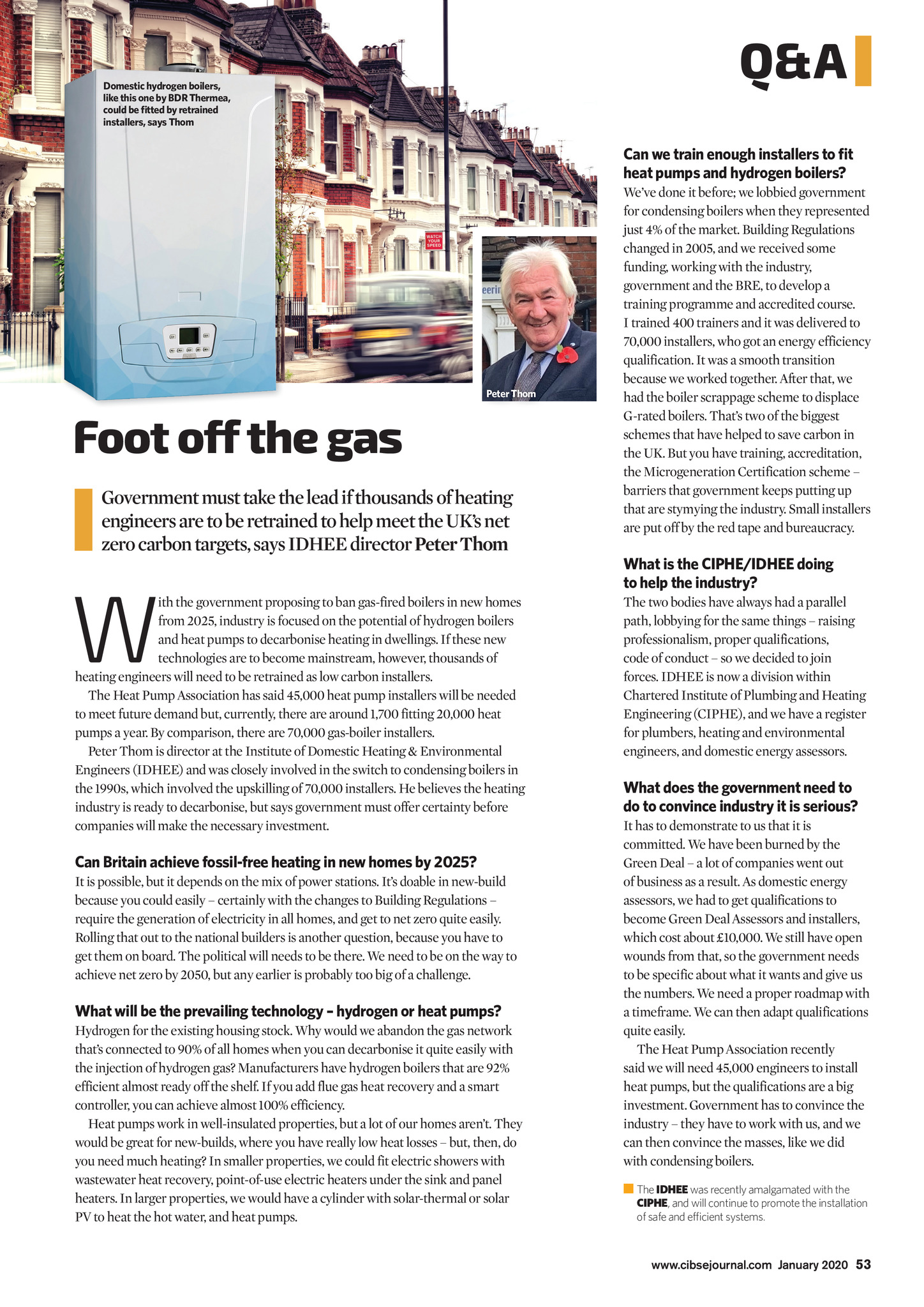
Q&A Domestic hydrogen boilers, like this one by BDR Thermea, could be tted by retrained installers, says Thom Can we train enough installers to t heat pumps and hydrogen boilers? Peter Thom Foot off the gas Government must take the lead if thousands of heating engineers are to be retrained to help meet the UKs net zero carbon targets, says IDHEE director Peter Thom W ith the government proposing to ban gas-fired boilers in new homes from 2025, industry is focused on the potential of hydrogen boilers and heat pumps to decarbonise heating in dwellings. If these new technologies are to become mainstream, however, thousands of heating engineers will need to be retrained as low carbon installers. The Heat Pump Association has said 45,000 heat pump installers will be needed to meet future demand but, currently, there are around 1,700 fitting 20,000 heat pumps a year. By comparison, there are 70,000 gas-boiler installers. Peter Thom is director at the Institute of Domestic Heating & Environmental Engineers (IDHEE) and was closely involved in the switch to condensing boilers in the 1990s, which involved the upskilling of 70,000 installers. He believes the heating industry is ready to decarbonise, but says government must offer certainty before companies will make the necessary investment. Can Britain achieve fossil-free heating in new homes by 2025? It is possible, but it depends on the mix of power stations. Its doable in new-build because you could easily certainly with the changes to Building Regulations require the generation of electricity in all homes, and get to net zero quite easily. Rolling that out to the national builders is another question, because you have to get them on board. The political will needs to be there. We need to be on the way to achieve net zero by 2050, but any earlier is probably too big of a challenge. What will be the prevailing technology hydrogen or heat pumps? Hydrogen for the existing housing stock. Why would we abandon the gas network thats connected to 90% of all homes when you can decarbonise it quite easily with the injection of hydrogen gas? Manufacturers have hydrogen boilers that are 92% efficient almost ready off the shelf. If you add flue gas heat recovery and a smart controller, you can achieve almost 100% efficiency. Heat pumps work in well-insulated properties, but a lot of our homes arent. They would be great for new-builds, where you have really low heat losses but, then, do you need much heating? In smaller properties, we could fit electric showers with wastewater heat recovery, point-of-use electric heaters under the sink and panel heaters. In larger properties, we would have a cylinder with solar-thermal or solar PV to heat the hot water, and heat pumps. Weve done it before; we lobbied government for condensing boilers when they represented just 4% of the market. Building Regulations changed in 2005, and we received some funding, working with the industry, government and the BRE, to develop a training programme and accredited course. I trained 400 trainers and it was delivered to 70,000 installers, who got an energy efficiency qualification. It was a smooth transition because we worked together. After that, we had the boiler scrappage scheme to displace G-rated boilers. Thats two of the biggest schemes that have helped to save carbon in the UK. But you have training, accreditation, the Microgeneration Certification scheme barriers that government keeps putting up that are stymying the industry. Small installers are put off by the red tape and bureaucracy. What is the CIPHE/IDHEE doing to help the industry? The two bodies have always had a parallel path, lobbying for the same things raising professionalism, proper qualifications, code of conduct so we decided to join forces. IDHEE is now a division within Chartered Institute of Plumbing and Heating Engineering (CIPHE), and we have a register for plumbers, heating and environmental engineers, and domestic energy assessors. What does the government need to do to convince industry it is serious? It has to demonstrate to us that it is committed. We have been burned by the Green Deal a lot of companies went out of business as a result. As domestic energy assessors, we had to get qualifications to become Green Deal Assessors and installers, which cost about 10,000. We still have open wounds from that, so the government needs to be specific about what it wants and give us the numbers. We need a proper roadmap with a timeframe. We can then adapt qualifications quite easily. The Heat Pump Association recently said we will need 45,000 engineers to install heat pumps, but the qualifications are a big investment. Government has to convince the industry they have to work with us, and we can then convince the masses, like we did with condensing boilers. The IDHEE was recently amalgamated with the CIPHE, and will continue to promote the installation of safe and efcient systems. www.cibsejournal.com January 2020 53 CIBSE Jan20 pp53 Q&A.indd 53 20/12/2019 15:32