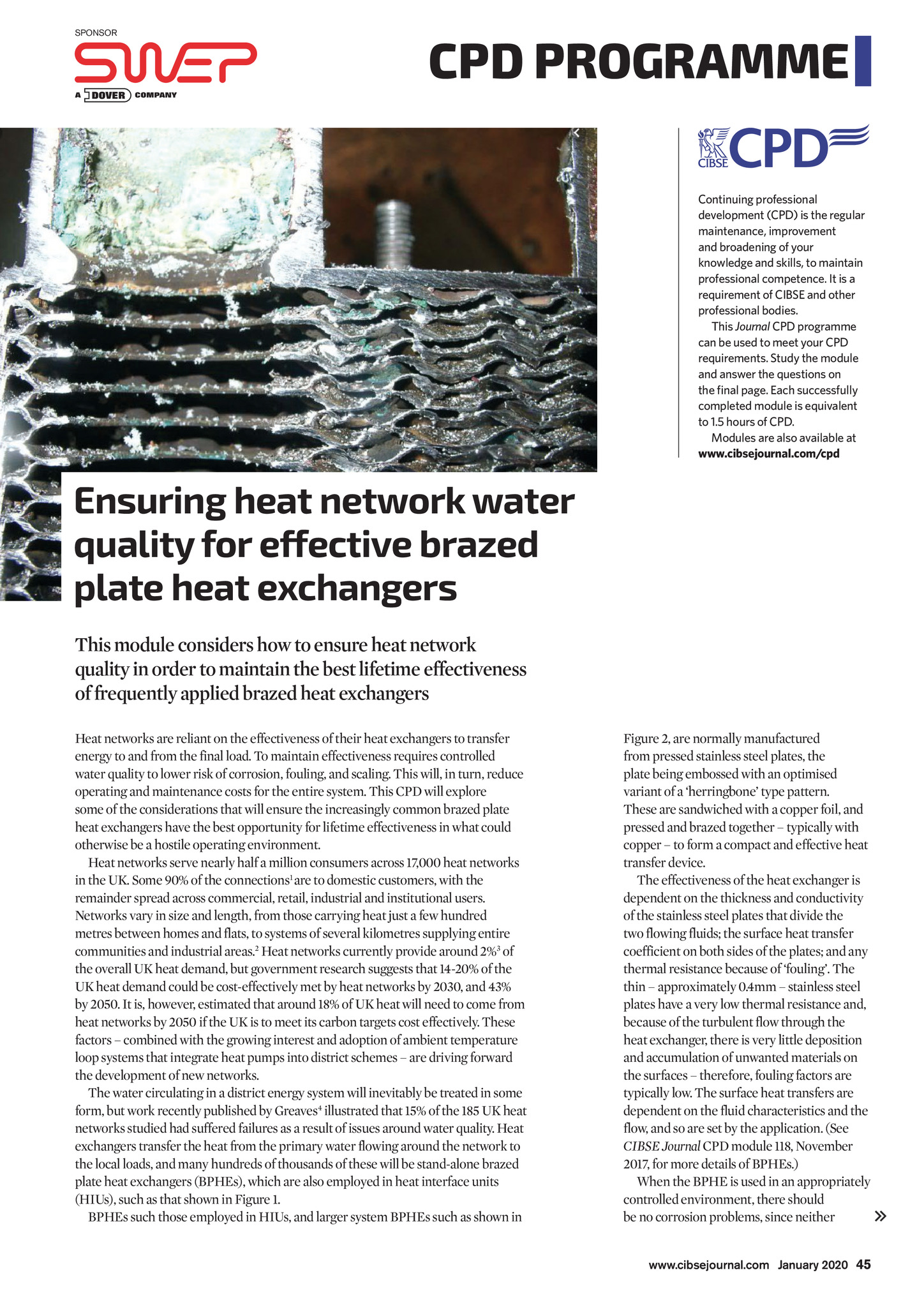

SPONSOR CPD PROGRAMME Continuing professional development (CPD) is the regular maintenance, improvement and broadening of your knowledge and skills, to maintain professional competence. It is a requirement of CIBSE and other professional bodies. This Journal CPD programme can be used to meet your CPD requirements. Study the module and answer the questions on the final page. Each successfully completed module is equivalent to 1.5 hours of CPD. Modules are also available at www.cibsejournal.com/cpd Ensuring heat network water quality for effective brazed plate heat exchangers This module considers how to ensure heat network quality in order to maintain the best lifetime effectiveness of frequently applied brazed heat exchangers Heat networks are reliant on the effectiveness of their heat exchangers to transfer energy to and from the final load. To maintain effectiveness requires controlled water quality to lower risk of corrosion, fouling, and scaling. This will, in turn, reduce operating and maintenance costs for the entire system. This CPD will explore some of the considerations that will ensure the increasingly common brazed plate heat exchangers have the best opportunity for lifetime effectiveness in what could otherwise be a hostile operating environment. Heat networks serve nearly half a million consumers across 17,000 heat networks in the UK. Some 90% of the connections1 are to domestic customers, with the remainder spread across commercial, retail, industrial and institutional users. Networks vary in size and length, from those carrying heat just a few hundred metres between homes and flats, to systems of several kilometres supplying entire communities and industrial areas.2 Heat networks currently provide around 2%3 of the overall UK heat demand, but government research suggests that 14-20% of the UK heat demand could be cost-effectively met by heat networks by 2030, and 43% by 2050. It is, however, estimated that around 18% of UK heat will need to come from heat networks by 2050 if the UK is to meet its carbon targets cost effectively. These factors combined with the growing interest and adoption of ambient temperature loop systems that integrate heat pumps into district schemes are driving forward the development of new networks. The water circulating in a district energy system will inevitably be treated in some form, but work recently published by Greaves4 illustrated that 15% of the 185 UK heat networks studied had suffered failures as a result of issues around water quality. Heat exchangers transfer the heat from the primary water flowing around the network to the local loads, and many hundreds of thousands of these will be stand-alone brazed plate heat exchangers (BPHEs), which are also employed in heat interface units (HIUs), such as that shown in Figure 1. BPHEs such those employed in HIUs, and larger system BPHEs such as shown in Figure 2, are normally manufactured from pressed stainless steel plates, the plate being embossed with an optimised variant of a herringbone type pattern. These are sandwiched with a copper foil, and pressed and brazed together typically with copper to form a compact and effective heat transfer device. The effectiveness of the heat exchanger is dependent on the thickness and conductivity of the stainless steel plates that divide the two flowing fluids; the surface heat transfer coefficient on both sides of the plates; and any thermal resistance because of fouling. The thin approximately 0.4mm stainless steel plates have a very low thermal resistance and, because of the turbulent flow through the heat exchanger, there is very little deposition and accumulation of unwanted materials on the surfaces therefore, fouling factors are typically low. The surface heat transfers are dependent on the fluid characteristics and the flow, and so are set by the application. (See CIBSE Journal CPD module 118, November 2017, for more details of BPHEs.) When the BPHE is used in an appropriately controlled environment, there should be no corrosion problems, since neither www.cibsejournal.com January 2020 45 CIBSE Jan20 pp45-48 CPD v2.indd 45 20/12/2019 15:30