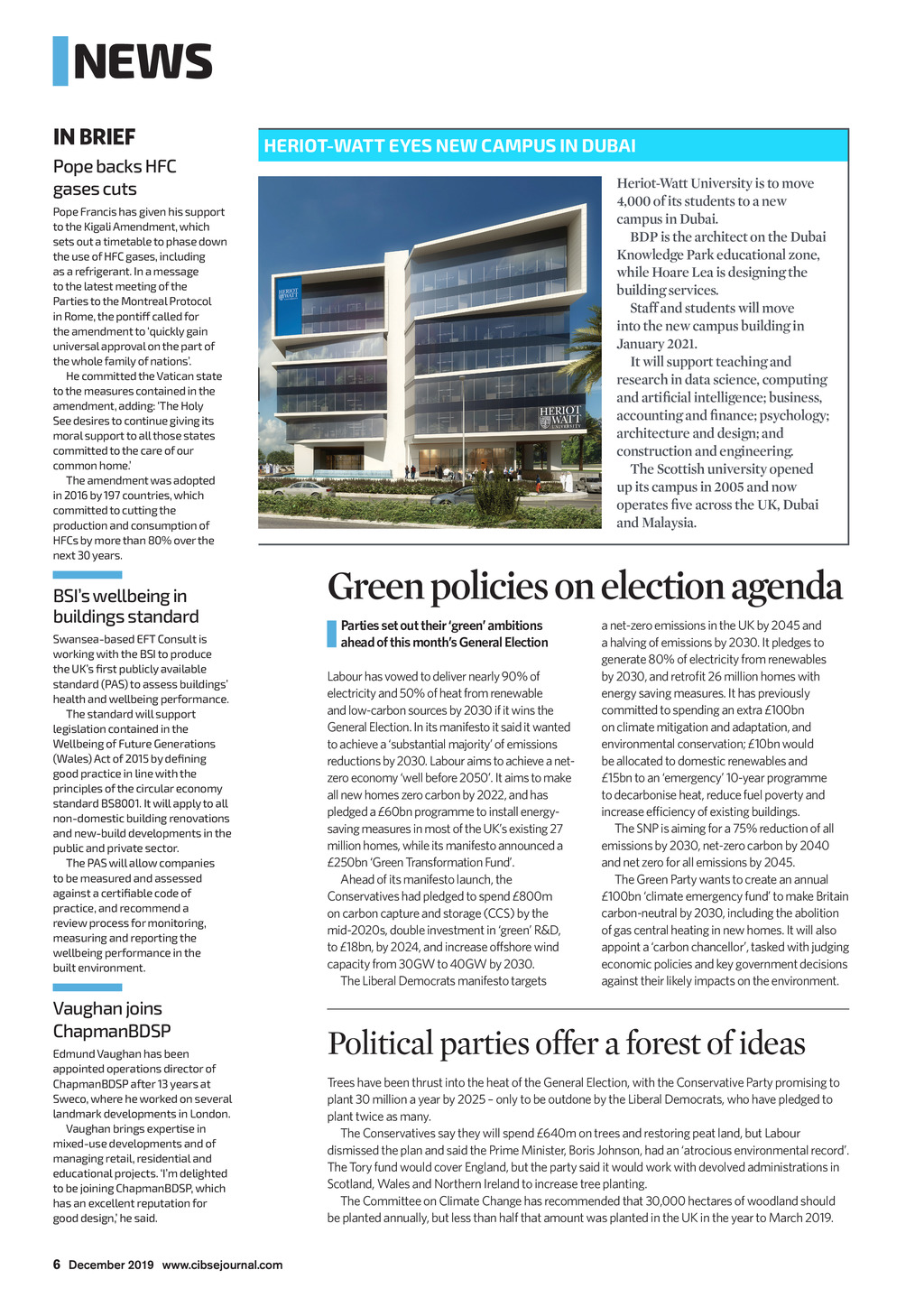



EWS IN BRIEF Pope backs HFC gases cuts HERIOT-WATT EYES NEW CAMPUS IN DUBAI Heriot-Watt University is to move 4,000 of its students to a new campus in Dubai. BDP is the architect on the Dubai Knowledge Park educational zone, while Hoare Lea is designing the building services. Staff and students will move into the new campus building in January 2021. It will support teaching and research in data science, computing and artificial intelligence; business, accounting and finance; psychology; architecture and design; and construction and engineering. The Scottish university opened up its campus in 2005 and now operates five across the UK, Dubai and Malaysia. Pope Francis has given his support to the Kigali Amendment, which sets out a timetable to phase down the use of HFC gases, including as a refrigerant. In a message to the latest meeting of the Parties to the Montreal Protocol in Rome, the pontiff called for the amendment to quickly gain universal approval on the part of the whole family of nations. He committed the Vatican state to the measures contained in the amendment, adding: The Holy See desires to continue giving its moral support to all those states committed to the care of our common home. The amendment was adopted in 2016 by 197 countries, which committed to cutting the production and consumption of HFCs by more than 80% over the next 30 years. BSIs wellbeing in buildings standard Swansea-based EFT Consult is working with the BSI to produce the UKs first publicly available standard (PAS) to assess buildings health and wellbeing performance. The standard will support legislation contained in the Wellbeing of Future Generations (Wales) Act of 2015 by defining good practice in line with the principles of the circular economy standard BS8001. It will apply to all non-domestic building renovations and new-build developments in the public and private sector. The PAS will allow companies to be measured and assessed against a certifiable code of practice, and recommend a review process for monitoring, measuring and reporting the wellbeing performance in the built environment. Vaughan joins ChapmanBDSP Edmund Vaughan has been appointed operations director of ChapmanBDSP after 13 years at Sweco, where he worked on several landmark developments in London. Vaughan brings expertise in mixed-use developments and of managing retail, residential and educational projects. Im delighted to be joining ChapmanBDSP, which has an excellent reputation for good design, he said. Green policies on election agenda Parties set out their green ambitions ahead of this months General Election Labour has vowed to deliver nearly 90% of electricity and 50% of heat from renewable and low-carbon sources by 2030 if it wins the General Election. In its manifesto it said it wanted to achieve a substantial majority of emissions reductions by 2030. Labour aims to achieve a netzero economy well before 2050. It aims to make all new homes zero carbon by 2022, and has pledged a 60bn programme to install energysaving measures in most of the UKs existing 27 million homes, while its manifesto announced a 250bn Green Transformation Fund. Ahead of its manifesto launch, the Conservatives had pledged to spend 800m on carbon capture and storage (CCS) by the mid-2020s, double investment in green R&D, to 18bn, by 2024, and increase offshore wind capacity from 30GW to 40GW by 2030. The Liberal Democrats manifesto targets a net-zero emissions in the UK by 2045 and a halving of emissions by 2030. It pledges to generate 80% of electricity from renewables by 2030, and retrofit 26 million homes with energy saving measures. It has previously committed to spending an extra 100bn on climate mitigation and adaptation, and environmental conservation; 10bn would be allocated to domestic renewables and 15bn to an emergency 10-year programme to decarbonise heat, reduce fuel poverty and increase efficiency of existing buildings. The SNP is aiming for a 75% reduction of all emissions by 2030, net-zero carbon by 2040 and net zero for all emissions by 2045. The Green Party wants to create an annual 100bn climate emergency fund to make Britain carbon-neutral by 2030, including the abolition of gas central heating in new homes. It will also appoint a carbon chancellor, tasked with judging economic policies and key government decisions against their likely impacts on the environment. Political parties offer a forest of ideas Trees have been thrust into the heat of the General Election, with the Conservative Party promising to plant 30 million a year by 2025 only to be outdone by the Liberal Democrats, who have pledged to plant twice as many. The Conservatives say they will spend 640m on trees and restoring peat land, but Labour dismissed the plan and said the Prime Minister, Boris Johnson, had an atrocious environmental record. The Tory fund would cover England, but the party said it would work with devolved administrations in Scotland, Wales and Northern Ireland to increase tree planting. The Committee on Climate Change has recommended that 30,000 hectares of woodland should be planted annually, but less than half that amount was planted in the UK in the year to March 2019. 6 December 2019 www.cibsejournal.com CIBSE Dec19 pp06-07 News.indd 6 22/11/2019 16:55