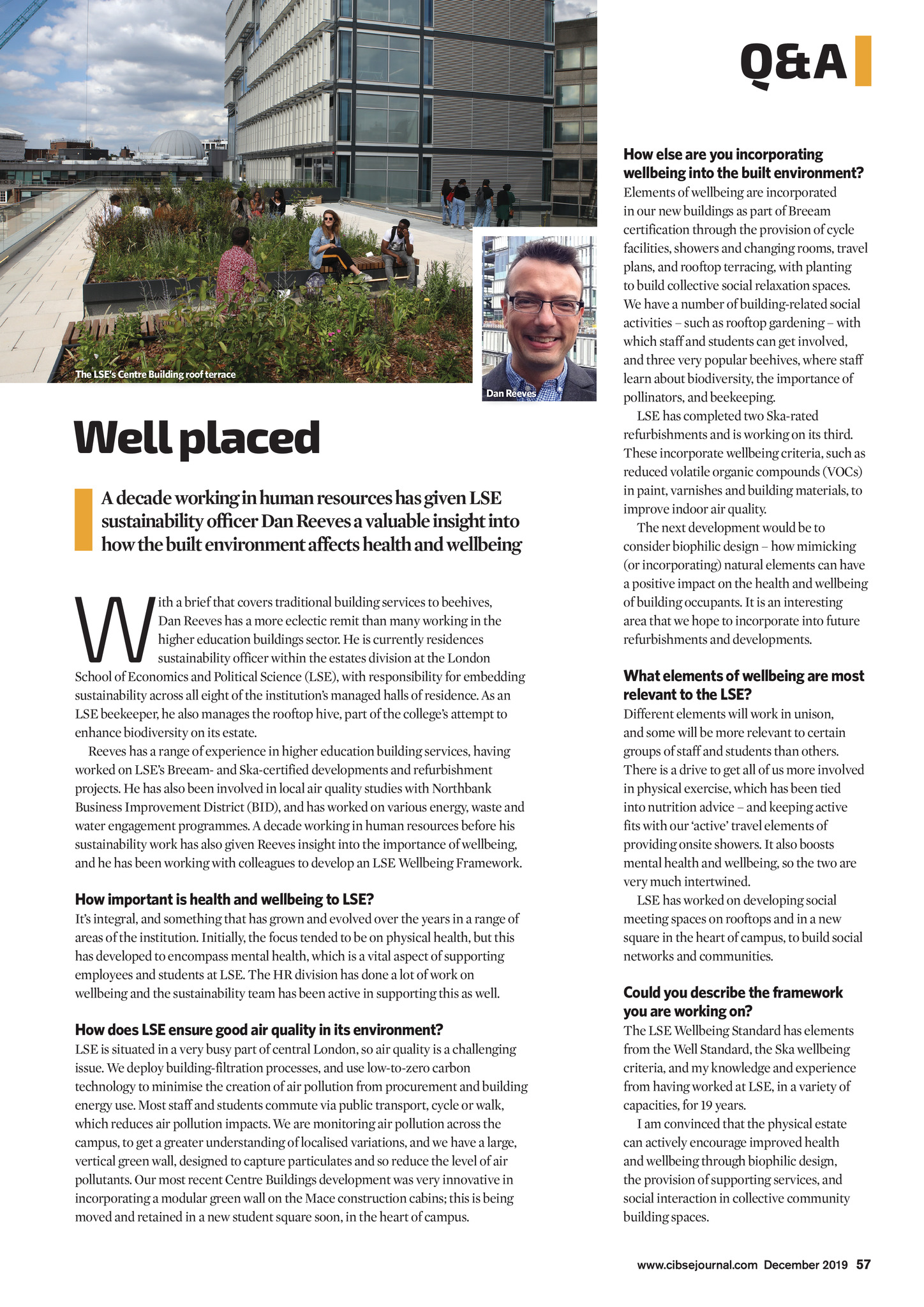

Q&A How else are you incorporating wellbeing into the built environment? The LSEs Centre Building roof terrace Dan Reeves Well placed A decade working in human resources has given LSE sustainability ofcer Dan Reeves a valuable insight into how the built environment affects health and wellbeing W ith a brief that covers traditional building services to beehives, Dan Reeves has a more eclectic remit than many working in the higher education buildings sector. He is currently residences sustainability officer within the estates division at the London School of Economics and Political Science (LSE), with responsibility for embedding sustainability across all eight of the institutions managed halls of residence. As an LSE beekeeper, he also manages the rooftop hive, part of the colleges attempt to enhance biodiversity on its estate. Reeves has a range of experience in higher education building services, having worked on LSEs Breeam- and Ska-certified developments and refurbishment projects. He has also been involved in local air quality studies with Northbank Business Improvement District (BID), and has worked on various energy, waste and water engagement programmes. A decade working in human resources before his sustainability work has also given Reeves insight into the importance of wellbeing, and he has been working with colleagues to develop an LSE Wellbeing Framework. How important is health and wellbeing to LSE? Its integral, and something that has grown and evolved over the years in a range of areas of the institution. Initially, the focus tended to be on physical health, but this has developed to encompass mental health, which is a vital aspect of supporting employees and students at LSE. The HR division has done a lot of work on wellbeing and the sustainability team has been active in supporting this as well. How does LSE ensure good air quality in its environment? LSE is situated in a very busy part of central London, so air quality is a challenging issue. We deploy building-filtration processes, and use low-to-zero carbon technology to minimise the creation of air pollution from procurement and building energy use. Most staff and students commute via public transport, cycle or walk, which reduces air pollution impacts. We are monitoring air pollution across the campus, to get a greater understanding of localised variations, and we have a large, vertical green wall, designed to capture particulates and so reduce the level of air pollutants. Our most recent Centre Buildings development was very innovative in incorporating a modular green wall on the Mace construction cabins; this is being moved and retained in a new student square soon, in the heart of campus. Elements of wellbeing are incorporated in our new buildings as part of Breeam certification through the provision of cycle facilities, showers and changing rooms, travel plans, and rooftop terracing, with planting to build collective social relaxation spaces. We have a number of building-related social activities such as rooftop gardening with which staff and students can get involved, and three very popular beehives, where staff learn about biodiversity, the importance of pollinators, and beekeeping. LSE has completed two Ska-rated refurbishments and is working on its third. These incorporate wellbeing criteria, such as reduced volatile organic compounds (VOCs) in paint, varnishes and building materials, to improve indoor air quality. The next development would be to consider biophilic design how mimicking (or incorporating) natural elements can have a positive impact on the health and wellbeing of building occupants. It is an interesting area that we hope to incorporate into future refurbishments and developments. What elements of wellbeing are most relevant to the LSE? Different elements will work in unison, and some will be more relevant to certain groups of staff and students than others. There is a drive to get all of us more involved in physical exercise, which has been tied into nutrition advice and keeping active fits with our active travel elements of providing onsite showers. It also boosts mental health and wellbeing, so the two are very much intertwined. LSE has worked on developing social meeting spaces on rooftops and in a new square in the heart of campus, to build social networks and communities. Could you describe the framework you are working on? The LSE Wellbeing Standard has elements from the Well Standard, the Ska wellbeing criteria, and my knowledge and experience from having worked at LSE, in a variety of capacities, for 19 years. I am convinced that the physical estate can actively encourage improved health and wellbeing through biophilic design, the provision of supporting services, and social interaction in collective community building spaces. www.cibsejournal.com December 2019 57 CIBSE Dec19 pp57 Q&A.indd 57 22/11/2019 15:34