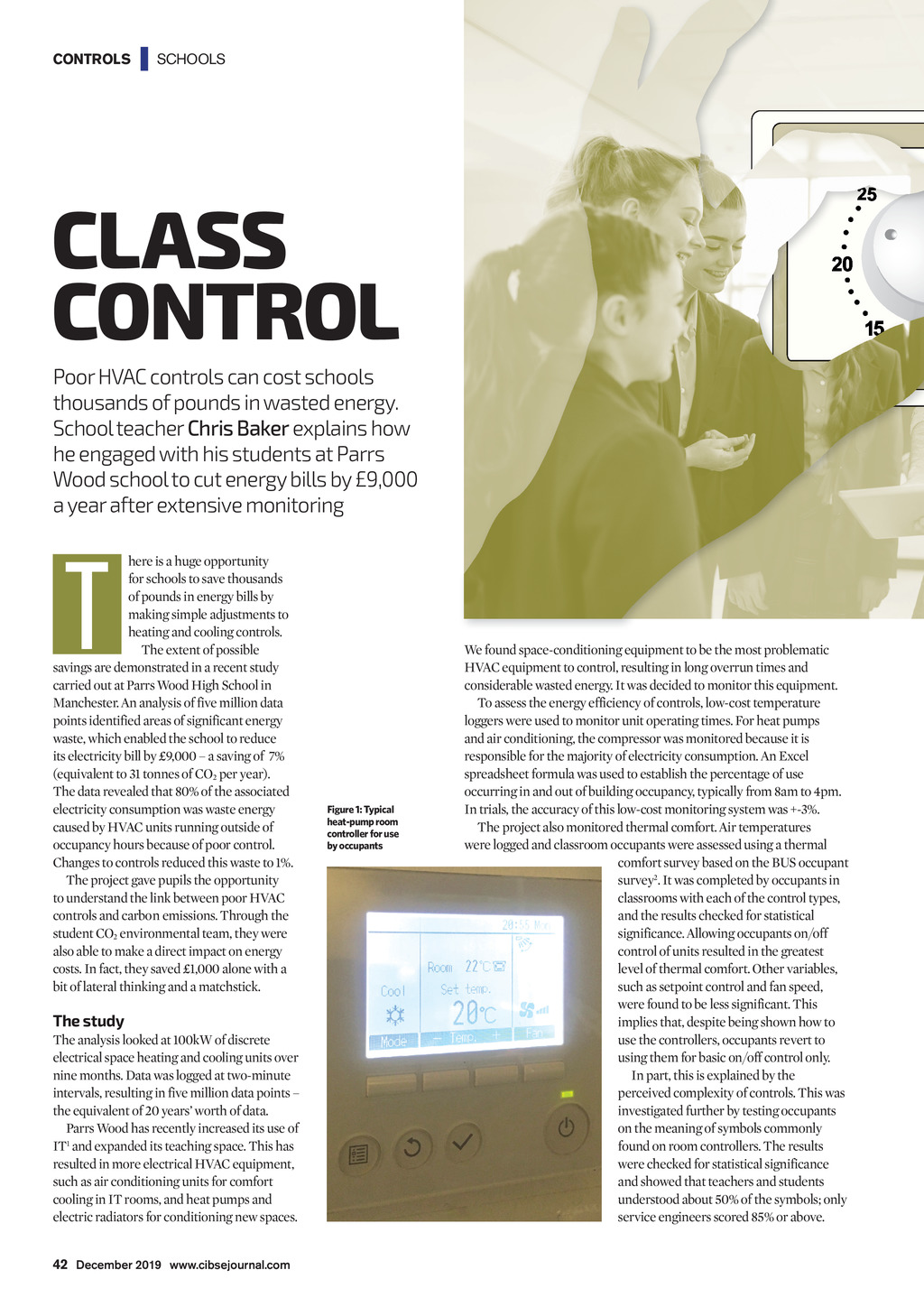
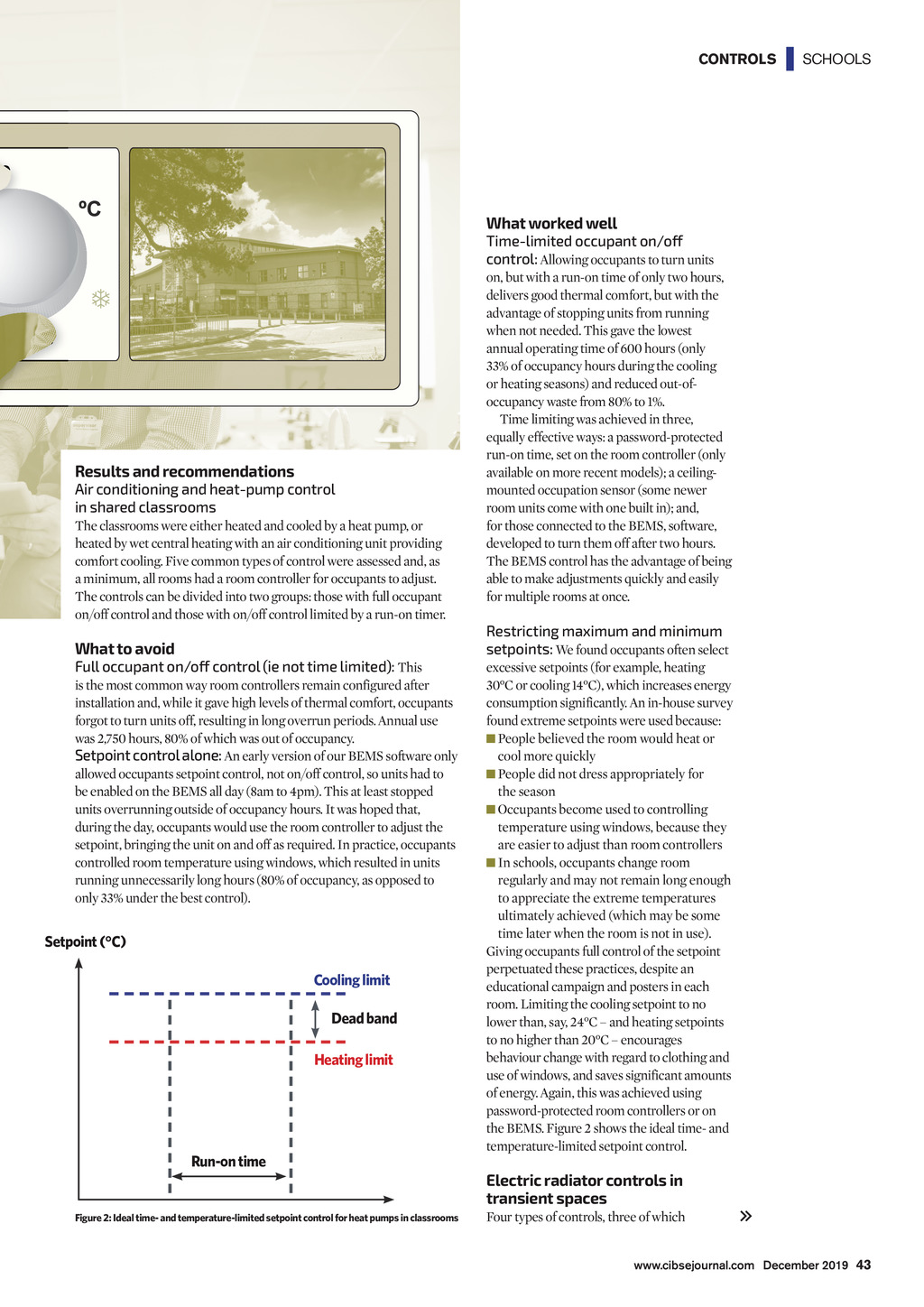


CONTROLS | SCHOOLS CLASS CONTROL Poor HVAC controls can cost schools thousands of pounds in wasted energy. School teacher Chris Baker explains how he engaged with his students at Parrs Wood school to cut energy bills by 9,000 a year after extensive monitoring T here is a huge opportunity for schools to save thousands of pounds in energy bills by making simple adjustments to heating and cooling controls. The extent of possible savings are demonstrated in a recent study carried out at Parrs Wood High School in Manchester. An analysis of five million data points identified areas of significant energy waste, which enabled the school to reduce its electricity bill by 9,000 a saving of 7% (equivalent to 31 tonnes of CO2 per year). The data revealed that 80% of the associated electricity consumption was waste energy caused by HVAC units running outside of occupancy hours because of poor control. Changes to controls reduced this waste to 1%. The project gave pupils the opportunity to understand the link between poor HVAC controls and carbon emissions. Through the student CO2 environmental team, they were also able to make a direct impact on energy costs. In fact, they saved 1,000 alone with a bit of lateral thinking and a matchstick. The study The analysis looked at 100kW of discrete electrical space heating and cooling units over nine months. Data was logged at two-minute intervals, resulting in five million data points the equivalent of 20 years worth of data. Parrs Wood has recently increased its use of IT1 and expanded its teaching space. This has resulted in more electrical HVAC equipment, such as air conditioning units for comfort cooling in IT rooms, and heat pumps and electric radiators for conditioning new spaces. Figure 1: Typical heat-pump room controller for use by occupants We found space-conditioning equipment to be the most problematic HVAC equipment to control, resulting in long overrun times and considerable wasted energy. It was decided to monitor this equipment. To assess the energy efficiency of controls, low-cost temperature loggers were used to monitor unit operating times. For heat pumps and air conditioning, the compressor was monitored because it is responsible for the majority of electricity consumption. An Excel spreadsheet formula was used to establish the percentage of use occurring in and out of building occupancy, typically from 8am to 4pm. In trials, the accuracy of this low-cost monitoring system was +-3%. The project also monitored thermal comfort. Air temperatures were logged and classroom occupants were assessed using a thermal comfort survey based on the BUS occupant survey2. It was completed by occupants in classrooms with each of the control types, and the results checked for statistical significance. Allowing occupants on/off control of units resulted in the greatest level of thermal comfort. Other variables, such as setpoint control and fan speed, were found to be less significant. This implies that, despite being shown how to use the controllers, occupants revert to using them for basic on/off control only. In part, this is explained by the perceived complexity of controls. This was investigated further by testing occupants on the meaning of symbols commonly found on room controllers. The results were checked for statistical significance and showed that teachers and students understood about 50% of the symbols; only service engineers scored 85% or above. 42 December 2019 www.cibsejournal.com CIBSE Dec19 pp42-44 Schools controls.indd 42 22/11/2019 15:42