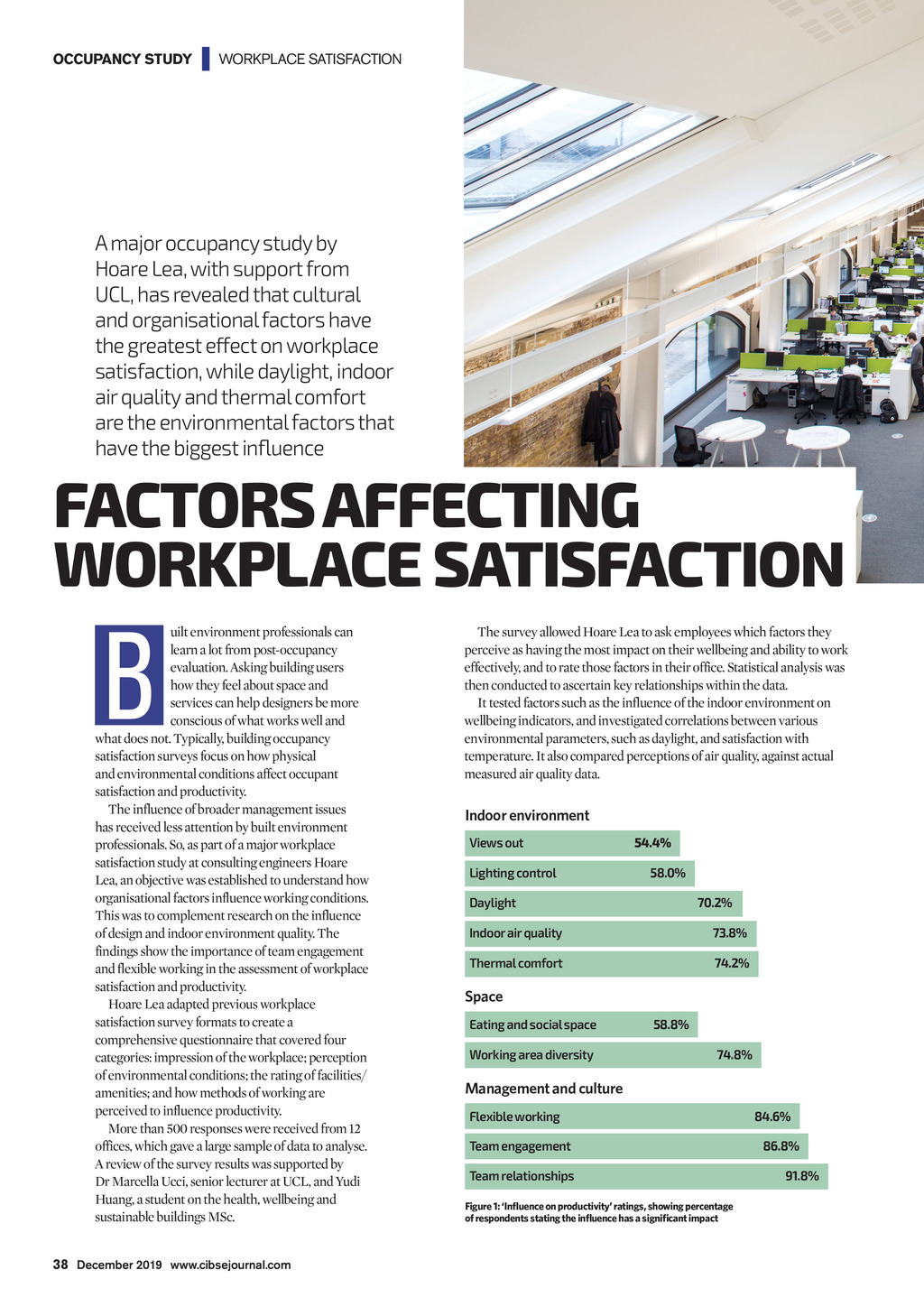
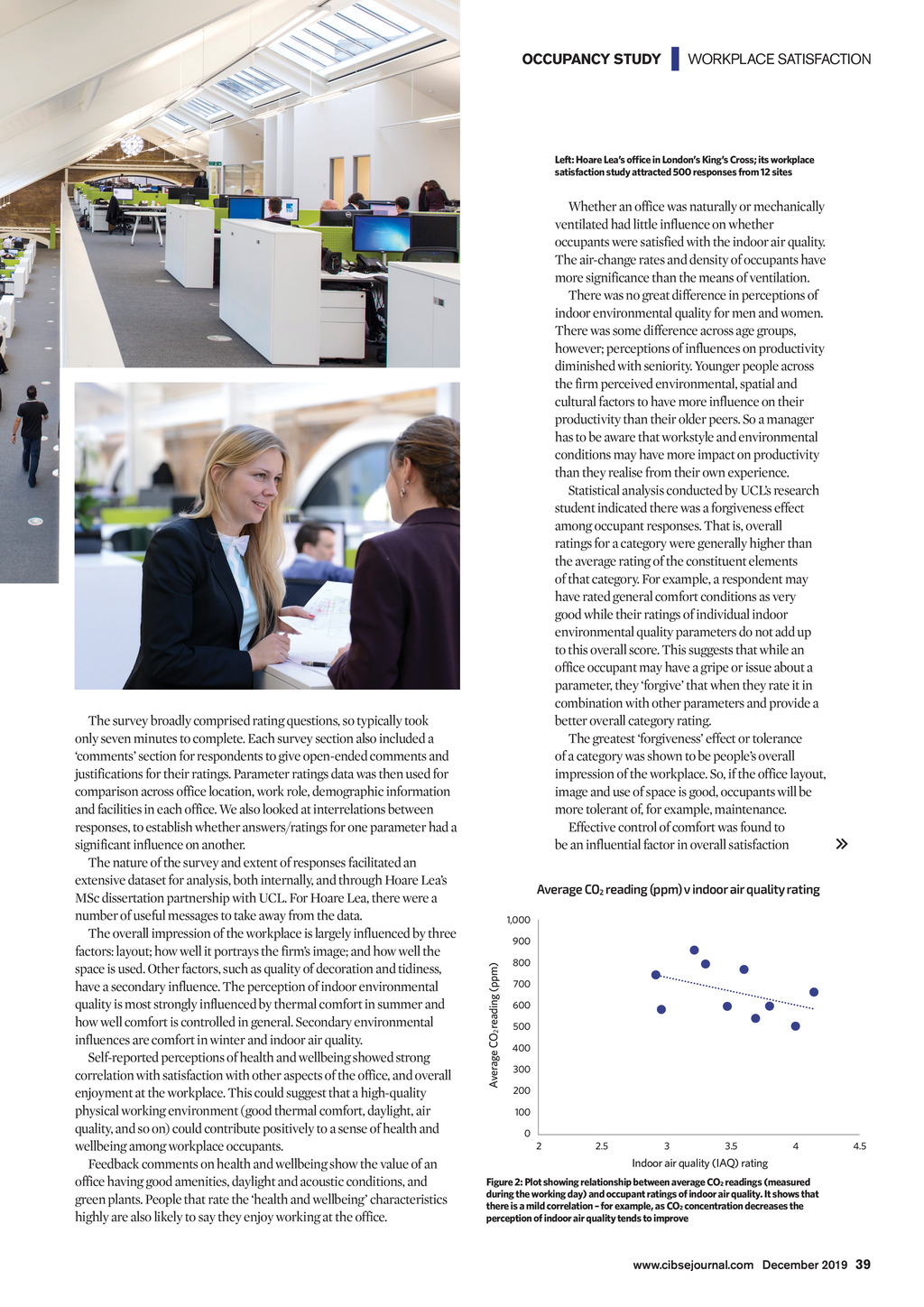


OCCUPANCY STUDY | WORKPLACE SATISFACTION A major occupancy study by Hoare Lea, with support from UCL, has revealed that cultural and organisational factors have the greatest effect on workplace satisfaction, while daylight, indoor air quality and thermal comfort are the environmental factors that have the biggest influence FACTORS AFFECTING WORKPLACE SATISFACTION B uilt environment professionals can learn a lot from post-occupancy evaluation. Asking building users how they feel about space and services can help designers be more conscious of what works well and what does not. Typically, building occupancy satisfaction surveys focus on how physical and environmental conditions affect occupant satisfaction and productivity. The influence of broader management issues has received less attention by built environment professionals. So, as part of a major workplace satisfaction study at consulting engineers Hoare Lea, an objective was established to understand how organisational factors influence working conditions. This was to complement research on the influence of design and indoor environment quality. The findings show the importance of team engagement and flexible working in the assessment of workplace satisfaction and productivity. Hoare Lea adapted previous workplace satisfaction survey formats to create a comprehensive questionnaire that covered four categories: impression of the workplace; perception of environmental conditions; the rating of facilities/ amenities; and how methods of working are perceived to influence productivity. More than 500 responses were received from 12 offices, which gave a large sample of data to analyse. A review of the survey results was supported by Dr Marcella Ucci, senior lecturer at UCL, and Yudi Huang, a student on the health, wellbeing and sustainable buildings MSc. The survey allowed Hoare Lea to ask employees which factors they perceive as having the most impact on their wellbeing and ability to work effectively, and to rate those factors in their office. Statistical analysis was then conducted to ascertain key relationships within the data. It tested factors such as the influence of the indoor environment on wellbeing indicators, and investigated correlations between various environmental parameters, such as daylight, and satisfaction with temperature. It also compared perceptions of air quality, against actual measured air quality data. Indoor environment Views out Lighting control 54.4% 58.0% 70.2% Daylight Indoor air quality 73.8% Thermal comfort 74.2% Space Eating and social space Working area diversity 58.8% 74.8% Management and culture Flexible working Team engagement Team relationships 84.6% 86.8% 91.8% Figure 1: Influence on productivity ratings, showing percentage of respondents stating the influence has a significant impact 38 December 2019 www.cibsejournal.com CIBSE Dec19 pp38-40 Hoare Lea POE.indd 38 22/11/2019 15:26