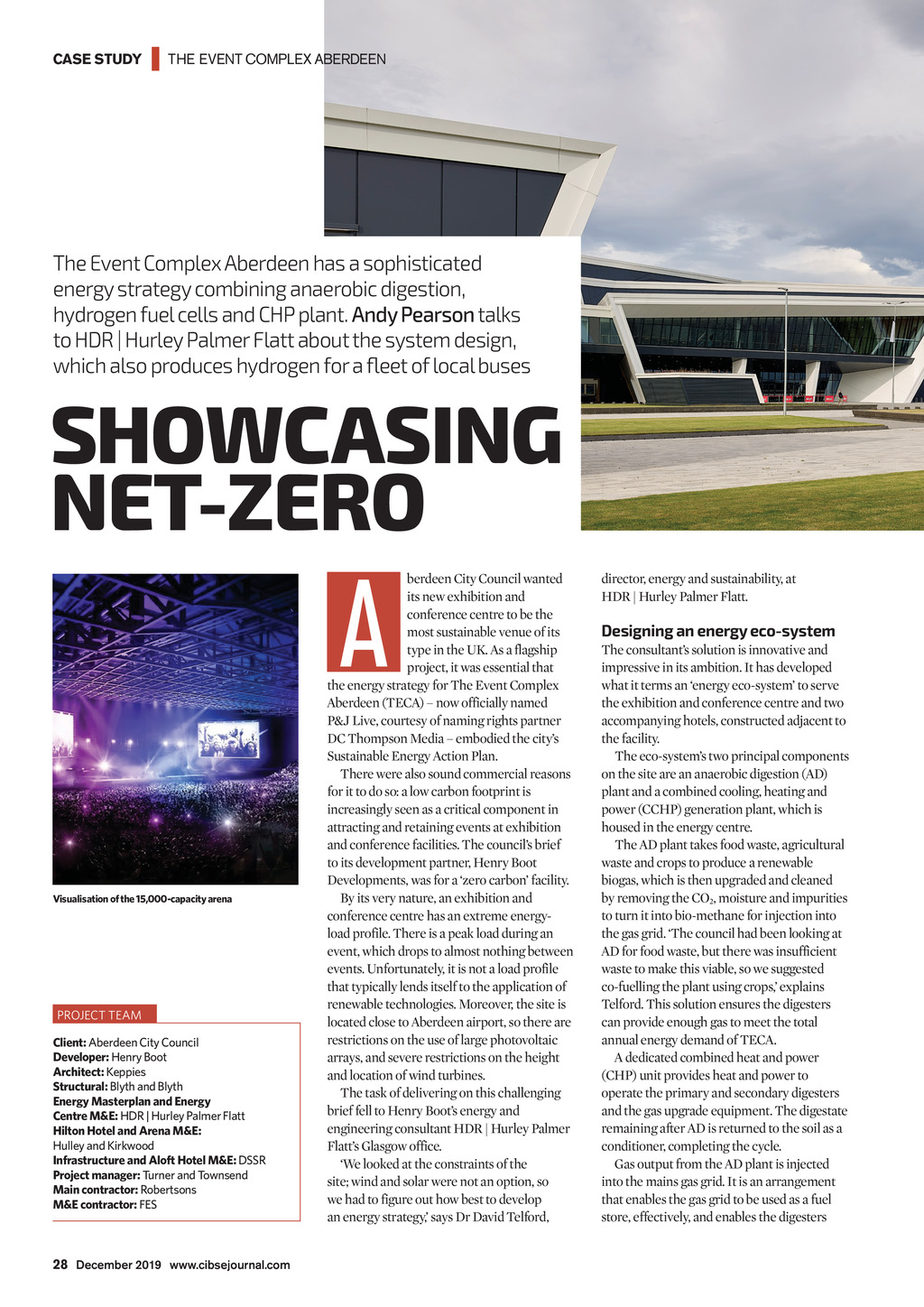
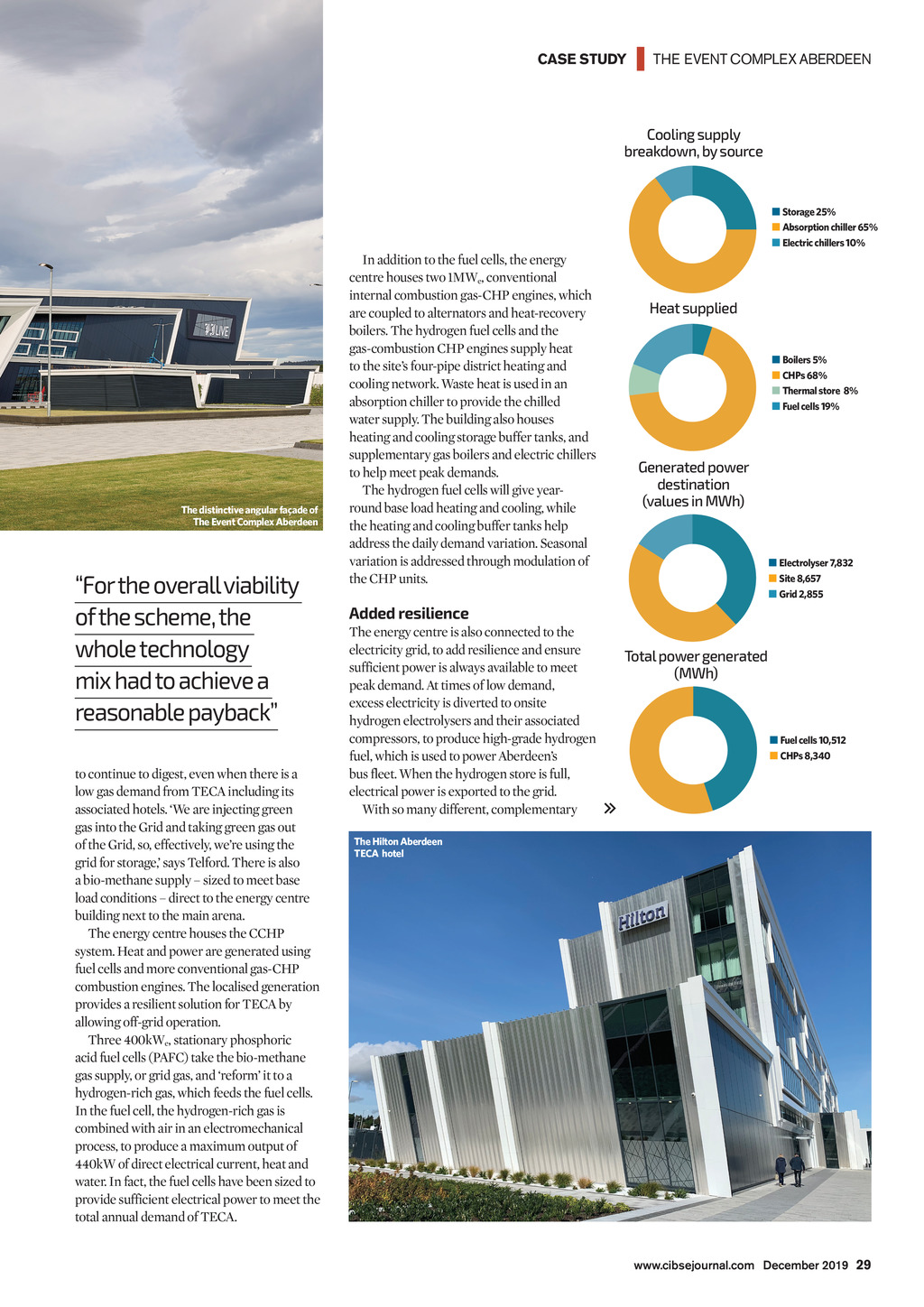

CASE STUDY | THE EVENT COMPLEX ABERDEEN The Event Complex Aberdeen has a sophisticated energy strategy combining anaerobic digestion, hydrogen fuel cells and CHP plant. Andy Pearson talks to HDR | Hurley Palmer Flatt about the system design, which also produces hydrogen for a fleet of local buses SHOWCASING NET-ZERO A Visualisation of the 15,000-capacity arena PROJECT TEAM Client: Aberdeen City Council Developer: Henry Boot Architect: Keppies Structural: Blyth and Blyth Energy Masterplan and Energy Centre M&E: HDR | Hurley Palmer Flatt Hilton Hotel and Arena M&E: Hulley and Kirkwood Infrastructure and Aloft Hotel M&E: DSSR Project manager: Turner and Townsend Main contractor: Robertsons M&E contractor: FES berdeen City Council wanted its new exhibition and conference centre to be the most sustainable venue of its type in the UK. As a flagship project, it was essential that the energy strategy for The Event Complex Aberdeen (TECA) now officially named P&J Live, courtesy of naming rights partner DC Thompson Media embodied the citys Sustainable Energy Action Plan. There were also sound commercial reasons for it to do so: a low carbon footprint is increasingly seen as a critical component in attracting and retaining events at exhibition and conference facilities. The councils brief to its development partner, Henry Boot Developments, was for a zero carbon facility. By its very nature, an exhibition and conference centre has an extreme energyload profile. There is a peak load during an event, which drops to almost nothing between events. Unfortunately, it is not a load profile that typically lends itself to the application of renewable technologies. Moreover, the site is located close to Aberdeen airport, so there are restrictions on the use of large photovoltaic arrays, and severe restrictions on the height and location of wind turbines. The task of delivering on this challenging brief fell to Henry Boots energy and engineering consultant HDR | Hurley Palmer Flatts Glasgow office. We looked at the constraints of the site; wind and solar were not an option, so we had to figure out how best to develop an energy strategy, says Dr David Telford, director, energy and sustainability, at HDR | Hurley Palmer Flatt. Designing an energy eco-system The consultants solution is innovative and impressive in its ambition. It has developed what it terms an energy eco-system to serve the exhibition and conference centre and two accompanying hotels, constructed adjacent to the facility. The eco-systems two principal components on the site are an anaerobic digestion (AD) plant and a combined cooling, heating and power (CCHP) generation plant, which is housed in the energy centre. The AD plant takes food waste, agricultural waste and crops to produce a renewable biogas, which is then upgraded and cleaned by removing the CO2, moisture and impurities to turn it into bio-methane for injection into the gas grid. The council had been looking at AD for food waste, but there was insufficient waste to make this viable, so we suggested co-fuelling the plant using crops, explains Telford. This solution ensures the digesters can provide enough gas to meet the total annual energy demand of TECA. A dedicated combined heat and power (CHP) unit provides heat and power to operate the primary and secondary digesters and the gas upgrade equipment. The digestate remaining after AD is returned to the soil as a conditioner, completing the cycle. Gas output from the AD plant is injected into the mains gas grid. It is an arrangement that enables the gas grid to be used as a fuel store, effectively, and enables the digesters 28 December 2019 www.cibsejournal.com CIBSE Dec19 pp28-31 Aberdeen centre.indd 28 22/11/2019 15:23