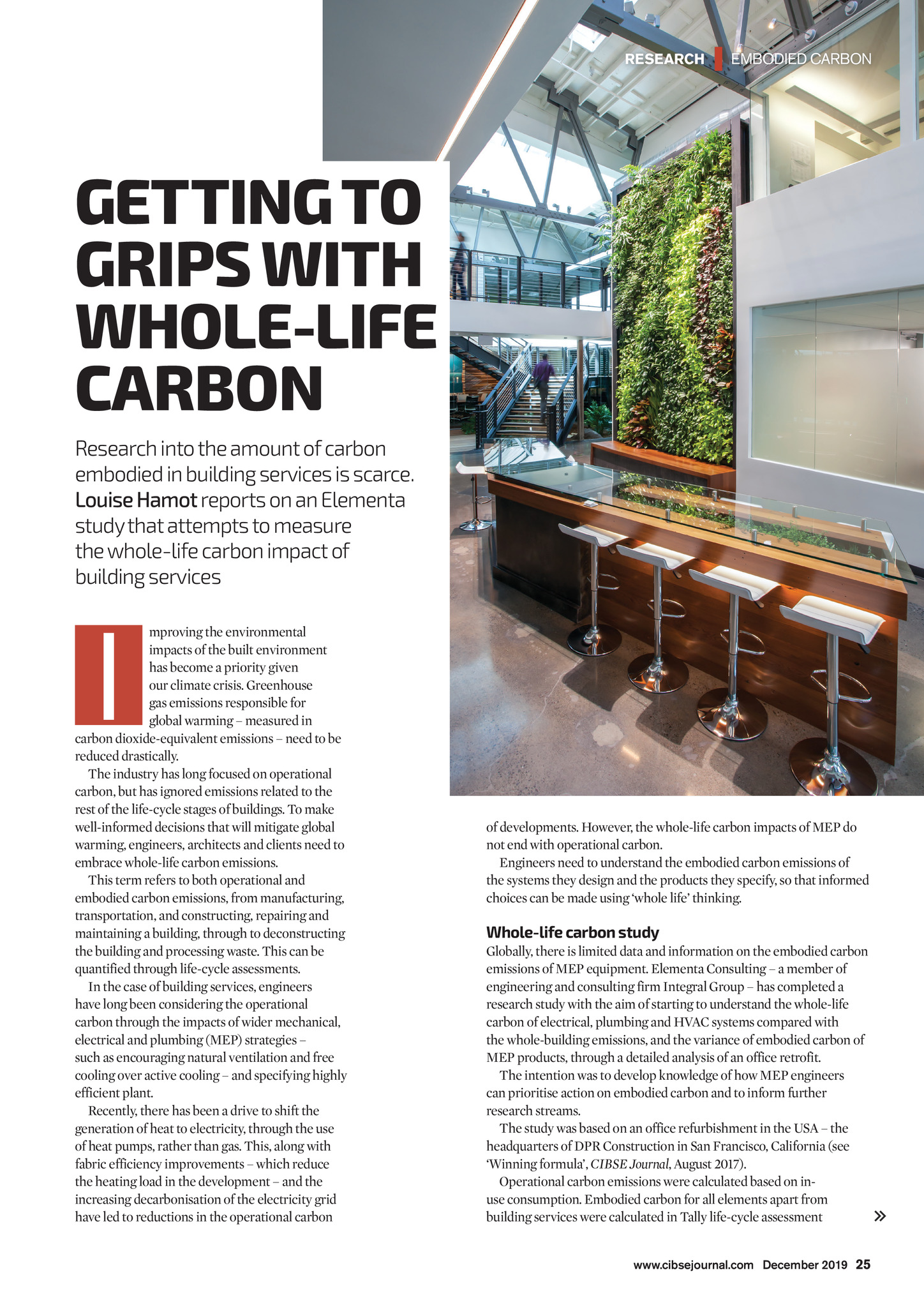

RESEARCH | EMBODIED CARBON GETTING TO GRIPS WITH WHOLE-LIFE CARBON Research into the amount of carbon embodied in building services is scarce. Louise Hamot reports on an Elementa study that attempts to measure the whole-life carbon impact of building services I mproving the environmental impacts of the built environment has become a priority given our climate crisis. Greenhouse gas emissions responsible for global warming measured in carbon dioxide-equivalent emissions need to be reduced drastically. The industry has long focused on operational carbon, but has ignored emissions related to the rest of the life-cycle stages of buildings. To make well-informed decisions that will mitigate global warming, engineers, architects and clients need to embrace whole-life carbon emissions. This term refers to both operational and embodied carbon emissions, from manufacturing, transportation, and constructing, repairing and maintaining a building, through to deconstructing the building and processing waste. This can be quantified through life-cycle assessments. In the case of building services, engineers have long been considering the operational carbon through the impacts of wider mechanical, electrical and plumbing (MEP) strategies such as encouraging natural ventilation and free cooling over active cooling and specifying highly efficient plant. Recently, there has been a drive to shift the generation of heat to electricity, through the use of heat pumps, rather than gas. This, along with fabric efficiency improvements which reduce the heating load in the development and the increasing decarbonisation of the electricity grid have led to reductions in the operational carbon of developments. However, the whole-life carbon impacts of MEP do not end with operational carbon. Engineers need to understand the embodied carbon emissions of the systems they design and the products they specify, so that informed choices can be made using whole life thinking. Whole-life carbon study Globally, there is limited data and information on the embodied carbon emissions of MEP equipment. Elementa Consulting a member of engineering and consulting firm Integral Group has completed a research study with the aim of starting to understand the whole-life carbon of electrical, plumbing and HVAC systems compared with the whole-building emissions, and the variance of embodied carbon of MEP products, through a detailed analysis of an office retrofit. The intention was to develop knowledge of how MEP engineers can prioritise action on embodied carbon and to inform further research streams. The study was based on an office refurbishment in the USA the headquarters of DPR Construction in San Francisco, California (see Winning formula, CIBSE Journal, August 2017). Operational carbon emissions were calculated based on inuse consumption. Embodied carbon for all elements apart from building services were calculated in Tally life-cycle assessment www.cibsejournal.com December 2019 25 CIBSE Dec19 pp25-27 Embodied carbon.indd 25 22/11/2019 15:19