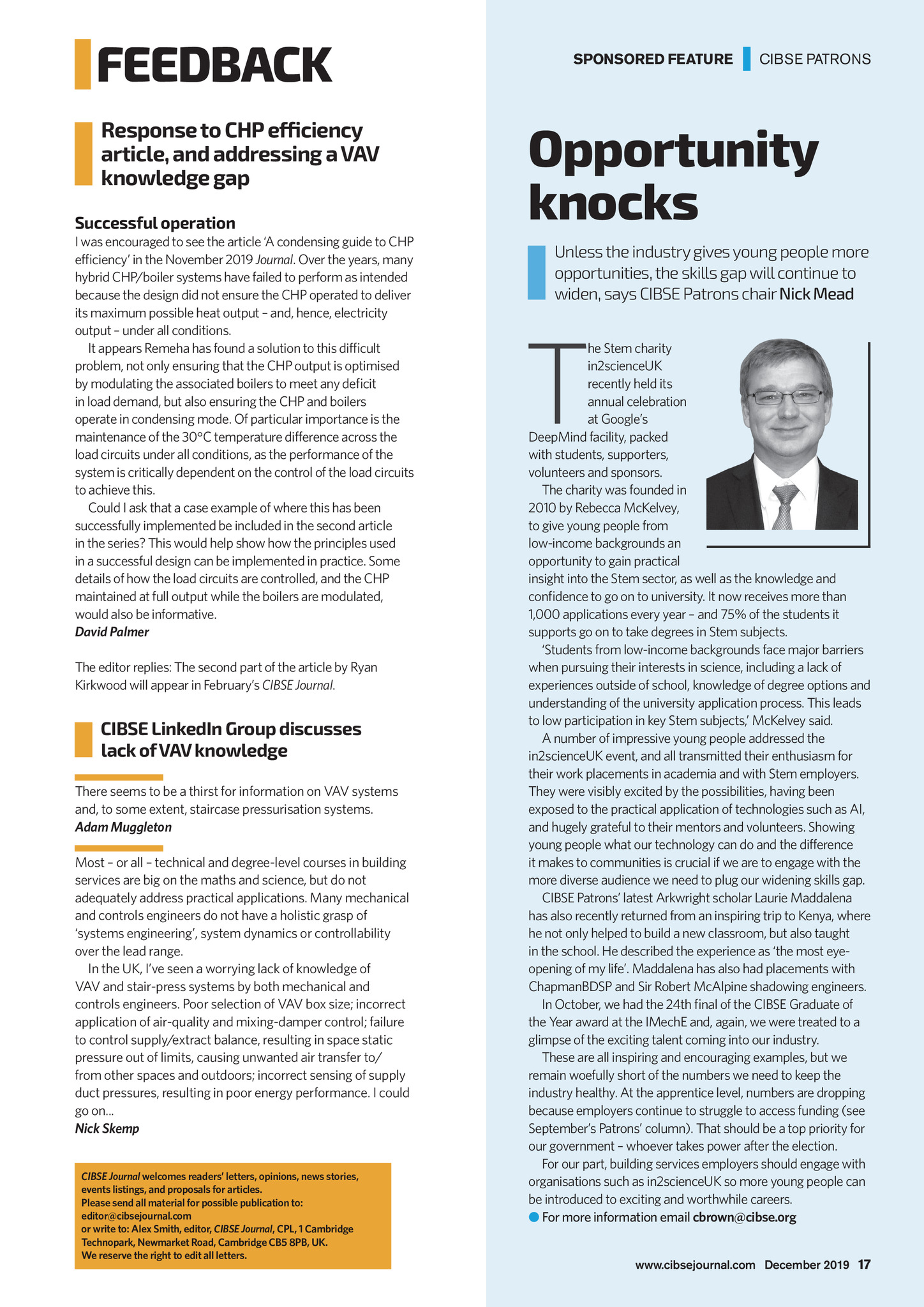

FEEDBACK Response to CHP efficiency article, and addressing a VAV knowledge gap Successful operation I was encouraged to see the article A condensing guide to CHP efciency in the November 2019 Journal. Over the years, many hybrid CHP/boiler systems have failed to perform as intended because the design did not ensure the CHP operated to deliver its maximum possible heat output and, hence, electricity output under all conditions. It appears Remeha has found a solution to this difcult problem, not only ensuring that the CHP output is optimised by modulating the associated boilers to meet any decit in load demand, but also ensuring the CHP and boilers operate in condensing mode. Of particular importance is the maintenance of the 30C temperature difference across the load circuits under all conditions, as the performance of the system is critically dependent on the control of the load circuits to achieve this. Could I ask that a case example of where this has been successfully implemented be included in the second article in the series? This would help show how the principles used in a successful design can be implemented in practice. Some details of how the load circuits are controlled, and the CHP maintained at full output while the boilers are modulated, would also be informative. David Palmer The editor replies: The second part of the article by Ryan Kirkwood will appear in Februarys CIBSE Journal. CIBSE LinkedIn Group discusses lack of VAV knowledge There seems to be a thirst for information on VAV systems and, to some extent, staircase pressurisation systems. Adam Muggleton Most or all technical and degree-level courses in building services are big on the maths and science, but do not adequately address practical applications. Many mechanical and controls engineers do not have a holistic grasp of systems engineering, system dynamics or controllability over the lead range. In the UK, Ive seen a worrying lack of knowledge of VAV and stair-press systems by both mechanical and controls engineers. Poor selection of VAV box size; incorrect application of air-quality and mixing-damper control; failure to control supply/extract balance, resulting in space static pressure out of limits, causing unwanted air transfer to/ from other spaces and outdoors; incorrect sensing of supply duct pressures, resulting in poor energy performance. I could go on... Nick Skemp CIBSE Journal welcomes readers letters, opinions, news stories, events listings, and proposals for articles. Please send all material for possible publication to: editor@cibsejournal.com or write to: Alex Smith, editor, CIBSE Journal, CPL, 1 Cambridge Technopark, Newmarket Road, Cambridge CB5 8PB, UK. We reserve the right to edit all letters. CIBSE Dec19 pp17 Letters Patrons.indd 17 SPONSORED FEATURE | CIBSE PATRONS Opportunity knocks Unless the industry gives young people more opportunities, the skills gap will continue to widen, says CIBSE Patrons chair Nick Mead T he Stem charity in2scienceUK recently held its annual celebration at Googles DeepMind facility, packed with students, supporters, volunteers and sponsors. The charity was founded in 2010 by Rebecca McKelvey, to give young people from low-income backgrounds an opportunity to gain practical insight into the Stem sector, as well as the knowledge and condence to go on to university. It now receives more than 1,000 applications every year and 75% of the students it supports go on to take degrees in Stem subjects. Students from low-income backgrounds face major barriers when pursuing their interests in science, including a lack of experiences outside of school, knowledge of degree options and understanding of the university application process. This leads to low participation in key Stem subjects, McKelvey said. A number of impressive young people addressed the in2scienceUK event, and all transmitted their enthusiasm for their work placements in academia and with Stem employers. They were visibly excited by the possibilities, having been exposed to the practical application of technologies such as AI, and hugely grateful to their mentors and volunteers. Showing young people what our technology can do and the difference it makes to communities is crucial if we are to engage with the more diverse audience we need to plug our widening skills gap. CIBSE Patrons latest Arkwright scholar Laurie Maddalena has also recently returned from an inspiring trip to Kenya, where he not only helped to build a new classroom, but also taught in the school. He described the experience as the most eyeopening of my life. Maddalena has also had placements with ChapmanBDSP and Sir Robert McAlpine shadowing engineers. In October, we had the 24th nal of the CIBSE Graduate of the Year award at the IMechE and, again, we were treated to a glimpse of the exciting talent coming into our industry. These are all inspiring and encouraging examples, but we remain woefully short of the numbers we need to keep the industry healthy. At the apprentice level, numbers are dropping because employers continue to struggle to access funding (see Septembers Patrons column). That should be a top priority for our government whoever takes power after the election. For our part, building services employers should engage with organisations such as in2scienceUK so more young people can be introduced to exciting and worthwhile careers. For more information email cbrown@cibse.org www.cibsejournal.com December 2019 17 22/11/2019 15:15