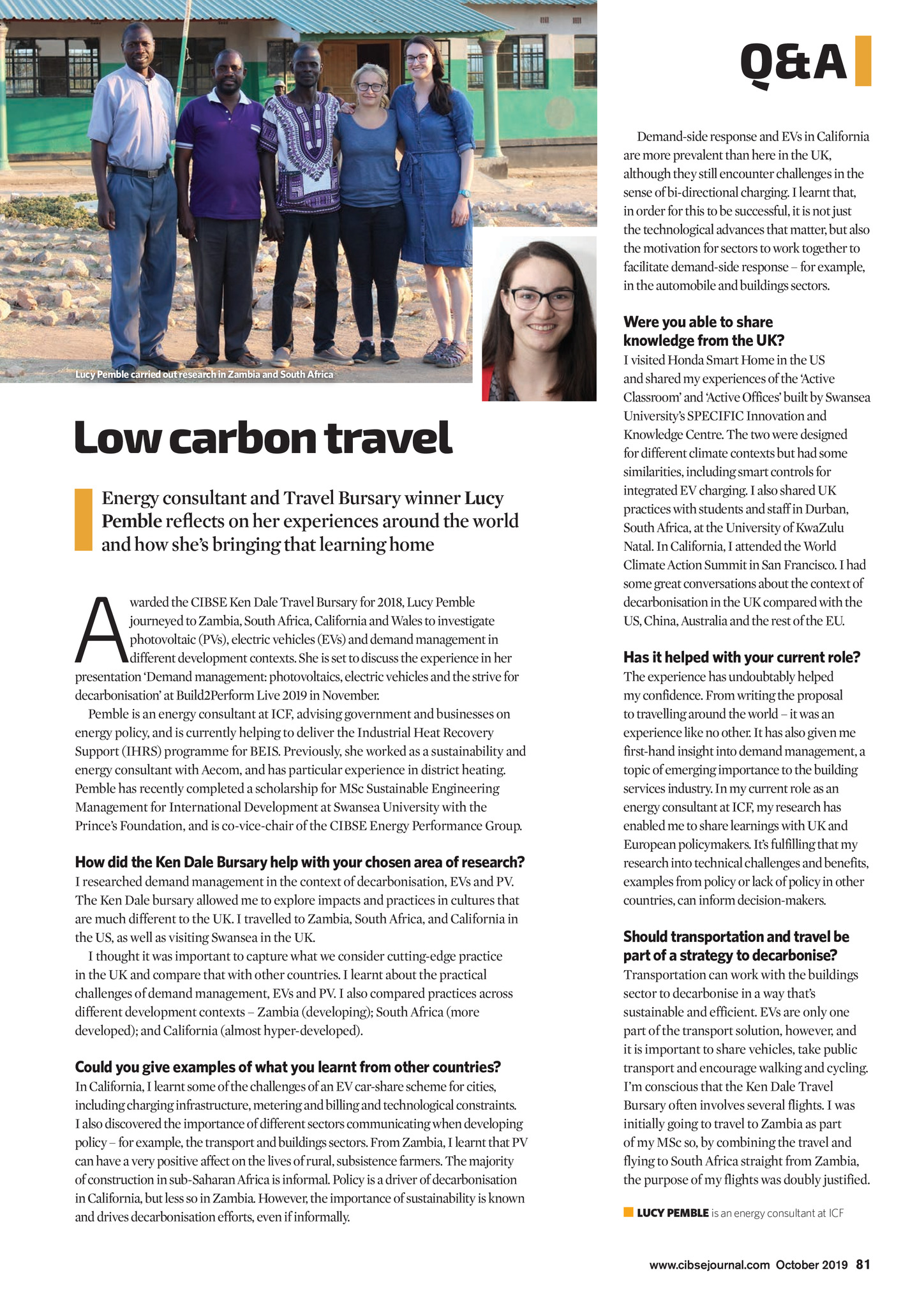
Q&A Demand-side response and EVs in California are more prevalent than here in the UK, although they still encounter challenges in the sense of bi-directional charging. I learnt that, in order for this to be successful, it is not just the technological advances that matter, but also the motivation for sectors to work together to facilitate demand-side response for example, in the automobile and buildings sectors. Were you able to share knowledge from the UK? Lucy Pemble carried out research in Zambia and South Africa Low carbon travel Energy consultant and Travel Bursary winner Lucy Pemble reects on her experiences around the world and how shes bringing that learning home A warded the CIBSE Ken Dale Travel Bursary for 2018, Lucy Pemble journeyed to Zambia, South Africa, California and Wales to investigate photovoltaic (PVs), electric vehicles (EVs) and demand management in different development contexts. She is set to discuss the experience in her presentation Demand management: photovoltaics, electric vehicles and the strive for decarbonisation at Build2Perform Live 2019 in November. Pemble is an energy consultant at ICF, advising government and businesses on energy policy, and is currently helping to deliver the Industrial Heat Recovery Support (IHRS) programme for BEIS. Previously, she worked as a sustainability and energy consultant with Aecom, and has particular experience in district heating. Pemble has recently completed a scholarship for MSc Sustainable Engineering Management for International Development at Swansea University with the Princes Foundation, and is co-vice-chair of the CIBSE Energy Performance Group. How did the Ken Dale Bursary help with your chosen area of research? I researched demand management in the context of decarbonisation, EVs and PV. The Ken Dale bursary allowed me to explore impacts and practices in cultures that are much different to the UK. I travelled to Zambia, South Africa, and California in the US, as well as visiting Swansea in the UK. I thought it was important to capture what we consider cutting-edge practice in the UK and compare that with other countries. I learnt about the practical challenges of demand management, EVs and PV. I also compared practices across different development contexts Zambia (developing); South Africa (more developed); and California (almost hyper-developed). Could you give examples of what you learnt from other countries? In California, I learnt some of the challenges of an EV car-share scheme for cities, including charging infrastructure, metering and billing and technological constraints. I also discovered the importance of different sectors communicating when developing policy for example, the transport and buildings sectors. From Zambia, I learnt that PV can have a very positive affect on the lives of rural, subsistence farmers. The majority of construction in sub-Saharan Africa is informal. Policy is a driver of decarbonisation in California, but less so in Zambia. However, the importance of sustainability is known and drives decarbonisation efforts, even if informally. I visited Honda Smart Home in the US and shared my experiences of the Active Classroom and Active Offices built by Swansea Universitys SPECIFIC Innovation and Knowledge Centre. The two were designed for different climate contexts but had some similarities, including smart controls for integrated EV charging. I also shared UK practices with students and staff in Durban, South Africa, at the University of KwaZulu Natal. In California, I attended the World Climate Action Summit in San Francisco. I had some great conversations about the context of decarbonisation in the UK compared with the US, China, Australia and the rest of the EU. Has it helped with your current role? The experience has undoubtably helped my confidence. From writing the proposal to travelling around the world it was an experience like no other. It has also given me first-hand insight into demand management, a topic of emerging importance to the building services industry. In my current role as an energy consultant at ICF, my research has enabled me to share learnings with UK and European policymakers. Its fulfilling that my research into technical challenges and benefits, examples from policy or lack of policy in other countries, can inform decision-makers. Should transportation and travel be part of a strategy to decarbonise? Transportation can work with the buildings sector to decarbonise in a way thats sustainable and efficient. EVs are only one part of the transport solution, however, and it is important to share vehicles, take public transport and encourage walking and cycling. Im conscious that the Ken Dale Travel Bursary often involves several flights. I was initially going to travel to Zambia as part of my MSc so, by combining the travel and flying to South Africa straight from Zambia, the purpose of my flights was doubly justified. LUCY PEMBLE is an energy consultant at ICF www.cibsejournal.com October 2019 81 CIBSE Oct19 pp81 Q&A.indd 81 20/09/2019 16:30