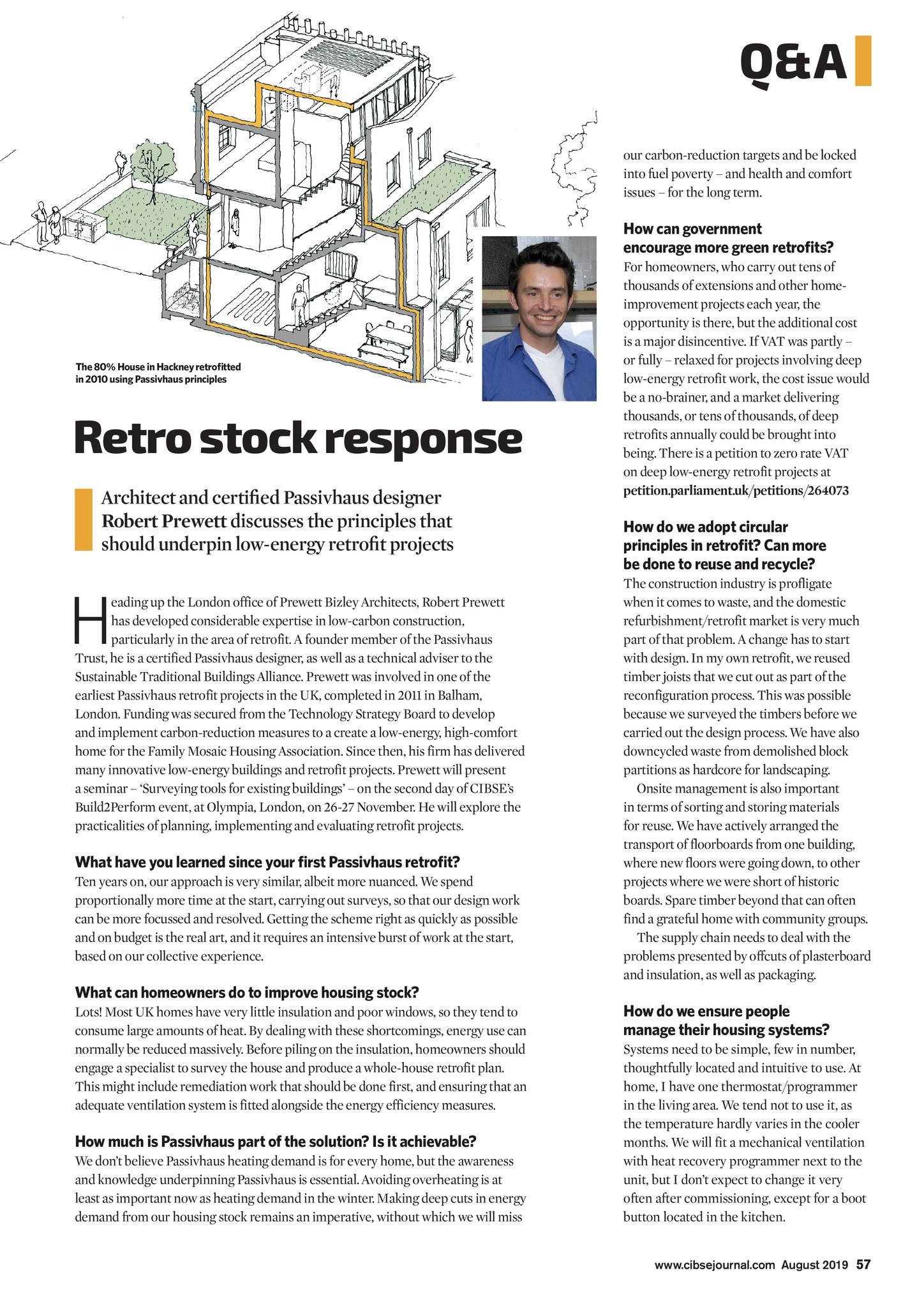
Q&A our carbon-reduction targets and be locked into fuel poverty and health and comfort issues for the long term. How can government encourage more green retrofits? The 80% House in Hackney retrofitted in 2010 using Passivhaus principles Retro stock response Architect and certified Passivhaus designer Robert Prewett discusses the principles that should underpinlow-energy retrofit projects H eading up the London office of Prewett Bizley Architects, Robert Prewett has developed considerable expertise in low-carbon construction, particularly in the area of retrofit. A founder member of the Passivhaus Trust, he is a certified Passivhaus designer, as well as a technical adviser to the Sustainable Traditional Buildings Alliance. Prewett was involved in one of the earliest Passivhaus retrofit projects in the UK, completed in 2011 in Balham, London. Funding was secured from the Technology Strategy Board to develop and implement carbon-reduction measures to a create a low-energy, high-comfort home for the Family Mosaic Housing Association. Since then, his firm has delivered many innovative low-energy buildings and retrofit projects. Prewett will present a seminar Surveying tools for existing buildings on the second day of CIBSEs Build2Perform event, at Olympia, London, on 26-27 November. He will explore the practicalities of planning, implementing and evaluating retrofit projects. What have you learned since your first Passivhaus retrofit? Ten years on, our approach is very similar, albeit more nuanced. We spend proportionally more time at the start, carrying out surveys, so that our design work can be more focussed and resolved. Getting the scheme right as quickly as possible and on budget is the real art, and it requires an intensive burst of work at the start, based on our collective experience. What can homeowners do to improve housing stock? Lots! Most UK homes have very little insulation and poor windows, so they tend to consume large amounts of heat. By dealing with these shortcomings, energy use can normally be reduced massively. Before piling on the insulation, homeowners should engage a specialist to survey the house and produce a whole-house retrofit plan. This might include remediation work that should be done first, and ensuring that an adequate ventilation system is fitted alongside the energy efficiency measures. How much is Passivhaus part of the solution? Is it achievable? We dont believe Passivhaus heating demand is for every home, but the awareness and knowledge underpinning Passivhaus is essential. Avoiding overheating is at least as important now as heating demand in the winter. Making deep cuts in energy demand from our housing stock remains an imperative, without which we will miss For homeowners, who carry out tens of thousands of extensions and other homeimprovement projects each year, the opportunity is there, but the additional cost is a major disincentive. If VAT was partly orfully relaxed for projects involving deep low-energy retrofit work, the cost issue would be a no-brainer, and a market delivering thousands, or tens of thousands, of deep retrofits annually could be brought into being. There is a petition to zero rate VAT on deep low-energy retrofit projects at petition.parliament.uk/petitions/264073 How do we adopt circular principles in retrofit? Can more be done to reuse and recycle? The construction industry is profligate when it comes to waste, and the domestic refurbishment/retrofit market is very much part of that problem. A change has to start with design. In my own retrofit, we reused timber joists that we cut out as part of the reconfiguration process. This was possible because we surveyed the timbers before we carried out the design process. We have also downcycled waste from demolished block partitions as hardcore for landscaping. Onsite management is also important in terms of sorting and storing materials for reuse. We have actively arranged the transport of floorboards from one building, where new floors were going down, to other projects where we were short of historic boards. Spare timber beyond that can often find a grateful home with community groups. The supply chain needs to deal with the problems presented by offcuts of plasterboard and insulation, as well as packaging. How do we ensure people manage their housing systems? Systems need to be simple, few in number, thoughtfully located and intuitive to use. At home, I have one thermostat/programmer in the living area. We tend not to use it, as the temperature hardly varies in the cooler months. We will fit a mechanical ventilation with heat recovery programmer next to the unit, but I dont expect to change it very often after commissioning, except for a boot button located in the kitchen. www.cibsejournal.com August 2019 57 CIBSE Aug19 pp57 Q&A.indd 57 19/07/2019 14:34