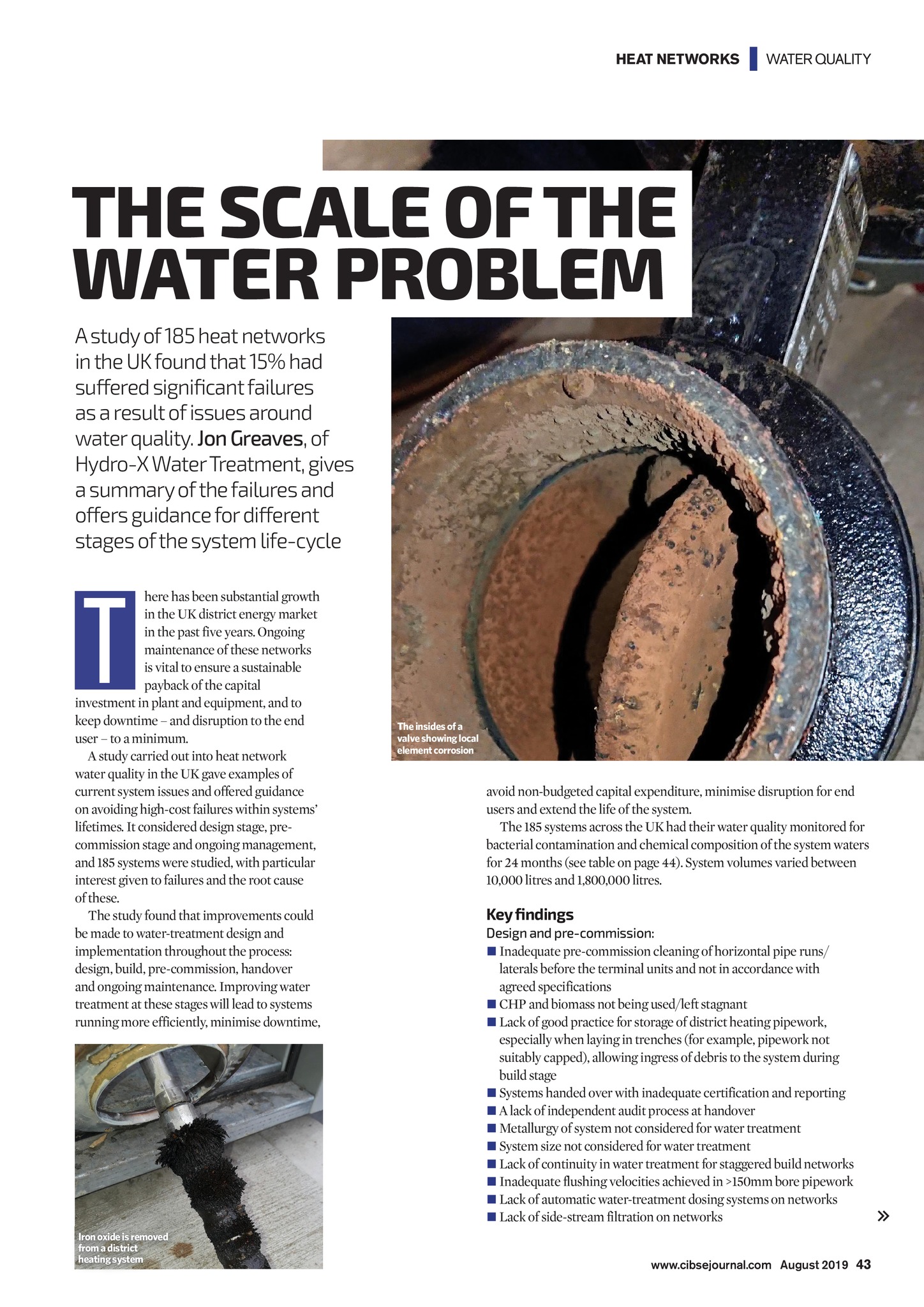
HEAT NETWORKS | WATER QUALITY THE SCALE OF THE WATER PROBLEM A study of 185 heat networks in the UK found that 15% had suffered significant failures as a result of issues around water quality. Jon Greaves, of Hydro-X Water Treatment, gives a summary of the failures and offers guidance for different stages of the system life-cycle T here has been substantial growth in the UK district energy market in the past five years. Ongoing maintenance of these networks is vital to ensure a sustainable payback of the capital investment in plant and equipment, and to keep downtime and disruption to the end user to a minimum. A study carried out into heat network water quality in the UK gave examples of current system issues and offered guidance on avoiding high-cost failures within systems lifetimes. It considered design stage, precommission stage and ongoing management, and 185 systems were studied, with particular interest given to failures and the root cause of these. The study found that improvements could be made to water-treatment design and implementation throughout the process: design, build, pre-commission, handover and ongoing maintenance. Improving water treatment at these stages will lead to systems running more efficiently, minimise downtime, Iron oxide is removed from a district heating system CIBSE Aug19 pp43-44 Water quality.indd 43 The insides of a valve showing local element corrosion avoid non-budgeted capital expenditure, minimise disruption for end users and extend the life of the system. The 185 systems across the UK had their water quality monitored for bacterial contamination and chemical composition of the system waters for 24 months (see table on page 44). System volumes varied between 10,000 litres and 1,800,000 litres. Key findings Design and pre-commission: n Inadequate pre-commission cleaning of horizontal pipe runs/ laterals before the terminal units and not in accordance with agreed specifications n CHP and biomass not being used/left stagnant n Lack of good practice for storage of district heating pipework, especially when laying in trenches (for example, pipework not suitably capped), allowing ingress of debris to the system during build stage n Systems handed over with inadequate certification and reporting n A lack of independent audit process at handover n Metallurgy of system not considered for water treatment n System size not considered for water treatment n Lack of continuity in water treatment for staggered build networks n Inadequate flushing velocities achieved in >150mm bore pipework n Lack of automatic water-treatment dosing systems on networks n Lack of side-stream filtration on networks www.cibsejournal.com August 2019 43 19/07/2019 14:38