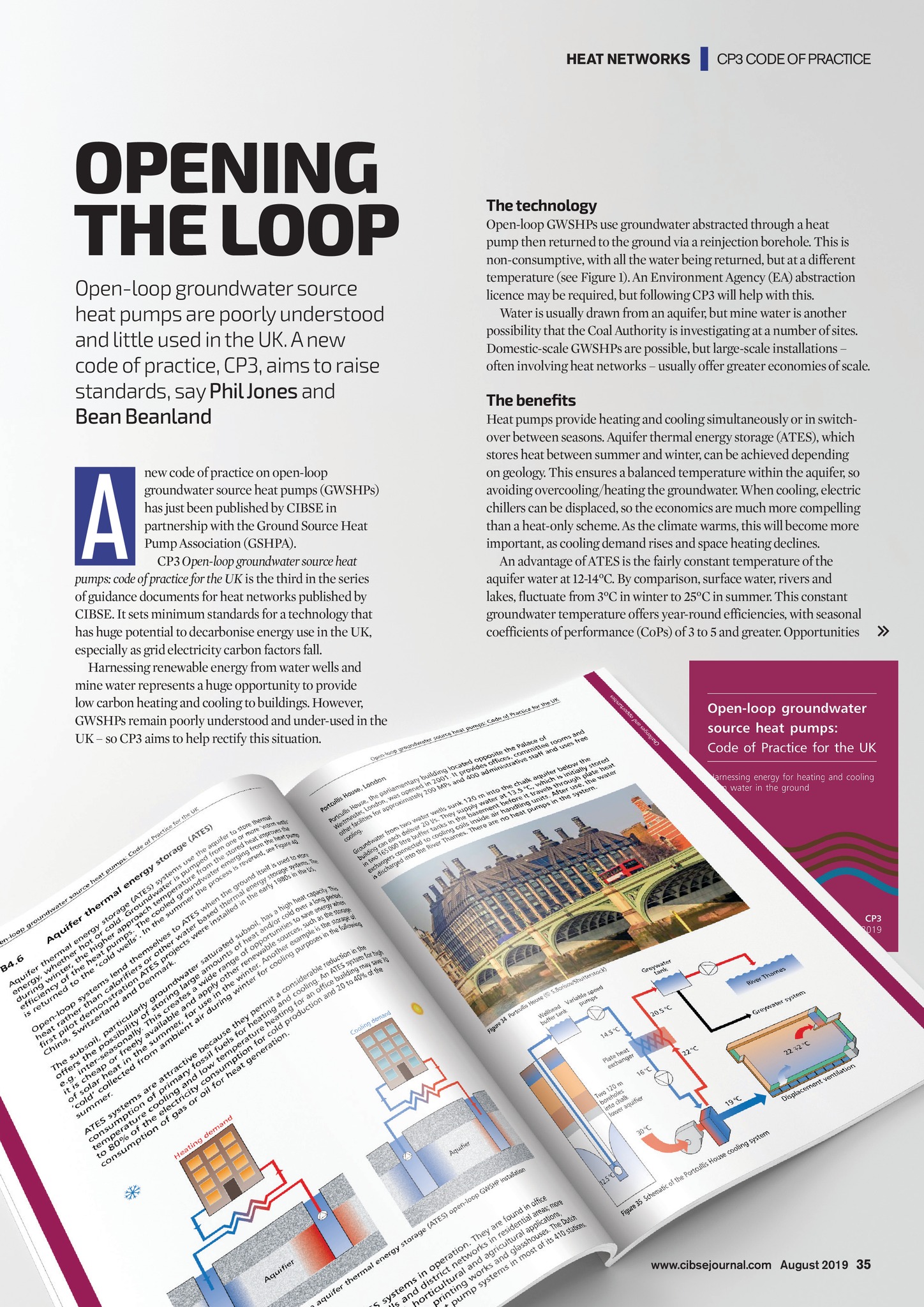

HEAT NETWORKS OPENING THE LOOP Open-loop groundwater source heat pumps are poorly understood and little used in the UK. A new code of practice, CP3, aims to raise standards, say Phil Jones and Bean Beanland A new code of practice on open-loop groundwater source heat pumps (GWSHPs) has just been published by CIBSE in partnership with the Ground Source Heat Pump Association (GSHPA). CP3 Open-loop groundwater source heat pumps: code of practice for the UK is the third in the series of guidance documents for heat networks published by CIBSE. It sets minimum standards for a technology that has huge potential to decarbonise energy use in the UK, especially as grid electricity carbon factors fall. Harnessing renewable energy from water wells and mine water represents a huge opportunity to provide low carbon heating and cooling to buildings. However, GWSHPs remain poorly understood and under-used in the UK so CP3 aims to help rectify this situation. | CP3 CODE OF PRACTICE The technology Open-loop GWSHPs use groundwater abstracted through a heat pump then returned to the ground via a reinjection borehole. This is non-consumptive, with all the water being returned, but at a different temperature (see Figure 1). An Environment Agency (EA) abstraction licence may be required, but following CP3 will help with this. Water is usually drawn from an aquifer, but mine water is another possibility that the Coal Authority is investigating at a number of sites. Domestic-scale GWSHPs are possible, but large-scale installations often involving heat networks usually offer greater economies of scale. The benefits Heat pumps provide heating and cooling simultaneously or in switchover between seasons. Aquifer thermal energy storage (ATES), which stores heat between summer and winter, can be achieved depending on geology. This ensures a balanced temperature within the aquifer, so avoiding overcooling/heating the groundwater. When cooling, electric chillers can be displaced, so the economics are much more compelling than a heat-only scheme. As the climate warms, this will become more important, as cooling demand rises and space heating declines. An advantage of ATES is the fairly constant temperature of the aquifer water at 12-14C. By comparison, surface water, rivers and lakes, fluctuate from 3C in winter to 25C in summer. This constant groundwater temperature offers year-round efficiencies, with seasonal coefficients of performance (CoPs) of 3 to 5 and greater. Opportunities www.cibsejournal.com August 2019 35 CIBSE Aug19 pp35-36 CP3 Code.indd 35 19/07/2019 13:26