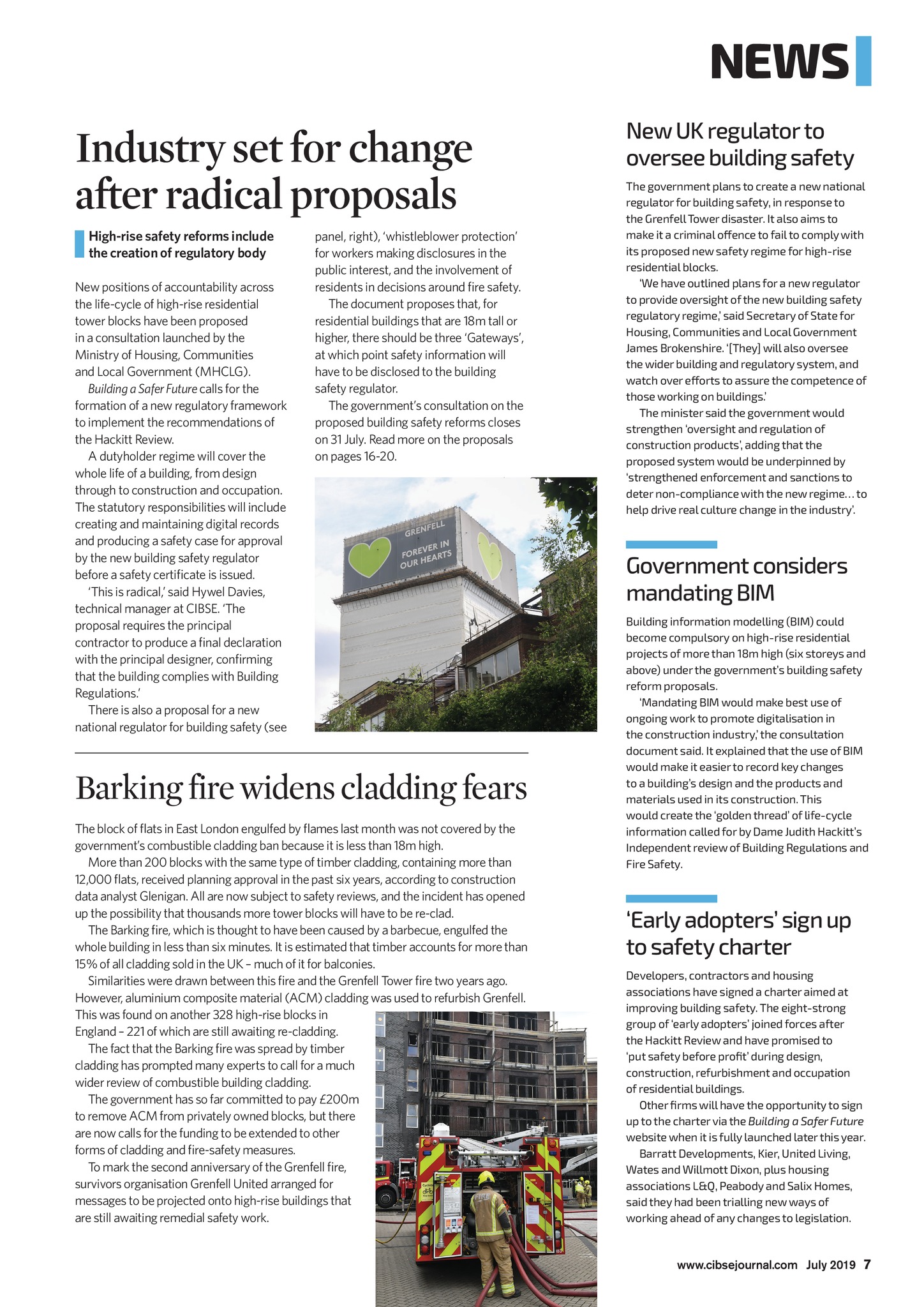

EWS Industry set for change after radical proposals High-rise safety reforms include the creation of regulatory body New positions of accountability across the life-cycle of high-rise residential tower blocks have been proposed in aconsultation launched by the Ministryof Housing, Communities and Local Government (MHCLG). Building a Safer Future calls for the formation of a new regulatory framework to implement the recommendations of the Hackitt Review. A dutyholder regime will cover the whole life of a building, from design through to construction and occupation. The statutory responsibilities will include creating and maintaining digital records and producing a safety case for approval by the new building safety regulator before a safety certificate is issued. This is radical, said Hywel Davies, technical manager at CIBSE. The proposal requires the principal contractorto produce a final declaration with the principal designer, confirming that the building complies with Building Regulations. There is also a proposal for a new national regulator for building safety (see panel, right), whistleblower protection for workers making disclosures in the public interest, and the involvement of residents in decisions around fire safety. The document proposes that, for residential buildings that are 18m tall or higher, there should be three Gateways, at which point safety information will have to be disclosed to the building safety regulator. The governments consultation on the proposed building safety reforms closes on 31 July. Read more on the proposals on pages 16-20. Barking fire widens cladding fears The block of flats in East London engulfed by flames last month was not covered by the governments combustible cladding ban because it is less than 18m high. More than 200 blocks with the same type of timber cladding, containing more than 12,000 flats, received planning approval in the past six years, according to construction data analyst Glenigan. All are now subject to safety reviews, and the incident has opened up the possibility that thousands more tower blocks will have to be re-clad. The Barking fire, which is thought to have been caused by a barbecue, engulfed the whole building in less than six minutes. It is estimated that timber accounts for more than 15% of all cladding sold in the UK much of it for balconies. Similarities were drawn between this fire and the Grenfell Tower fire two years ago. However, aluminium composite material (ACM) cladding was used to refurbish Grenfell. This was found on another 328 high-rise blocks in England 221 of which are still awaiting re-cladding. The fact that the Barking fire was spread by timber cladding has prompted many experts to call for a much wider review of combustible building cladding. The government has so far committed to pay 200m to remove ACM from privately owned blocks, but there are now calls for the funding to be extended to other forms of cladding and fire-safety measures. To mark the second anniversary of the Grenfell fire, survivors organisation Grenfell United arranged for messages to be projected onto high-rise buildings that are still awaiting remedial safety work. New UK regulator to oversee building safety The government plans to create a new national regulator for building safety, in response to the Grenfell Tower disaster. It also aims to make it a criminal offence to fail to comply with its proposed new safety regime for high-rise residential blocks. We have outlined plans for a new regulator to provide oversight of the new building safety regulatory regime, said Secretary of State for Housing, Communities and Local Government James Brokenshire. [They] will also oversee the wider building and regulatory system, and watch over efforts to assure the competence of those working on buildings. The minister said the government would strengthen oversight and regulation of construction products, adding that the proposed system would be underpinned by strengthened enforcement and sanctions to deter non-compliance with the new regime to help drive real culture change in the industry. Government considers mandating BIM Building information modelling (BIM) could become compulsory on high-rise residential projects of more than 18m high (six storeys and above) under the governments building safety reform proposals. Mandating BIM would make best use of ongoing work to promote digitalisation in the construction industry, the consultation document said. It explained that the use of BIM would make it easier to record key changes to a buildings design and the products and materials used in its construction. This would create the golden thread of life-cycle information called for by Dame Judith Hackitts Independent review of Building Regulations and Fire Safety. Early adopters sign up to safety charter Developers, contractors and housing associations have signed a charter aimed at improving building safety. The eight-strong group of early adopters joined forces after theHackitt Review and have promised to putsafety before profit during design, construction, refurbishment and occupation of residential buildings. Other firms will have the opportunity to sign up to the charter via the Building a Safer Future website when it is fully launched later this year. Barratt Developments, Kier, United Living, Wates and Willmott Dixon, plus housing associations L&Q, Peabody and Salix Homes, said they had been trialling new ways of working ahead of any changes to legislation. www.cibsejournal.com July 2019 7 CIBSE July19 pp07 News.indd 7 21/06/2019 15:28