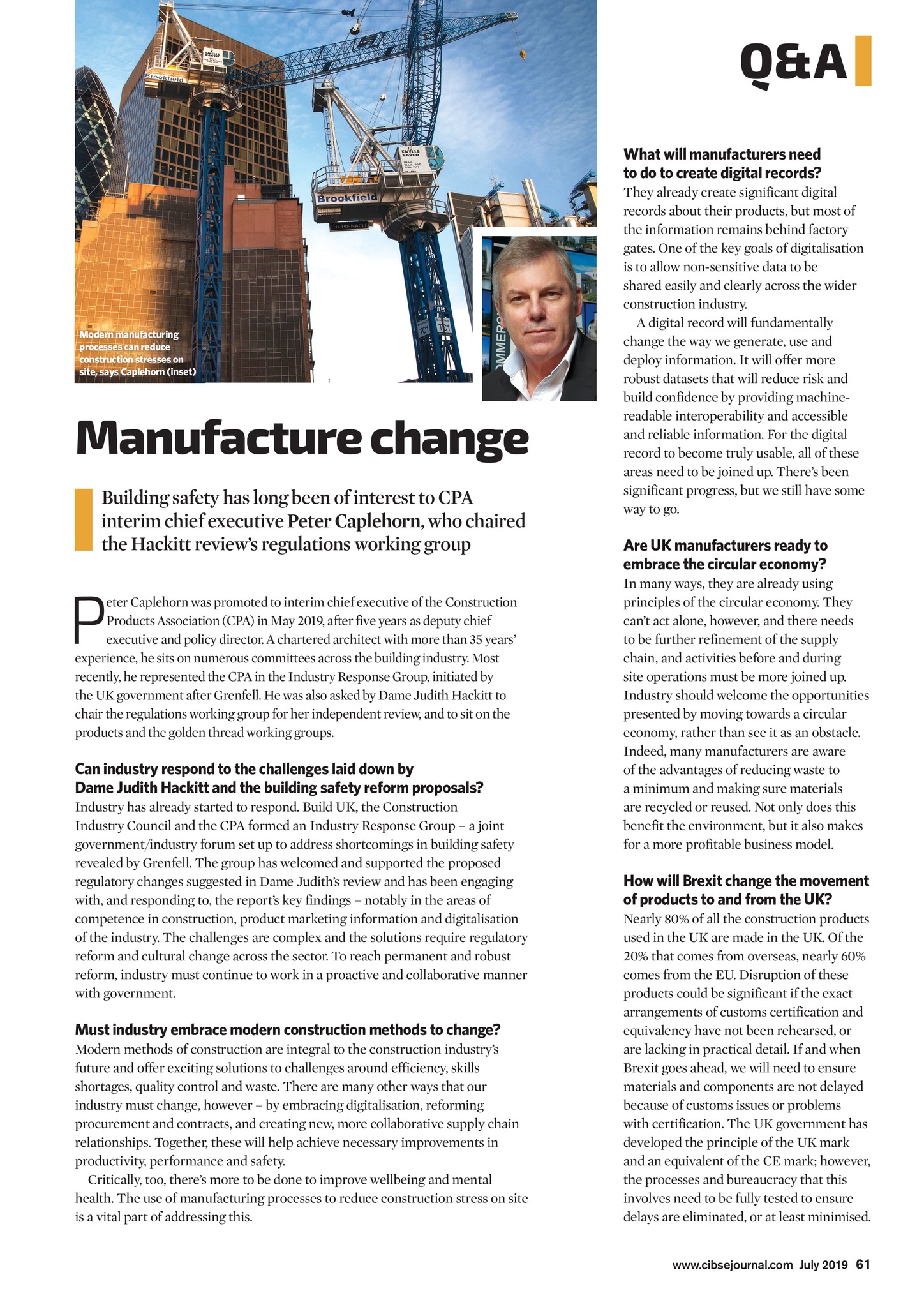
Q&A What will manufacturers need to do to create digital records? Modern manufacturing processes can reduce construction stresses on site, says Caplehorn (inset) Manufacture change Building safety has long been of interest to CPA interim chief executive Peter Caplehorn, who chaired the Hackitt reviews regulations working group P eter Caplehorn was promoted to interim chief executive of the Construction Products Association (CPA) in May 2019, after five years as deputy chief executive and policy director. A chartered architect with more than 35 years experience, he sits on numerous committees across the building industry. Most recently, he represented the CPA in the Industry Response Group, initiated by the UK government after Grenfell. He was also asked by Dame Judith Hackitt to chair the regulations working group for her independent review, and to sit on the products and the golden thread working groups. Can industry respond to the challenges laid down by Dame Judith Hackitt and the building safety reform proposals? Industry has already started to respond. Build UK, the Construction Industry Council and the CPA formed an Industry Response Group a joint government/industry forum set up to address shortcomings in building safety revealed by Grenfell. The group has welcomed and supported the proposed regulatory changes suggested in Dame Judiths review and has been engaging with, and responding to, the reports key findings notably in the areas of competence in construction, product marketing information and digitalisation of the industry. The challenges are complex and the solutions require regulatory reform and cultural change across the sector. To reach permanent and robust reform, industry must continue to work in a proactive and collaborative manner with government. Must industry embrace modern construction methods to change? Modern methods of construction are integral to the construction industrys future and offer exciting solutions to challenges around efficiency, skills shortages, quality control and waste. There are many other ways that our industry must change, however by embracing digitalisation, reforming procurement and contracts, and creating new, more collaborative supply chain relationships. Together, these will help achieve necessary improvements in productivity, performance and safety. Critically, too, theres more to be done to improve wellbeing and mental health. The use of manufacturing processes to reduce construction stress on site is a vital part of addressing this. They already create significant digital records about their products, but most of the information remains behind factory gates. One of the key goals of digitalisation is to allow non-sensitive data to be shared easily and clearly across the wider construction industry. A digital record will fundamentally change the way we generate, use and deploy information. It will offer more robust datasets that will reduce risk and build confidence by providing machinereadable interoperability and accessible and reliable information. For the digital record to become truly usable, all of these areas need to be joined up. Theres been significant progress, but we still have some way to go. Are UK manufacturers ready to embrace the circular economy? In many ways, they are already using principles of the circular economy. They cant act alone, however, and there needs to be further refinement of the supply chain, and activities before and during site operations must be more joined up. Industry should welcome the opportunities presented by moving towards a circular economy, rather than see it as an obstacle. Indeed, many manufacturers are aware of the advantages of reducing waste to a minimum and making sure materials are recycled or reused. Not only does this benefit the environment, but it also makes for a more profitable business model. How will Brexit change the movement of products to and from the UK? Nearly 80% of all the construction products used in the UK are made in the UK. Of the 20% that comes from overseas, nearly 60% comes from the EU. Disruption of these products could be significant if the exact arrangements of customs certification and equivalency have not been rehearsed, or are lacking in practical detail. If and when Brexit goes ahead, we will need to ensure materials and components are not delayed because of customs issues or problems with certification. The UK government has developed the principle of the UK mark and an equivalent of the CE mark; however, the processes and bureaucracy that this involves need to be fully tested to ensure delays are eliminated, or at least minimised. www.cibsejournal.com July 2019 61 CIBSE July19 pp61 Q&A.indd 61 21/06/2019 17:21