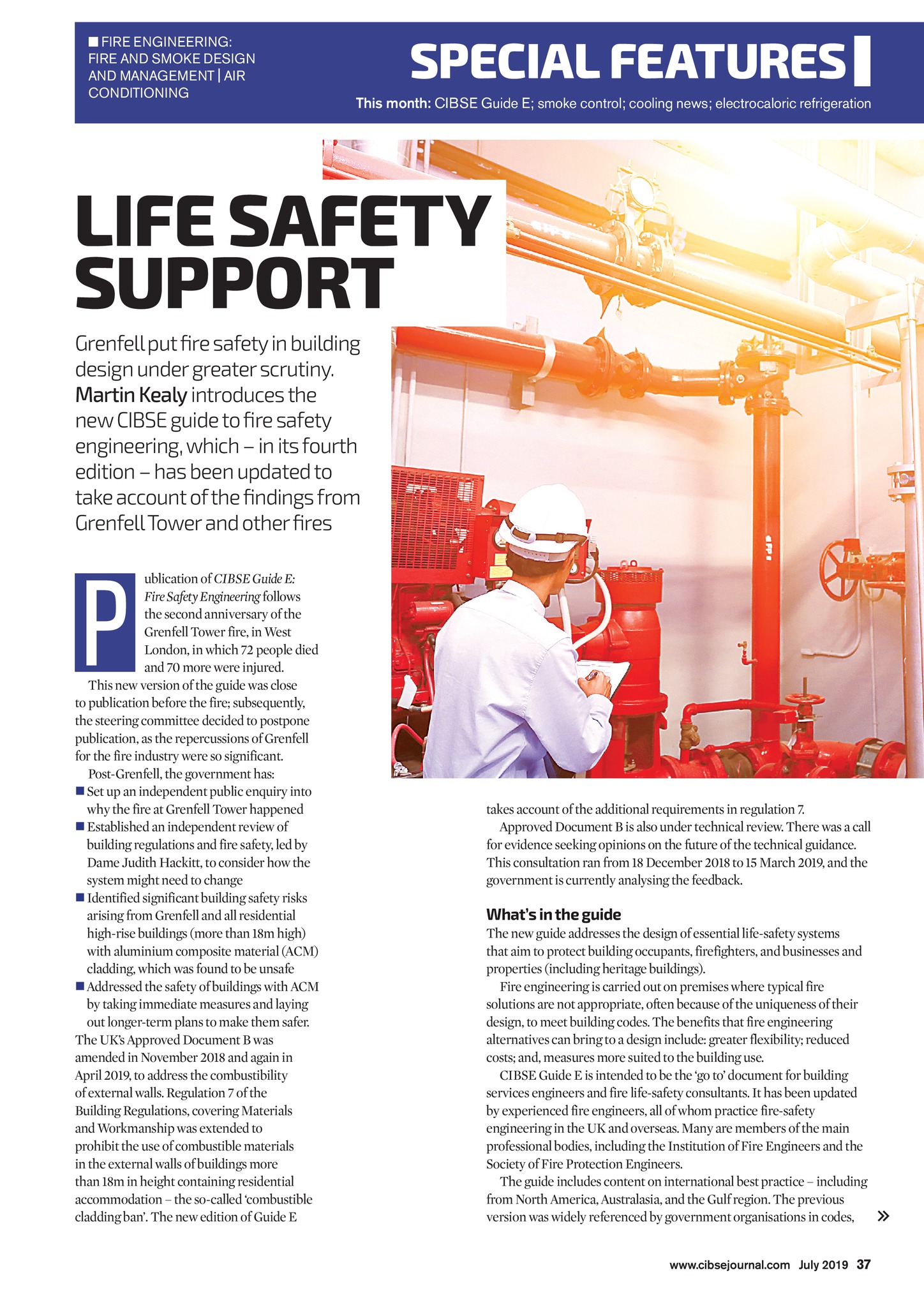
FIRE ENGINEERING: FIRE AND SMOKE DESIGN AND MANAGEMENT | AIR CONDITIONING SPECIAL FEATURES This month: CIBSE Guide E; smoke control; cooling news; electrocaloric refrigeration LIFE SAFETY SUPPORT Grenfell put fire safety in building design under greater scrutiny. Martin Kealy introduces the new CIBSE guide to fire safety engineering, which in its fourth edition has been updated to take account of the findings from Grenfell Tower and other fires P ublication of CIBSE Guide E: Fire Safety Engineering follows the second anniversary of the Grenfell Tower fire, in West London, in which 72 people died and 70 more were injured. This new version of the guide was close to publication before the fire; subsequently, the steering committee decided to postpone publication, as the repercussions of Grenfell for the fire industry were so significant. Post-Grenfell, the government has: n Set up an independent public enquiry into why the fire at Grenfell Tower happened n Established an independent review of building regulations and fire safety, led by Dame Judith Hackitt, to consider how the system might need to change n Identified significant building safety risks arising from Grenfell and all residential high-rise buildings (more than 18m high) with aluminium composite material (ACM) cladding, which was found to be unsafe n Addressed the safety of buildings with ACM by taking immediate measures and laying out longer-term plans to make them safer. The UKs Approved Document B was amended in November 2018 and again in April 2019, to address the combustibility of external walls. Regulation 7 of the Building Regulations, covering Materials and Workmanship was extended to prohibit the use of combustible materials in the external walls of buildings more than 18m in height containing residential accommodation the so-called combustible cladding ban. The new edition of Guide E takesaccountoftheadditional requirements in regulation 7. Approved Document B is also under technical review. There was a call for evidence seeking opinions on the future of the technical guidance. This consultation ran from 18 December 2018 to 15March 2019, and the government is currently analysing the feedback. Whats in the guide The new guide addresses the design of essential life-safety systems that aim to protect building occupants, firefighters, and businesses and properties (including heritage buildings). Fire engineering is carried out on premises where typical fire solutions are not appropriate, often because of the uniqueness of their design, to meet building codes. The benefits that fire engineering alternatives can bring to a design include: greater flexibility; reduced costs; and, measures more suited to the building use. CIBSE Guide E is intended to be the go to document for building services engineers and fire life-safety consultants. It has been updated by experienced fire engineers, all of whom practice fire-safety engineering in the UK and overseas. Many are members of the main professional bodies, including the Institution of Fire Engineers and the Society of Fire Protection Engineers. The guide includes content on international best practice including from North America, Australasia, and the Gulf region. The previous version was widely referenced by government organisations in codes, www.cibsejournal.com July 2019 37 CIBSE July19 pp37-38 Guide E summary.indd 37 21/06/2019 17:19