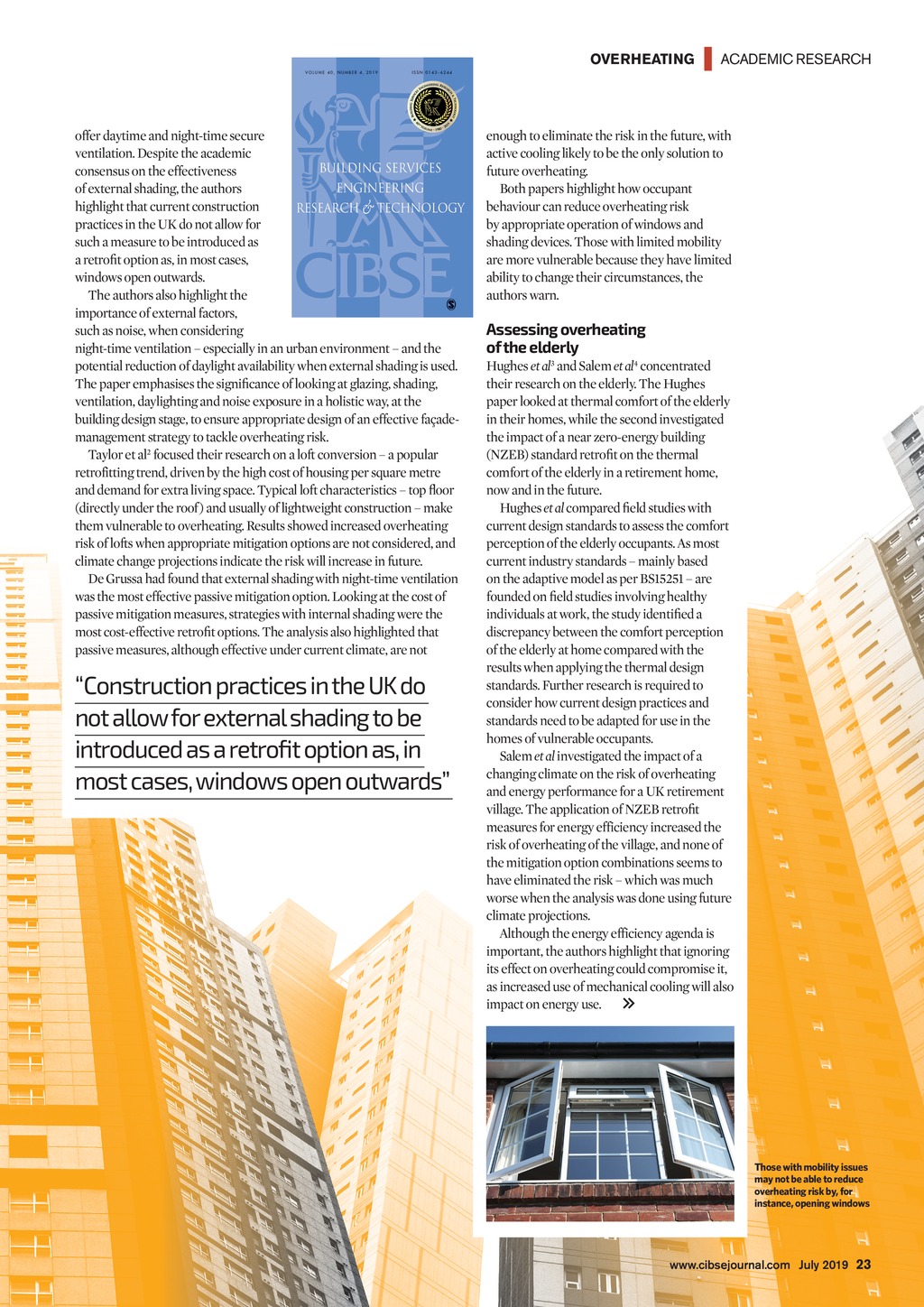

OVERHEATING | ACADEMIC RESEARCH HOT OFF THE PRESS The latest research on assessing and mitigating overheating in buildings is the focus of a Building Services and Engineering Research and Technology Journal special edition. CIBSES Anastasia Mylona looks at the key findings O All of these papers may be accessed in the July 2019 issue of BSER&T bit.ly/CJJul19bsjuly CIBSE members can access BSER&T for free at any time bit.ly/CJJul19BSERT ver the past 40 years, BSER&T has been reporting the latest on indoor environmental quality in buildings and, more specifically, on the thermal comfort of occupants. Research in this area has evolved greatly in recent years. In particular, the assessment of thermal comfort has moved from rules of thumb to a deterministic approach for example, a standard temperature threshold to a more dynamic approach, such as the adaptive comfort method. Designers can now assess thermal comfort for future climate projections, as well as for observed weather events. Although our understanding of occupant comfort and health has increased greatly, climate change and the resulting higher temperatures mean we are having to evolve designs continuously, to ensure buildings dont overheat. The effects of global warming are being exacerbated by the policy requirement for higher levels of insulation and airtightness, and the urban heat island (UHI) effect. In normally temperate climates, homes typically rely on passive design measures to tackle hot-weather events, rather than the mechanical means of ventilation and cooling employed in commercial buildings. Furthermore, occupancy in the domestic sector is much more unpredictable than in the non-domestic sector, with families using their homes in a variety of ways. These factors make homes more prone to overheating, and their design presents a greater challenge to professionals to make them resilient to hot-weather events. It is the most vulnerable occupants the elderly, the young and those with pre-existing health problems who will suffer most as a result of higher internal temperatures. They are more likely to be confined to their homes and less able to make their environment more comfortable. Mitigation options for domestic retrofit Previous research has established that shading and ventilation can reduce the risk of overheating in homes considerably. This is reiterated by De Grussa et al,1 who monitored a real-life retrofitted apartment building in London to investigate the effectiveness of passive measures in mitigating high indoor temperatures. The measures tested included different internal and external shading options combined with a night-time natural ventilation strategy. Results showed that external shading offers the most effective option in reducing solar gains and, therefore, overheating risk. Furthermore, external shading such as shutters can 22 July 2019 www.cibsejournal.com CIBSE July19 pp22-24 BSERT overheating.indd 22 21/06/2019 14:45