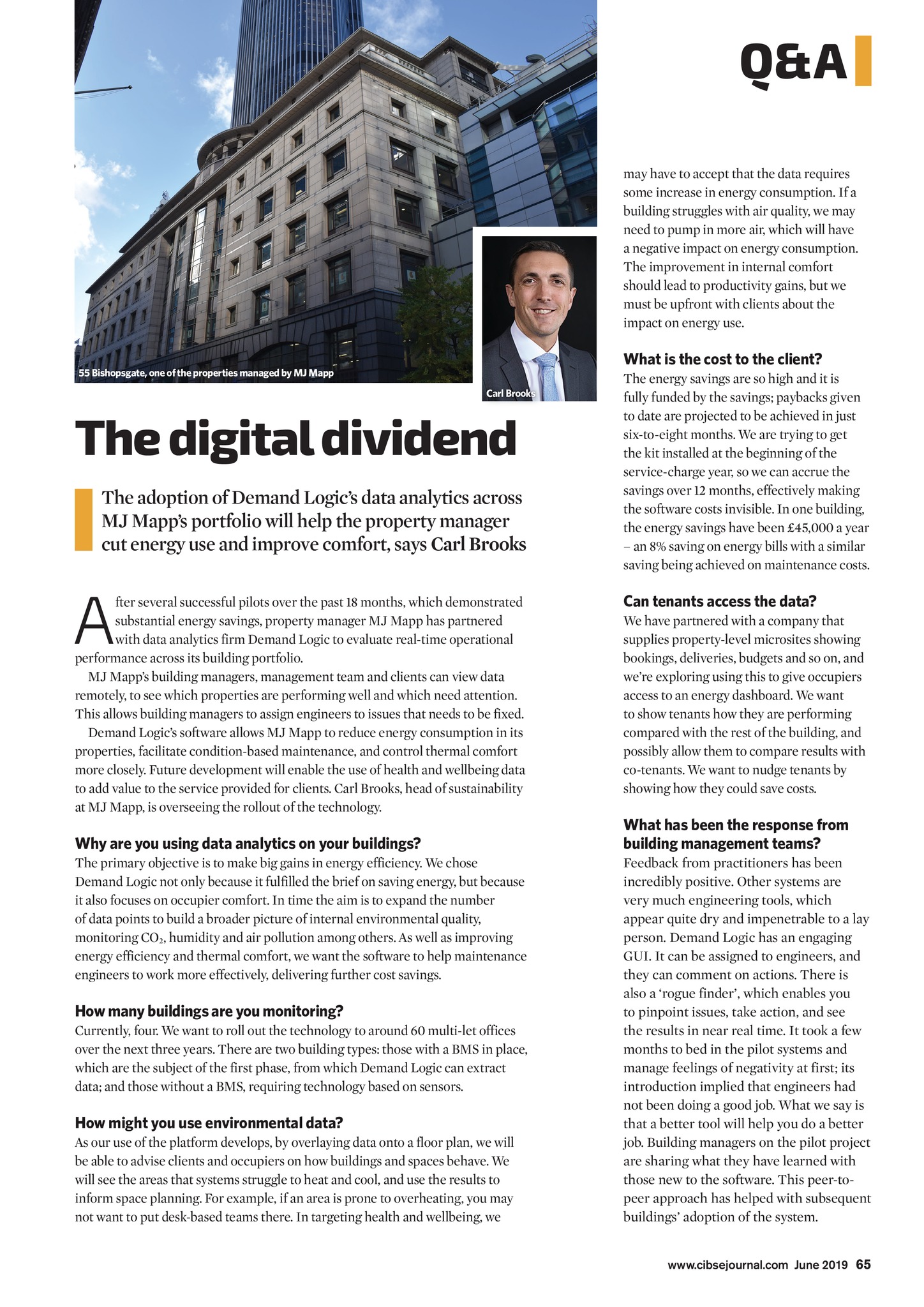
Q&A may have to accept that the data requires some increase in energy consumption. If a building struggles with air quality, we may need to pump in more air, which will have a negative impact on energy consumption. The improvement in internal comfort should lead to productivity gains, but we must be upfront with clients about the impact on energy use. What is the cost to the client? 55 Bishopsgate, one of the properties managed by MJ Mapp Carl Brooks The digital dividend The adoption of Demand Logics data analytics across MJ Mapps portfolio will help the property manager cut energy use and improve comfort, says Carl Brooks A fter several successful pilots over the past 18 months, which demonstrated substantial energy savings, property manager MJ Mapp has partnered with data analytics firm Demand Logic to evaluate real-time operational performance across its building portfolio. MJ Mapps building managers, management team and clients can view data remotely, to see which properties are performing well and which need attention. This allows building managers to assign engineers to issues that needs to be fixed. Demand Logics software allows MJ Mapp to reduce energy consumption in its properties, facilitate condition-based maintenance, and control thermal comfort more closely. Future development will enable the use of health and wellbeing data to add value to the service provided for clients. Carl Brooks, head of sustainability at MJ Mapp, is overseeing the rollout of the technology. Why are you using data analytics on your buildings? The primary objective is to make big gains in energy efficiency. We chose Demand Logic not only because it fulfilled the brief on saving energy, but because it also focuses on occupier comfort. In time the aim is to expand the number of data points to build a broader picture of internal environmental quality, monitoring CO2, humidity and air pollution among others. As well as improving energy efficiency and thermal comfort, we want the software to help maintenance engineers to work more effectively, delivering further cost savings. How many buildings are you monitoring? Currently, four. We want to roll out the technology to around 60 multi-let offices over the next three years. There are two building types: those with a BMS in place, which are the subject of the first phase, from which Demand Logic can extract data; and those without a BMS, requiring technology based on sensors. How might you use environmental data? As our use of the platform develops, by overlaying data onto a floor plan, we will be able to advise clients and occupiers on how buildings and spaces behave. We will see the areas that systems struggle to heat and cool, and use the results to inform space planning. For example, if an area is prone to overheating, you may not want to put desk-based teams there. In targeting health and wellbeing, we The energy savings are so high and it is fully funded by the savings; paybacks given to date are projected to be achieved in just six-to-eight months. We are trying to get the kit installed at the beginning of the service-charge year, so we can accrue the savings over 12 months, effectively making the software costs invisible. In one building, the energy savings have been 45,000 a year an 8% saving on energy bills with a similar saving being achieved on maintenance costs. Can tenants access the data? We have partnered with a company that supplies property-level microsites showing bookings, deliveries, budgets and so on, and were exploring using this to give occupiers access to an energy dashboard. We want to show tenants how they are performing compared with the rest of the building, and possibly allow them to compare results with co-tenants. We want to nudge tenants by showing how they could save costs. What has been the response from building management teams? Feedback from practitioners has been incredibly positive. Other systems are very much engineering tools, which appear quite dry and impenetrable to a lay person. Demand Logic has an engaging GUI. It can be assigned to engineers, and they can comment on actions. There is also a rogue finder, which enables you to pinpoint issues, take action, and see the results in near real time. It took a few months to bed in the pilot systems and manage feelings of negativity at first; its introduction implied that engineers had not been doing a good job. What we say is that a better tool will help you do a better job. Building managers on the pilot project are sharing what they have learned with those new to the software. This peer-topeer approach has helped with subsequent buildings adoption of the system. www.cibsejournal.com June 2019 65 CIBSE Jun19 pp65 Q&A 3.indd 65 24/05/2019 16:31