
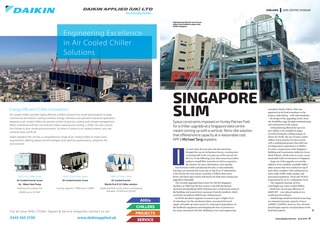
CHILLERS | DATA CENTRE UPGRADE Initial planning allows for up to six new chillers to be installed in stages at the DCSG in Singapore SINGAPORE SLIM Space constraints imposed on Hurley Palmer Flatt fora chiller upgrade at a Singapore data centre meantcoming up with a vertical, Tetris-like solution that offered extra capacity at a reasonable cost. HPFs Michael Tang explains I t is more than 20 years since the dot.com boom changed the way we do business forever, creating nearvertical growth in the everyday use of the internet for all of us. In the following years, data network providers rushed to install fibre networks in a bid to respond to the clamour for more information, more quickly. Fast forward to 2019, and data has become a vital commodity that plays an essential role in our day-to-day lives. If information is thefuel for the 21st-century economy, it follows that newer, betterandfaster data centres will need to be built and existing ones upgraded continually. The recently upgraded Data Centre SG (DCSG) Singapore Facilities, at 7000 Ang Mo Kio Avenue 5, has full mechanical, electrical and plumbing (MEP) infrastructure. It had tenant status in the building, and wanted more autonomy from the landlord, which owned the incumbent chilled water infrastructure. So DCSG decided to upgrade its system to give a higher level of redundancy for the mechanical plant, associated electrical supply and make-up water system, by reducing its dependence on the landlords equipment and mitigating the loss of control over key issues associated with this. Building services and engineering consultant Hurley Palmer Flatt was appointed as the lead consultant on the project, undertaking with subconsultants the design of the upgrading works, from site-feasibility stage through commissioning and construction ofthe system. Initial planning allowed for up to six new chillers to be installed in stages. As well as being the cooling strategy of choice for DCSG, the use of water-cooled chillers is best practice for data centres with a cooling load greater than 500 tons of refrigeration (equivalent to 1.76MW). It is also a requirement of the Singapore Building and Construction Authority Green Mark Scheme, which seeks to create a more sustainable built environment in Singapore. Stage one of the upgrade covered the addition of two modular, stackable chillerplant systems that were stacked on top of each other, complete with cooling towers, water tanks, buffer tanks, pumps, and associated equipment. These met DCSGs requirement for an N+1 redundancy level. The magnetic-bearing, oil-free, centrifugal-type water-cooled chillers which have an average efficiency of 0.6kW/RT were placed outdoors in a weatherproof enclosure. Initial design detail was based on meeting an estimated end-state capacity of up to 4,500RT (15.8MW). However, the end-state detail design capacity was dependent on the final load analysis. www.cibsejournal.com June 2019 47 CIBSE Jun19 pp47-48 DCSG chiller.indd 47 24/05/2019 16:24