
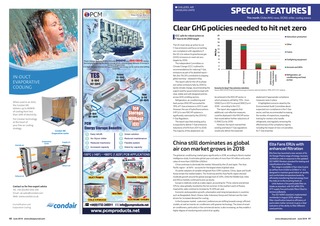
CHILLERS, AIR HANDLINGUNITS SPECIAL FEATURES This month: Chiller/AHU news; DCSG chiller; cooling towers Clear GHG policies needed to hit net zero CCC calls for robust action on F-Gas to hit 2050 target The UK must ramp up action to cut F-Gasemissions and focus on tackling non-compliance with regulations if the UK is to reduce its greenhouse gas (GHG)emissions to meet net zero targets by 2050. The independent Committee on Climate Change (CCC) outlined its recommendations for reducing F-Gas emissions as part of its detailed report Net Zero The UKs contribution to stopping global warming released in May. The report calls for the UK to phase out carbon emissions fully by 2050 to tackle climate change, recommending the urgent need for government to lead with clear, stable and well-designed policies across GHG-emitting sectors. Refrigeration, air conditioning and heat pumps (RACHP) accounted for 78% of F-Gas emissions in 2017, it said. However,the use of hydrofluorocarbons (HFCs) in new RACHP systems is significantly restricted by the 2014 EU F-Gas Regulation. The report says that existing policy is expected to deliver F-Gas emissions reductions of 65% from 2017 to 2030. The majority of this abatement can Scenarios for deep F-Gas emissions reductions Source: BEIS (2019) Final UK greenhouse gas emissions national statistics: 1990-2017, CCC analysis be achieved in the RACHP sector, in which emissions will fall by 75% from 12MtCO2e in 2017 to around 3MtCO2e in 2030 according to the CCC. The report also suggests that additional, cost-effective measures couldbe deployed in the RACHP sector that would deliver further reductions of 0.2MtCO2e by 2030. However, the report warned that existing and future F-Gas regulations would only deliver the expected China still dominates as global air con market grows in 2018 The global air conditioning market grew significantly in 2018, according to Bsrias market intelligence study. It estimates global year-end sales of more than 141 million units and a value of more than US$103bn (82bn). China continues to dominate the market, followed by the US and Japan. The Asia Pacific region at 56% accounts for the largest share of global value. As earlier adopters of variable refrigerant flow (VRF) systems, China, Japan and South Korea remain the market leaders. The Americas and the Asia Pacific region showed moderate growth around the global average level of 3.8%, while the Middle East, India and Africa markets continued to pick up slowly. Europe is relatively small as a sales region, accounting for 7% by volume and almost 12% by value globally, boosted by the hot summer. In the southern parts of Russia, meanwhile, sales continue to increase by 15-20% per year. Economic and population growth, urbanisation and rising temperatures in countries such as Bangladesh, Brazil, Ghana, India, Indonesia, Kenya and Vietnam are the main drivers for increased demand for cooling. In the European market, customers preferences are shifting towards energy-efficient models, as well as inverter air conditioners with greener technology. The share of smart air conditioners, particularly in the commercial sector, is also increasing, as they enable a higher degree of monitoring and control of air quality. abatement if appropriate compliance measures were in place. It highlighted concerns raised by the Environmental Audit Committee about suspected non-compliance in the F-Gas sector, and has recommended increasing the number of inspections, expanding training for workers who handle refrigerants, and regularly reviewing the effectiveness of the compliance regime, including the impact of new civil penalties for F-Gas breaches. Elta Fans ERUs with enhanced filtration Elta Fans has launched a new version of its Air Design Prema range of energy-recovery ventilation units in response to the updated ISO16890 filtration standard for testing and classification of air filters. The range is available in four sizes to give an airflow from 0.006 to 0.936m3.s-1. It is designed to maintain good indoor air quality and comfortable temperature levels by efficiently transferring thermal energy from the stale air to the incoming fresh air. Units feature a fine particulate filter on intake as standard, with ISO ePM1 55% (F7) supply fine particulate filters fitted to remove pollutants. The ISO 16890 standard, implemented worldwide in August 2018, redefines filter classification based on efficiency of particulate matter removal, to give a clear indication of the ability to filter differentsized particles. www.cibsejournal.com June 2019 41 CIBSE Jun19 pp41-43 Air Con News AS.indd 41 24/05/2019 18:52