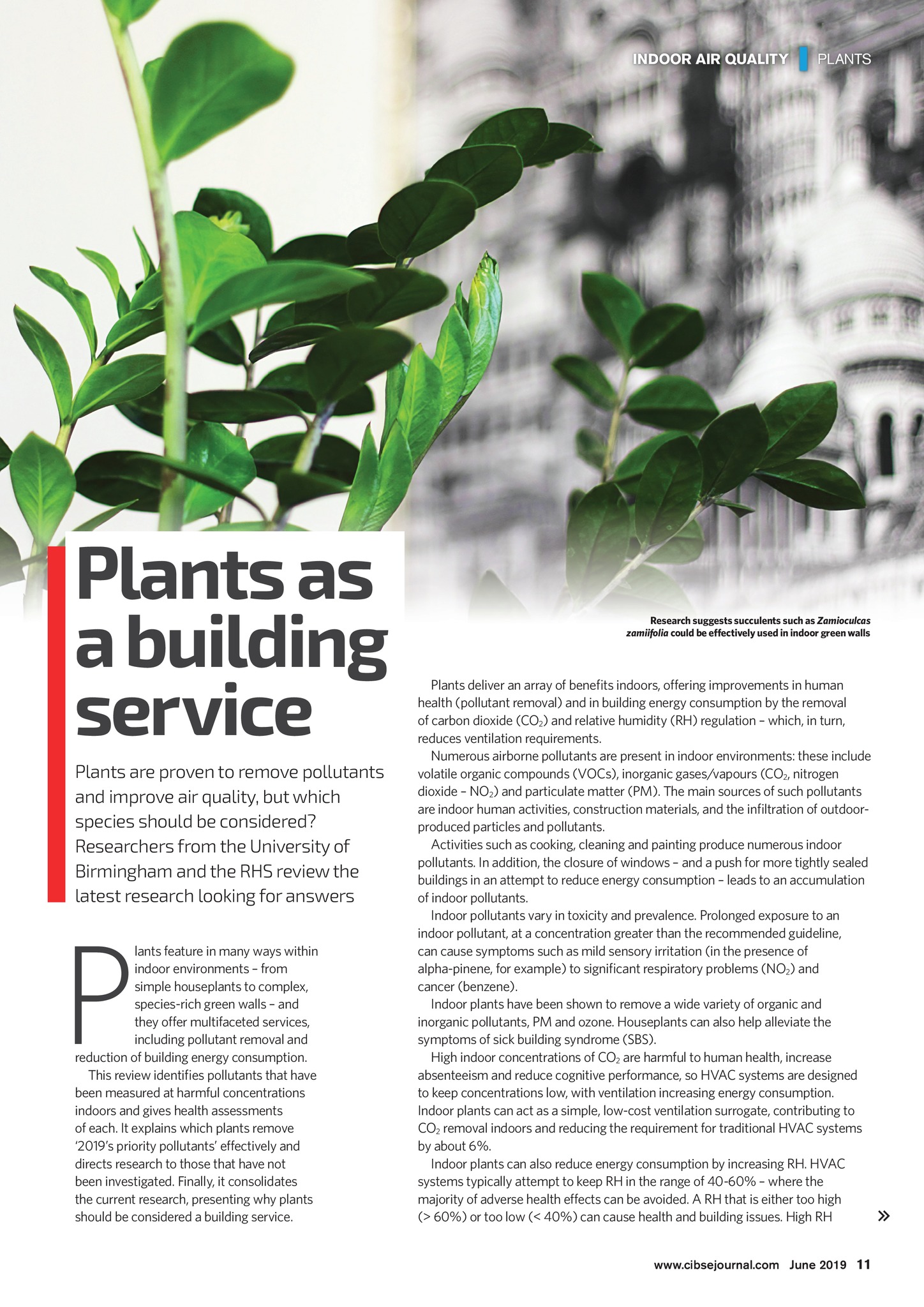
INDOOR AIR QUALITY Plants as a building service Plants are proven to remove pollutants and improve air quality, but which species should be considered? Researchers from the University of Birmingham and the RHS review the latest research looking for answers P lants feature in many ways within indoor environments from simple houseplants to complex, species-rich green walls and they offer multifaceted services, including pollutant removal and reduction of building energy consumption. This review identies pollutants that have been measured at harmful concentrations indoors and gives health assessments of each. It explains which plants remove 2019s priority pollutants effectively and directs research to those that have not been investigated. Finally, it consolidates the current research, presenting why plants should be considered a building service. | PLANTS Research suggests succulents such as Zamioculcas zamiifolia could be effectively used in indoor green walls Plants deliver an array of benets indoors, offering improvements in human health (pollutant removal) and in building energy consumption by the removal of carbon dioxide (CO2) and relative humidity (RH) regulation which, in turn, reduces ventilation requirements. Numerous airborne pollutants are present in indoor environments: these include volatile organic compounds (VOCs), inorganic gases/vapours (CO2, nitrogen dioxide NO2) and particulate matter (PM). The main sources of such pollutants are indoor human activities, construction materials, and the inltration of outdoorproduced particles and pollutants. Activities such as cooking, cleaning and painting produce numerous indoor pollutants. In addition, the closure of windows and a push for more tightly sealed buildings in an attempt to reduce energy consumption leads to an accumulation of indoor pollutants. Indoor pollutants vary in toxicity and prevalence. Prolonged exposure to an indoor pollutant, at a concentration greater than the recommended guideline, can cause symptoms such as mild sensory irritation (in the presence of alpha-pinene, for example) to signicant respiratory problems (NO2) and cancer (benzene). Indoor plants have been shown to remove a wide variety of organic and inorganic pollutants, PM and ozone. Houseplants can also help alleviate the symptoms of sick building syndrome (SBS). High indoor concentrations of CO2 are harmful to human health, increase absenteeism and reduce cognitive performance, so HVAC systems are designed to keep concentrations low, with ventilation increasing energy consumption. Indoor plants can act as a simple, low-cost ventilation surrogate, contributing to CO2 removal indoors and reducing the requirement for traditional HVAC systems by about 6%. Indoor plants can also reduce energy consumption by increasing RH. HVAC systems typically attempt to keep RH in the range of 40-60% where the majority of adverse health effects can be avoided. A RH that is either too high (> 60%) or too low (< 40%) can cause health and building issues. High RH www.cibsejournal.com June 2019 11 CIBSE Jun19 pp11-14 Green plants Supp.indd 11 24/05/2019 18:24