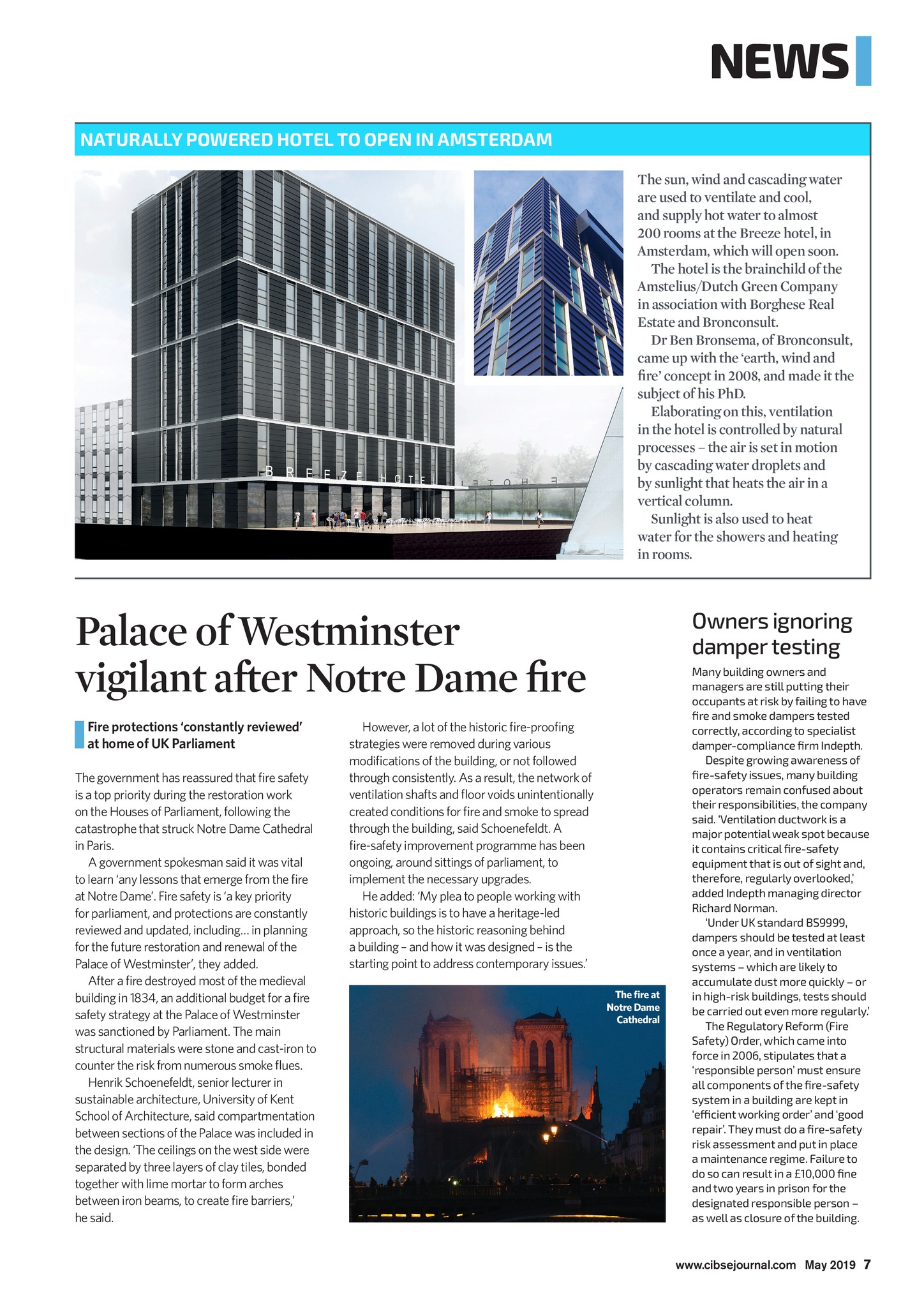
EWS NATURALLY POWERED HOTEL TO OPEN IN AMSTERDAM The sun, wind and cascading water are used to ventilate and cool, and supply hot water to almost 200 rooms at the Breeze hotel, in Amsterdam, which will open soon. The hotel is the brainchild of the Amstelius/Dutch Green Company in association with Borghese Real Estate and Bronconsult. Dr Ben Bronsema, of Bronconsult, came up with the earth, wind and fire concept in 2008, and made it the subject of his PhD. Elaborating on this, ventilation in the hotel is controlled by natural processes the air is set in motion by cascading water droplets and by sunlight that heats the air in a vertical column. Sunlight is also used to heat waterfor the showers and heating inrooms. Palace of Westminster vigilant after Notre Dame fire Fire protections constantly reviewed athome of UK Parliament The government has reassured that fire safety isa top priority during the restoration work on the Houses of Parliament, following the catastrophe that struck Notre Dame Cathedral in Paris. A government spokesman said it was vital to learn any lessons that emerge from the fire at Notre Dame. Fire safety is a key priority for parliament, and protections are constantly reviewed and updated, including in planning for the future restoration and renewal of the Palace of Westminster, they added. After a fire destroyed most of the medieval building in 1834, an additional budget for a fire safety strategy at the Palace of Westminster was sanctioned by Parliament. The main structural materials were stone and cast-iron to counter the risk from numerous smoke flues. Henrik Schoenefeldt, senior lecturer in sustainable architecture, University of Kent School of Architecture, said compartmentation between sections of the Palace was included in the design. The ceilings on the west side were separated by three layers of clay tiles, bonded together with lime mortar to form arches between iron beams, to create fire barriers, hesaid. Owners ignoring damper testing However, a lot of the historic fire-proofing strategies were removed during various modifications of the building, or not followed through consistently. As a result, the network of ventilation shafts and floor voids unintentionally created conditions for fire and smoke to spread through the building, said Schoenefeldt. A fire-safety improvement programme has been ongoing, around sittings of parliament, to implement the necessary upgrades. He added: My plea to people working with historic buildings is to have a heritage-led approach, so the historic reasoning behind a building and how it was designed is the starting point to address contemporary issues. The fire at Notre Dame Cathedral Many building owners and managers are still putting their occupants at risk by failing to have fire and smoke dampers tested correctly, according to specialist damper-compliance firm Indepth. Despite growing awareness of fire-safety issues, many building operators remain confused about their responsibilities, the company said. Ventilation ductwork is a major potential weak spot because it contains critical fire-safety equipment that is out of sight and, therefore, regularly overlooked, added Indepth managing director Richard Norman. Under UK standard BS9999, dampers should be tested at least once a year, and in ventilation systems which are likely to accumulate dust more quickly or in high-risk buildings, tests should be carried out even more regularly. The Regulatory Reform (Fire Safety) Order, which came into force in 2006, stipulates that a responsible person must ensure all components of the fire-safety system in a building are kept in efficient working order and good repair. They must do a fire-safety risk assessment and put in place a maintenance regime. Failure to do so can result in a 10,000 fine and two years in prison for the designated responsible person as well as closure of the building. www.cibsejournal.com May 2019 7 CIBSE May19 pp07 News.indd 7 26/04/2019 16:53