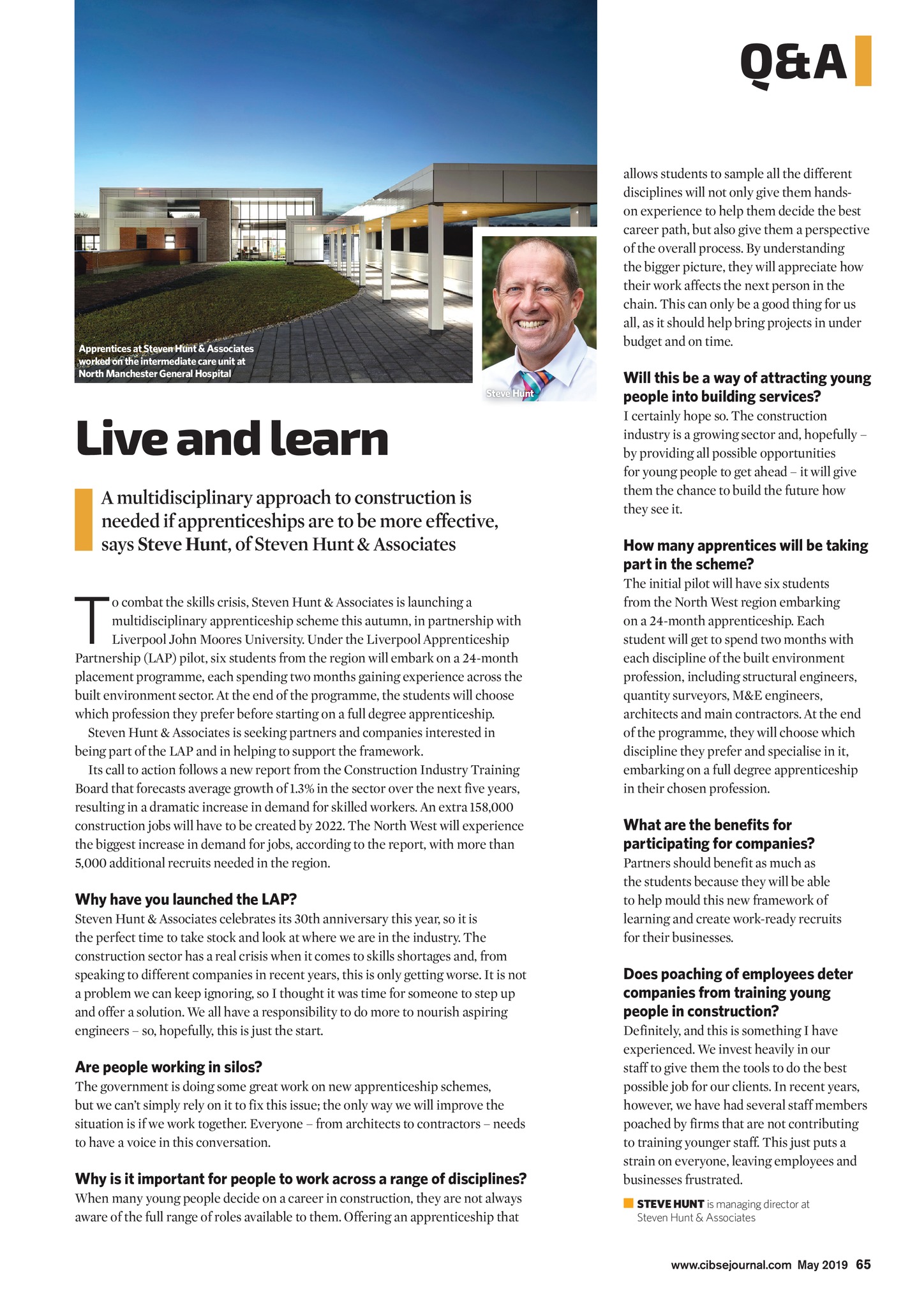

Q&A allows students to sample all the different disciplines will not only give them handson experience to help them decide the best career path, but also give them a perspective of the overall process. By understanding the bigger picture, they will appreciate how their work affects the next person in the chain. This can only be a good thing for us all, as it should help bring projects in under budget and on time. Apprentices at Steven Hunt & Associates worked on the intermediate care unit at North Manchester General Hospital Steve Hunt Live and learn A multidisciplinary approach to construction is needed if apprenticeships are to be more effective, says Steve Hunt, of Steven Hunt & Associates T o combat the skills crisis, Steven Hunt & Associates is launching a multidisciplinary apprenticeship scheme this autumn, in partnership with Liverpool John Moores University. Under the Liverpool Apprenticeship Partnership (LAP) pilot, six students from the region will embark on a 24-month placement programme, each spending two months gaining experience across the built environment sector. At the end of the programme, the students will choose which profession they prefer before starting on a full degree apprenticeship. Steven Hunt & Associates is seeking partners and companies interested in being part of the LAP and in helping to support the framework. Its call to action follows a new report from the Construction Industry Training Board that forecasts average growth of 1.3% in the sector over the next five years, resulting in a dramatic increase in demand for skilled workers. An extra 158,000 construction jobs will have to be created by 2022. The North West will experience the biggest increase in demand for jobs, according to the report, with more than 5,000 additional recruits needed in the region. Why have you launched the LAP? Steven Hunt & Associates celebrates its 30th anniversary this year, so it is the perfect time to take stock and look at where we are in the industry. The construction sector has a real crisis when it comes to skills shortages and, from speaking to different companies in recent years, this is only getting worse. It is not a problem we can keep ignoring, so I thought it was time for someone to step up and offer a solution. We all have a responsibility to do more to nourish aspiring engineers so, hopefully, this is just the start. Are people working in silos? The government is doing some great work on new apprenticeship schemes, but we cant simply rely on it to fix this issue; the only way we will improve the situation is if we work together. Everyone from architects to contractors needs to have a voice in this conversation. Why is it important for people to work across a range of disciplines? When many young people decide on a career in construction, they are not always aware of the full range of roles available to them. Offering an apprenticeship that Will this be a way of attracting young people into building services? I certainly hope so. The construction industry is a growing sector and, hopefully by providing all possible opportunities for young people to get ahead it will give them the chance to build the future how they see it. How many apprentices will be taking part in the scheme? The initial pilot will have six students from the North West region embarking on a 24-month apprenticeship. Each student will get to spend two months with each discipline of the built environment profession, including structural engineers, quantity surveyors, M&E engineers, architects and main contractors. At the end of the programme, they will choose which discipline they prefer and specialise in it, embarking on a full degree apprenticeship in their chosen profession. What are the benets for participating for companies? Partners should benefit as much as the students because they will be able to help mould this new framework of learning and create work-ready recruits for their businesses. Does poaching of employees deter companies from training young people in construction? Definitely, and this is something I have experienced. We invest heavily in our staff to give them the tools to do the best possible job for our clients. In recent years, however, we have had several staff members poached by firms that are not contributing to training younger staff. This just puts a strain on everyone, leaving employees and businesses frustrated. STEVE HUNT is managing director at Steven Hunt & Associates www.cibsejournal.com May 2019 65 CIBSE May19 pp65 Q&A.indd 65 26/04/2019 17:19