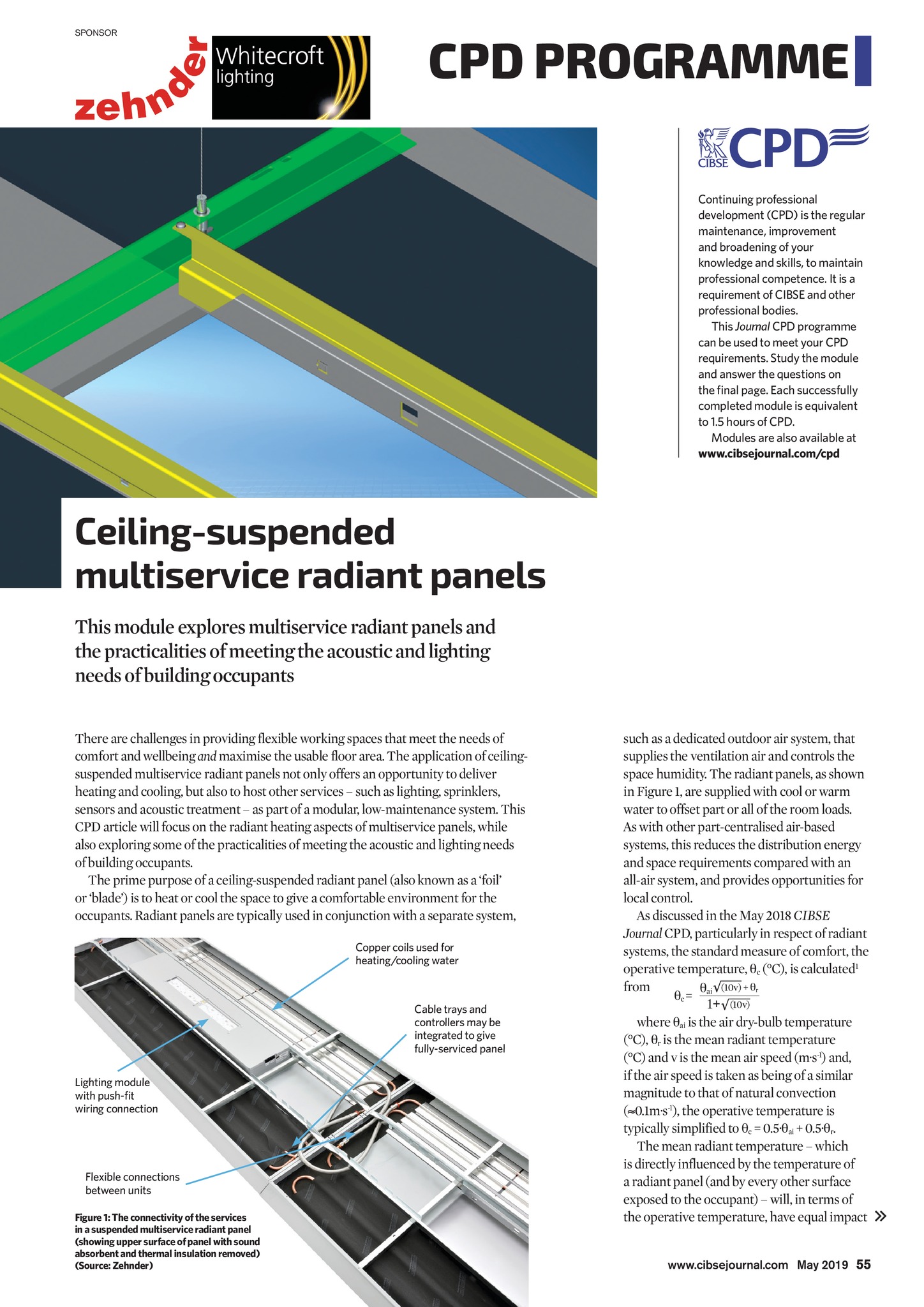
SPONSOR CPD PROGRAMME Continuing professional development (CPD) is the regular maintenance, improvement and broadening of your knowledge and skills, to maintain professional competence. It is a requirement of CIBSE and other professional bodies. This Journal CPD programme can be used to meet your CPD requirements. Study the module and answer the questions on the final page. Each successfully completed module is equivalent to 1.5 hours of CPD. Modules are also available at www.cibsejournal.com/cpd Ceiling-suspended multiservice radiant panels This module explores multiservice radiant panels and the practicalities of meeting the acoustic and lighting needs of building occupants There are challenges in providing flexible working spaces that meet the needs of comfort and wellbeing and maximise the usable floor area. The application of ceilingsuspended multiservice radiant panels not only offers an opportunity to deliver heating and cooling, but also to host other services such as lighting, sprinklers, sensors and acoustic treatment as part of a modular, low-maintenance system. This CPD article will focus on the radiant heating aspects of multiservice panels, while also exploring some of the practicalities of meeting the acoustic and lighting needs ofbuilding occupants. The prime purpose of a ceiling-suspended radiant panel (also known as a foil or blade) is to heat or cool the space to give a comfortable environment for the occupants. Radiant panels are typically used in conjunction with a separate system, Copper coils used for heating/cooling water Cable trays and controllers may be integrated to give fully-serviced panel Lighting module with push-fit wiring connection Flexible connections between units Figure 1: The connectivity of the services in a suspended multiservice radiant panel (showing upper surface of panel with sound absorbent and thermal insulation removed) (Source: Zehnder) CIBSE May19 pp55-58 CPD v2.indd 55 such as a dedicated outdoor air system, that supplies the ventilation air and controls the space humidity. The radiant panels, as shown in Figure 1, are supplied with cool or warm water to offset part or all of the room loads. Aswith other part-centralised air-based systems, this reduces the distribution energy and space requirements compared with an all-air system, and provides opportunities for local control. As discussed in the May 2018 CIBSE Journal CPD, particularly in respect of radiant systems, the standard measure of comfort, the operative temperature, c (C), is calculated1 from (10v) + r c = ai 1+ (10v) where ai is the air dry-bulb temperature (C), r is the mean radiant temperature (C) and v is the mean air speed (ms-1) and, if the air speed is taken as being of a similar magnitude to that of natural convection (0.1ms-1), the operative temperature is typically simplified to c = 0.5ai + 0.5r. The mean radiant temperature which is directly influenced by the temperature of a radiant panel (and by every other surface exposed to the occupant) will, in terms of the operative temperature, have equal impact www.cibsejournal.com May 2019 55 26/04/2019 17:14