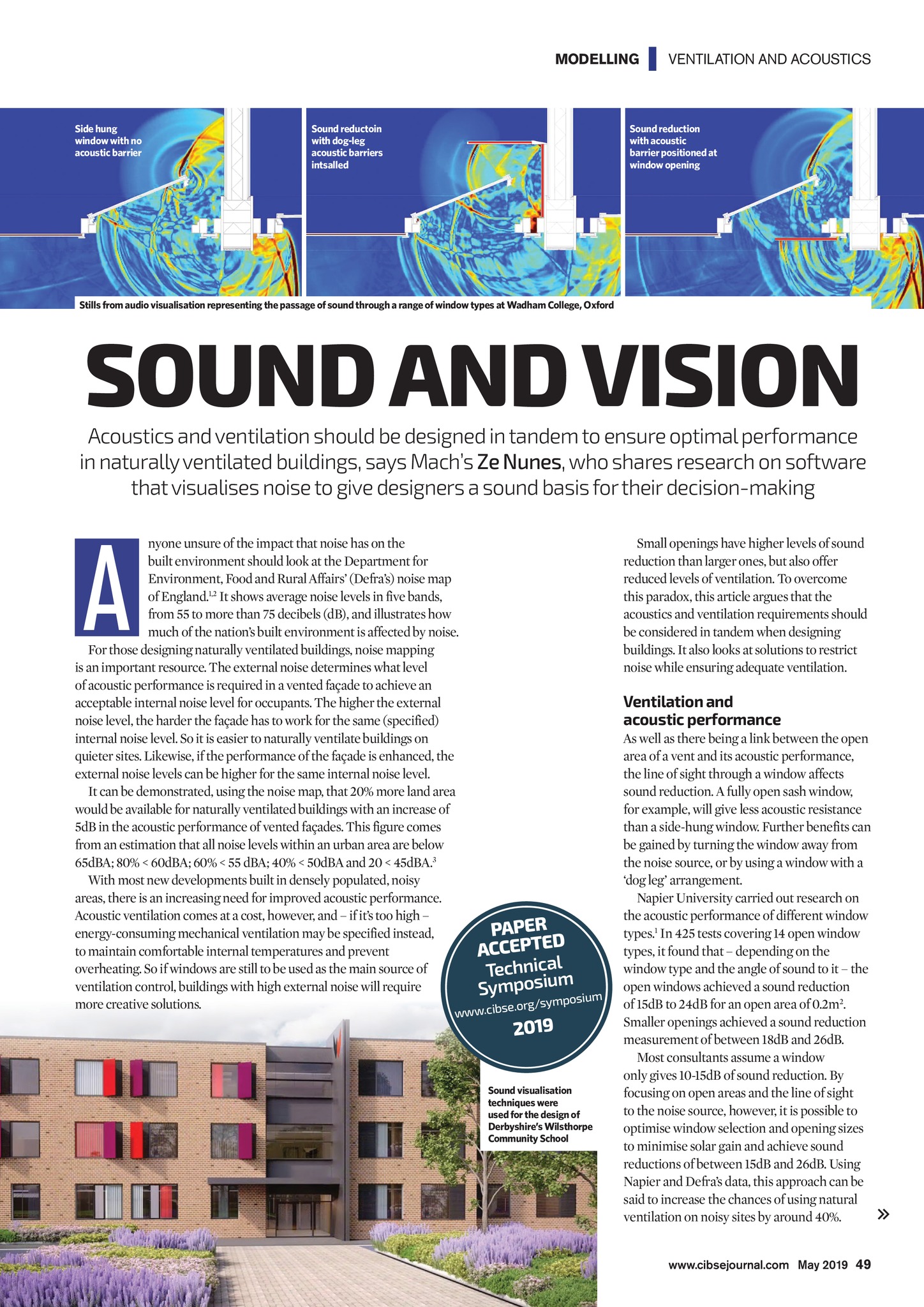
MODELLING Side hung window with no acoustic barrier Sound reductoin with dog-leg acoustic barriers intsalled | VENTILATION AND ACOUSTICS Sound reduction with acoustic barrier positioned at window opening Stills from audio visualisation representing the passage of sound through a range of window types at Wadham College, Oxford SOUND AND VISION Acoustics and ventilation should be designed in tandem to ensure optimal performance in naturally ventilated buildings, says Machs Ze Nunes, who shares research on software that visualises noise to give designers a sound basis for their decision-making A nyone unsure of the impact that noise has on the built environment should look at the Department for Environment, Food and Rural Affairs (Defras) noise map of England.1,2 It shows average noise levels in five bands, from 55 to more than 75 decibels (dB), and illustrates how much of the nations built environment is affected by noise. For those designing naturally ventilated buildings, noise mapping is an important resource. The external noise determines what level of acoustic performance is required in a vented faade to achieve an acceptable internal noise level for occupants. The higher the external noise level, the harder the faade has to work for the same (specified) internal noise level. So it is easier to naturally ventilate buildings on quieter sites. Likewise, if the performance of the faade is enhanced, the external noise levels can be higher for the same internal noise level. It can be demonstrated, using the noise map, that 20% more land area would be available for naturally ventilated buildings with an increase of 5dB in the acoustic performance of vented faades. This figure comes from an estimation that all noise levels within an urban area are below 65dBA; 80% < 60dBA; 60% < 55 dBA; 40% < 50dBA and 20 < 45dBA.3 With most new developments built in densely populated, noisy areas, there is an increasing need for improved acoustic performance. Acoustic ventilation comes at a cost, however, and if its too high energy-consuming mechanical ventilation may be specified instead, to maintain comfortable internal temperatures and prevent overheating. So if windows are still to be used as the main source of ventilation control, buildings with high external noise will require more creative solutions. Small openings have higher levels of sound reduction than larger ones, but also offer reduced levels of ventilation. To overcome this paradox, this article argues that the acoustics and ventilation requirements should be considered in tandem when designing buildings. It also looks at solutions to restrict noise while ensuring adequate ventilation. Ventilation and acoustic performance PAPER ACCEPTED Technicalm Symposiu posium .org/sym www.cibse 2019 Sound visualisation techniques were used for the design of Derbyshires Wilsthorpe Community School As well as there being a link between the open area of a vent and its acoustic performance, the line of sight through a window affects sound reduction. A fully open sash window, for example, will give less acoustic resistance than a side-hung window. Further benefits can be gained by turning the window away from the noise source, or by using a window with a dog leg arrangement. Napier University carried out research on the acoustic performance of different window types.1 In 425 tests covering 14 open window types, it found that depending on the window type and the angle of sound to it the open windows achieved a sound reduction of 15dB to 24dB for an open area of 0.2m2. Smaller openings achieved a sound reduction measurement of between 18dB and 26dB. Most consultants assume a window only gives 10-15dB of sound reduction. By focusing on open areas and the line of sight to the noise source, however, it is possible to optimise window selection and opening sizes to minimise solar gain and achieve sound reductions of between 15dB and 26dB. Using Napier and Defras data, this approach can be said to increase the chances of using natural ventilation on noisy sites by around 40%. www.cibsejournal.com May 2019 49 CIBSE May19 pp49-50, 52 Acoustics ventilation modelling.indd 49 26/04/2019 17:12