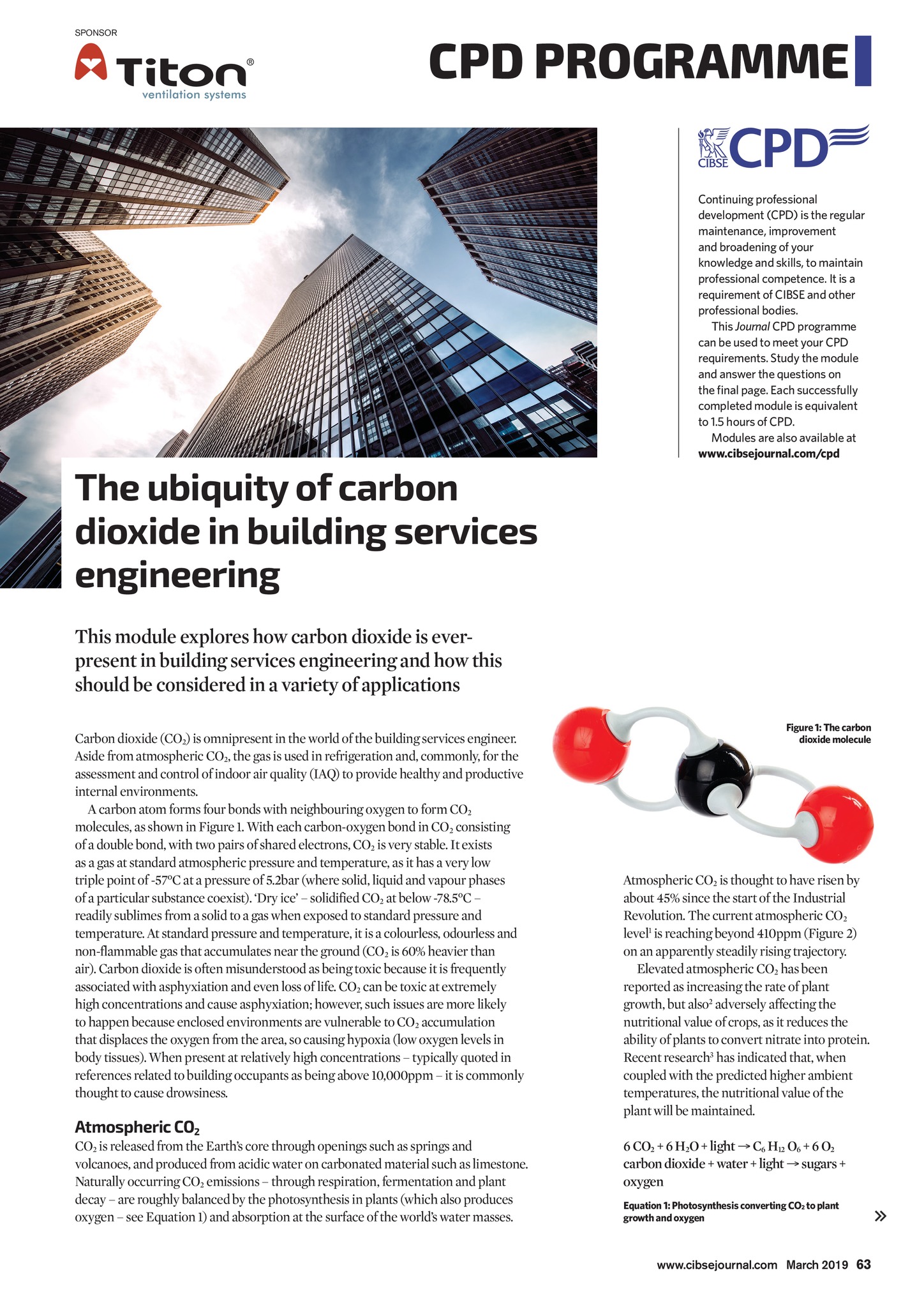

SPONSOR CPD PROGRAMME Continuing professional development (CPD) is the regular maintenance, improvement and broadening of your knowledge and skills, to maintain professional competence. It is a requirement of CIBSE and other professional bodies. This Journal CPD programme can be used to meet your CPD requirements. Study the module and answer the questions on the final page. Each successfully completed module is equivalent to 1.5 hours of CPD. Modules are also available at www.cibsejournal.com/cpd The ubiquity of carbon dioxide in building services engineering This module explores how carbon dioxide is everpresent in building services engineering and how this should be considered in a variety of applications Carbon dioxide (CO2) is omnipresent in the world of the building services engineer. Aside from atmospheric CO2, the gas is used in refrigeration and, commonly, for the assessment and control of indoor air quality (IAQ) to provide healthy and productive internal environments. A carbon atom forms four bonds with neighbouring oxygen to form CO2 molecules, as shown in Figure 1. With each carbon-oxygen bond in CO2 consisting ofa double bond, with two pairs of shared electrons, CO2 is very stable. It exists as a gas at standard atmospheric pressure and temperature, as it has a very low triple point of -57C at a pressure of 5.2bar (where solid, liquid and vapour phases of a particular substance coexist). Dry ice solidified CO2 at below -78.5C readily sublimes from a solid to a gas when exposed to standard pressure and temperature. At standard pressure and temperature, it is a colourless, odourless and non-flammable gas that accumulates near the ground (CO2 is 60% heavier than air). Carbon dioxide is often misunderstood as being toxic because it is frequently associated with asphyxiation and even loss of life. CO2 can be toxic at extremely high concentrations and cause asphyxiation; however, such issues are more likely to happen because enclosed environments are vulnerable to CO2 accumulation that displaces the oxygen from the area, so causing hypoxia (low oxygen levels in body tissues). When present at relatively high concentrations typically quoted in references related to building occupants as being above 10,000ppm it is commonly thought to cause drowsiness. Atmospheric CO2 CO2 is released from the Earths core through openings such as springs and volcanoes, and produced from acidic water on carbonated material such as limestone. Naturally occurring CO2 emissions through respiration, fermentation and plant decay are roughly balanced by the photosynthesis in plants (which also produces oxygen see Equation 1) and absorption at the surface of the worlds water masses. Figure 1: The carbon dioxide molecule Atmospheric CO2 is thought to have risen by about 45% since the start of the Industrial Revolution. The current atmospheric CO2 level1 is reaching beyond 410ppm (Figure 2) on an apparently steadily rising trajectory. Elevated atmospheric CO2 has been reported as increasing the rate of plant growth, but also2 adversely affecting the nutritional value of crops, as it reduces the ability of plants to convert nitrate into protein. Recent research3 has indicated that, when coupled with the predicted higher ambient temperatures, the nutritional value of the plant will be maintained. 6 CO2 + 6 H2O + light C6 H12 O6 + 6 O2 carbon dioxide + water + light sugars + oxygen Equation 1: Photosynthesis converting CO2 to plant growth and oxygen www.cibsejournal.com March 2019 63 CIBSE Mar19 pp63-66 CPD.indd 63 22/02/2019 16:46