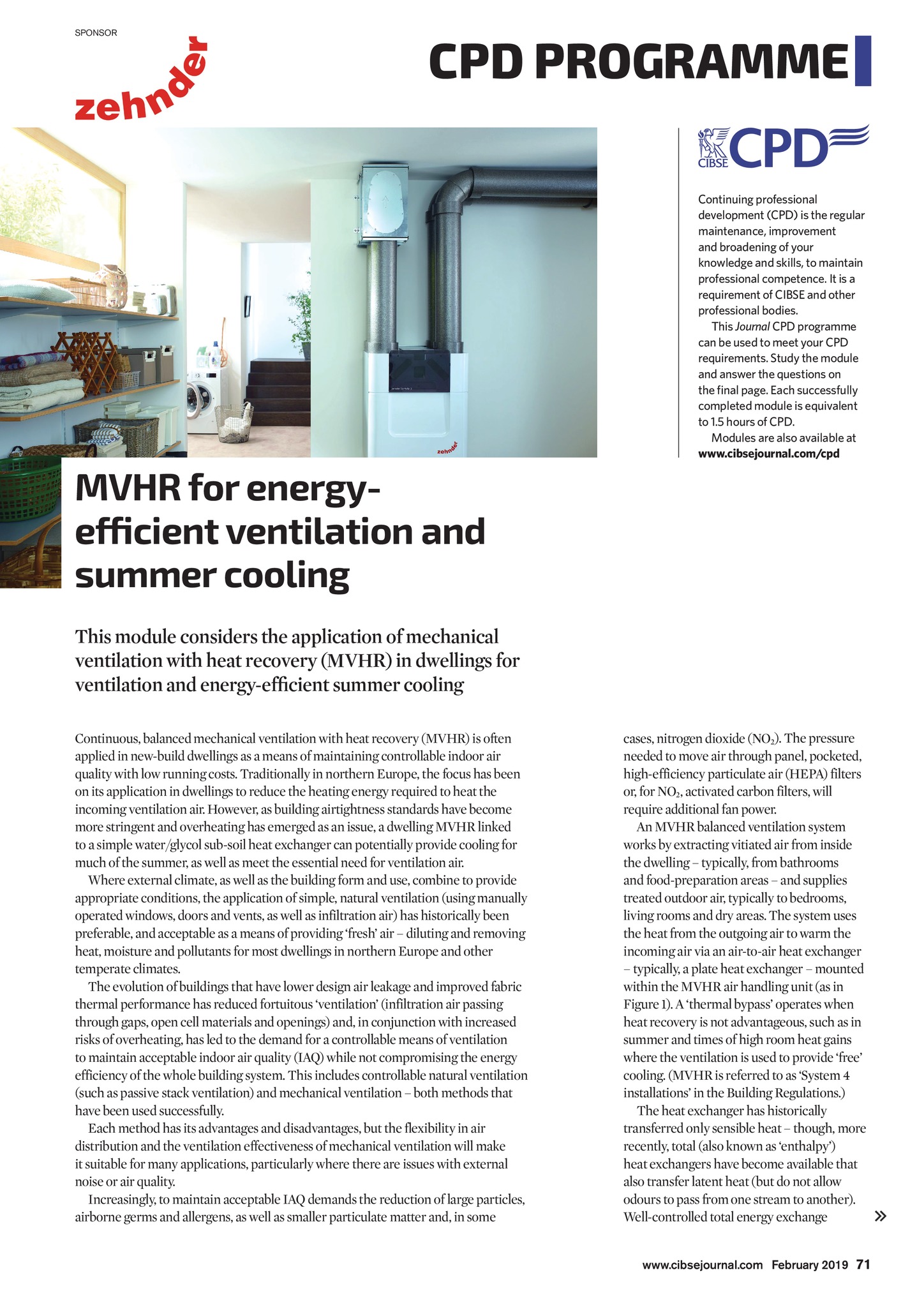
SPONSOR CPD PROGRAMME Continuing professional development (CPD) is the regular maintenance, improvement and broadening of your knowledge and skills, to maintain professional competence. It is a requirement of CIBSE and other professional bodies. This Journal CPD programme can be used to meet your CPD requirements. Study the module and answer the questions on the final page. Each successfully completed module is equivalent to 1.5 hours of CPD. Modules are also available at www.cibsejournal.com/cpd MVHR for energyefficient ventilation and summercooling This module considers the application of mechanical ventilation with heat recovery (MVHR) in dwellings for ventilation and energy-efficient summer cooling Continuous, balanced mechanical ventilation with heat recovery (MVHR) is often applied in new-build dwellings as a means of maintaining controllable indoor air quality with low running costs. Traditionally in northern Europe, the focus has been on its application in dwellings to reduce the heating energy required to heat the incoming ventilation air. However, as building airtightness standards have become more stringent and overheating has emerged as an issue, a dwelling MVHR linked to a simple water/glycol sub-soil heat exchanger can potentially provide cooling for much of the summer, as well as meet the essential need for ventilation air. Where external climate, as well as the building form and use, combine to provide appropriate conditions, the application of simple, natural ventilation (using manually operated windows, doors and vents, as well as infiltration air) has historically been preferable, and acceptable as a means of providing fresh air diluting and removing heat, moisture and pollutants for most dwellings in northern Europe and other temperate climates. The evolution of buildings that have lower design air leakage and improved fabric thermal performance has reduced fortuitous ventilation (infiltration air passing through gaps, open cell materials and openings) and, in conjunction with increased risks of overheating, has led to the demand for a controllable means of ventilation to maintain acceptable indoor air quality (IAQ) while not compromising the energy efficiency of the whole building system. This includes controllable natural ventilation (such as passive stack ventilation) and mechanical ventilation both methods that have been used successfully. Each method has its advantages and disadvantages, but the flexibility in air distribution and the ventilation effectiveness of mechanical ventilation will make it suitable for many applications, particularly where there are issues with external noise or air quality. Increasingly, to maintain acceptable IAQ demands the reduction of large particles, airborne germs and allergens, as well as smaller particulate matter and, in some cases, nitrogen dioxide (NO2). The pressure needed to move air through panel, pocketed, high-efficiency particulate air (HEPA) filters or, for NO2, activated carbon filters, will require additional fan power. An MVHR balanced ventilation system works by extracting vitiated air from inside the dwelling typically, from bathrooms and food-preparation areas and supplies treated outdoor air, typically to bedrooms, living rooms and dry areas. The system uses the heat from the outgoing air to warm the incoming air via an air-to-air heat exchanger typically, a plate heat exchanger mounted within the MVHR air handling unit (as in Figure 1). A thermal bypass operates when heat recovery is not advantageous, such as in summer and times of high room heat gains where the ventilation is used to provide free cooling. (MVHR is referred to as System 4 installations in the Building Regulations.) The heat exchanger has historically transferred only sensible heat though, more recently, total (also known as enthalpy) heat exchangers have become available that also transfer latent heat (but do not allow odours to pass from one stream to another). Well-controlled total energy exchange www.cibsejournal.com February 2019 71 CIBSE Feb19 pp71-74 CPD v2.indd 71 25/01/2019 16:00