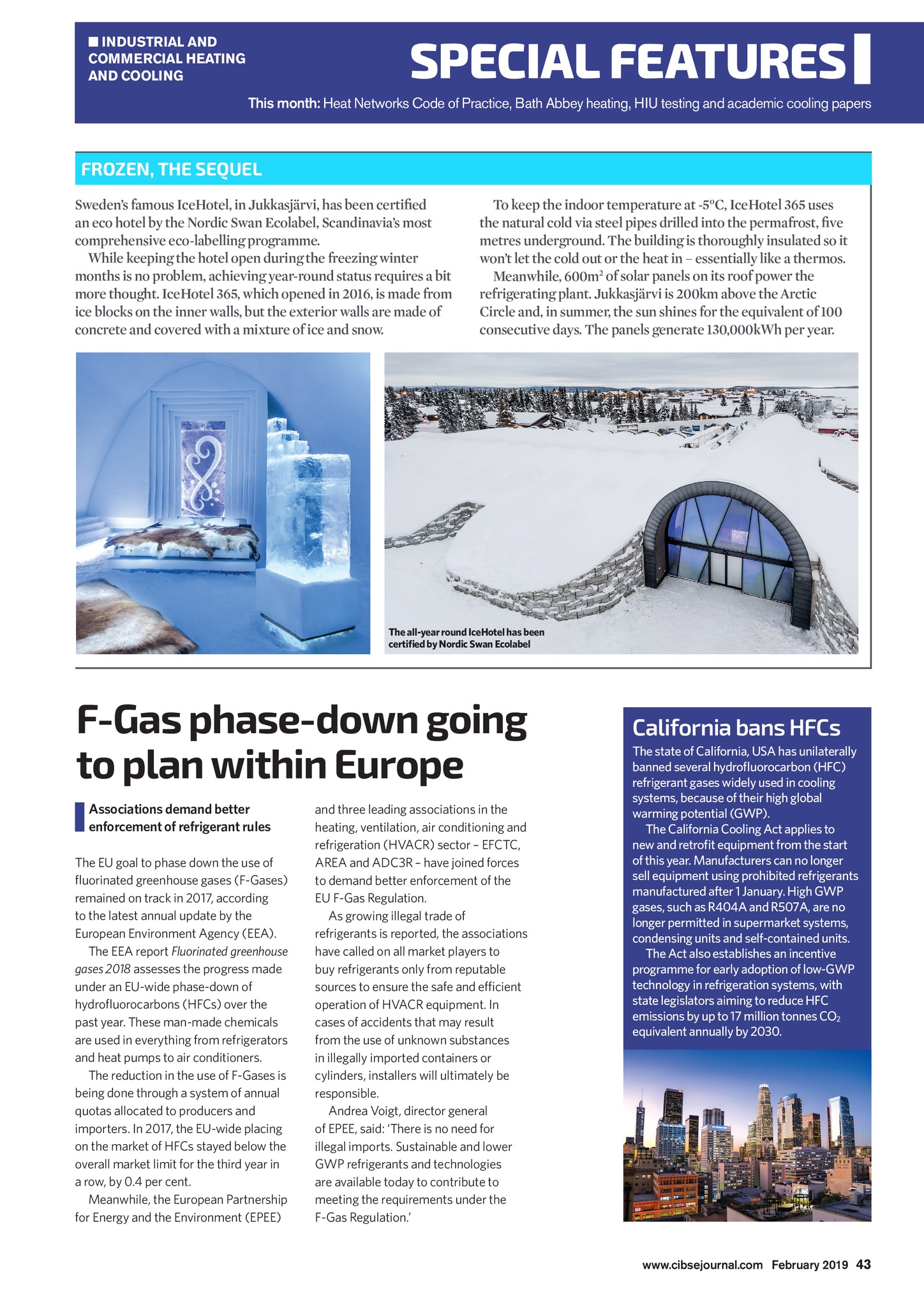

SPECIAL FEATURES INDUSTRIAL AND COMMERCIAL HEATING AND COOLING This month: Heat Networks Code of Practice, Bath Abbey heating, HIU testing and academic cooling papers FROZEN, THE SEQUEL Swedens famous IceHotel, in Jukkasjrvi, has been certified an eco hotel by the Nordic Swan Ecolabel, Scandinavias most comprehensive eco-labelling programme. While keeping the hotel open during the freezing winter months is no problem, achieving year-round status requires a bit more thought. IceHotel 365, which opened in 2016, is made from ice blocks on the inner walls, but the exterior walls are made of concrete and covered with a mixture of ice and snow. To keep the indoor temperature at -5C, IceHotel 365 uses the natural cold via steel pipes drilled into the permafrost, five metres underground. The building is thoroughly insulated so it wont let the cold out or the heat in essentially like a thermos. Meanwhile, 600m2 of solar panels on its roof power the refrigerating plant. Jukkasjrvi is 200km above the Arctic Circle and, in summer, the sun shines for the equivalent of 100 consecutive days. The panels generate 130,000kWh per year. The all-year round IceHotel has been certified by Nordic Swan Ecolabel F-Gas phase-down going to plan within Europe Associations demand better enforcement of refrigerant rules The EU goal to phase down the use of fluorinated greenhouse gases (F-Gases) remained on track in 2017, according to the latest annual update by the European Environment Agency (EEA). The EEA report Fluorinated greenhouse gases 2018 assesses the progress made under an EU-wide phase-down of hydrofluorocarbons (HFCs) over the past year. These man-made chemicals are used in everything from refrigerators and heat pumps to air conditioners. The reduction in the use of F-Gases is being done through a system of annual quotas allocated to producers and importers. In 2017, the EU-wide placing on the market of HFCs stayed below the overall market limit for the third year in a row, by 0.4 per cent. Meanwhile, the European Partnership for Energy and the Environment (EPEE) and three leading associations in the heating, ventilation, air conditioning and refrigeration (HVACR) sector EFCTC, AREA and ADC3R have joined forces to demand better enforcement of the EUF-Gas Regulation. As growing illegal trade of refrigerants is reported, the associations have called on all market players to buy refrigerants only from reputable sources to ensure the safe and efficient operation of HVACR equipment. In cases of accidents that may result from the use of unknown substances in illegally imported containers or cylinders, installers will ultimately be responsible. Andrea Voigt, director general of EPEE, said: There is no need for illegal imports. Sustainable and lower GWP refrigerants and technologies are available today to contribute to meetingthe requirements under the F-Gas Regulation. California bans HFCs The state of California, USA has unilaterally banned several hydrofluorocarbon (HFC) refrigerant gases widely used in cooling systems, because of their high global warming potential (GWP). The California Cooling Act applies to new and retrofit equipment from the start of this year. Manufacturers can no longer sell equipment using prohibited refrigerants manufactured after 1 January. High GWP gases, such as R404A and R507A, are no longer permitted in supermarket systems, condensing units and self-contained units. The Act also establishes an incentive programme for early adoption of low-GWP technology in refrigeration systems, with state legislators aiming to reduce HFC emissions by up to 17 million tonnes CO2 equivalent annually by 2030. www.cibsejournal.com February 2019 43 CIBSE Feb19 pp43-45 Cooling News.indd 43 25/01/2019 18:30