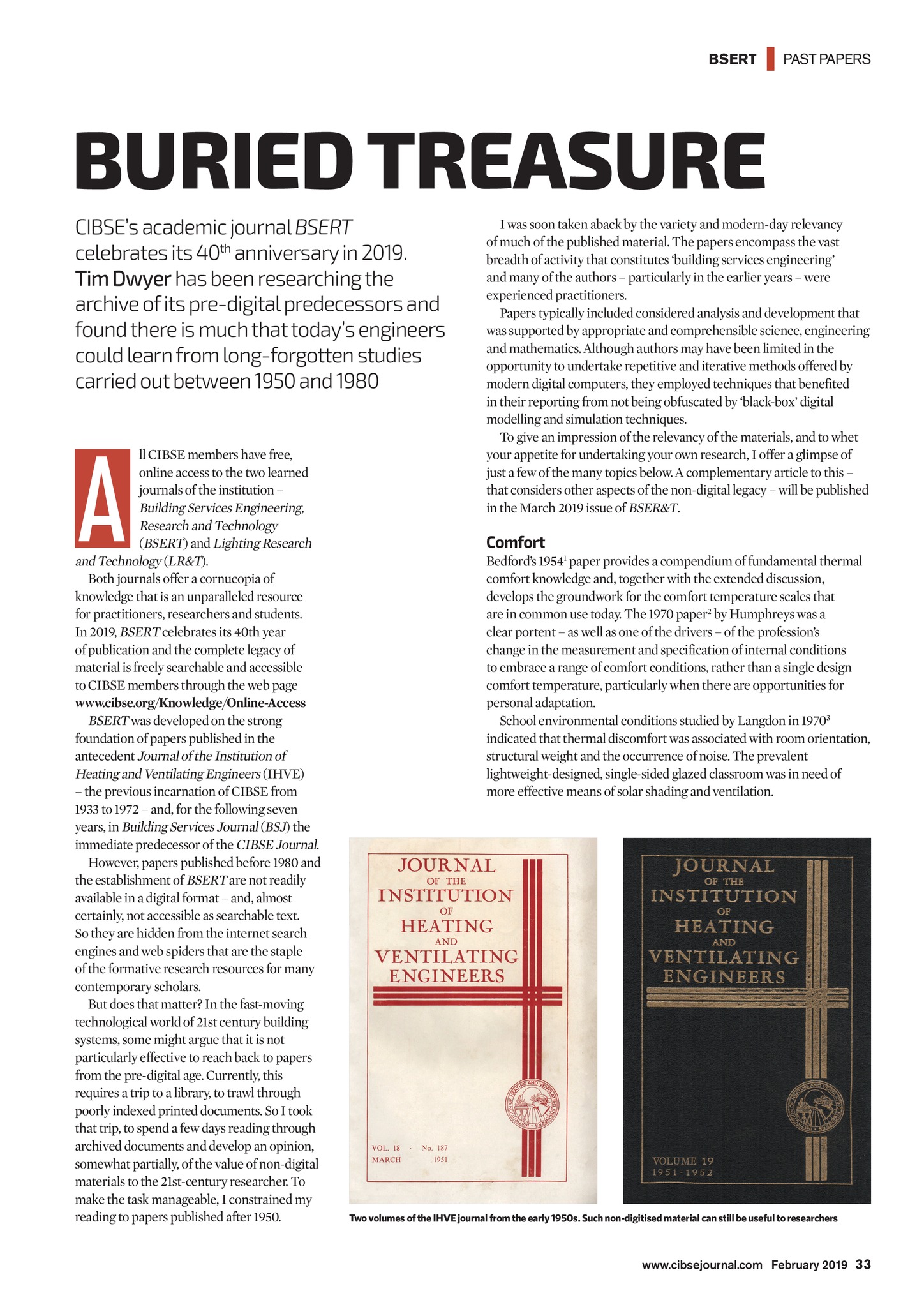
BSERT | PAST PAPERS BURIED TREASURE CIBSEs academic journal BSERT celebrates its 40th anniversary in 2019. TimDwyer has been researching the archive of its pre-digital predecessors and found there is much that todays engineers could learn from long-forgotten studies carried out between 1950 and 1980 A ll CIBSE members have free, online access to the two learned journals of the institution Building Services Engineering, Research and Technology (BSERT) and Lighting Research and Technology (LR&T). Both journals offer a cornucopia of knowledge that is an unparalleled resource for practitioners, researchers and students. In 2019, BSERT celebrates its 40th year of publication and the complete legacy of material is freely searchable and accessible toCIBSE members through the web page www.cibse.org/Knowledge/Online-Access BSERT was developed on the strong foundation of papers published in the antecedent Journal of the Institution of Heating and Ventilating Engineers (IHVE) the previous incarnation of CIBSE from 1933 to 1972 and, for the following seven years, in Building Services Journal (BSJ) the immediate predecessor of the CIBSE Journal. However, papers published before 1980 and the establishment of BSERT are not readily available in a digital format and, almost certainly, not accessible as searchable text. So they are hidden from the internet search engines and web spiders that are the staple of the formative research resources for many contemporary scholars. But does that matter? In the fast-moving technological world of 21st century building systems, some might argue that it is not particularly effective to reach back to papers from the pre-digital age. Currently, this requires a trip to a library, to trawl through poorly indexed printed documents. So I took that trip, to spend a few days reading through archived documents and develop an opinion, somewhat partially, of the value of non-digital materials to the 21st-century researcher. To make the task manageable, I constrained my reading to papers published after 1950. I was soon taken aback by the variety and modern-day relevancy of much of the published material. The papers encompass the vast breadthof activity that constitutes building services engineering and many of the authors particularly in the earlier years were experienced practitioners. Papers typically included considered analysis and development that was supported by appropriate and comprehensible science, engineering and mathematics. Although authors may have been limited in the opportunity to undertake repetitive and iterative methods offered by modern digital computers, they employed techniques that benefited in their reporting from not being obfuscated by black-box digital modelling and simulation techniques. To give an impression of the relevancy of the materials, and to whet your appetite for undertaking your own research, I offer a glimpse of just a few of the many topics below. A complementary article to this that considers other aspects of the non-digital legacy will be published in the March 2019 issue of BSER&T. Comfort Bedfords 19541 paper provides a compendium of fundamental thermal comfort knowledge and, together with the extended discussion, develops the groundwork for the comfort temperature scales that are incommon use today. The 1970 paper2 by Humphreys was a clearportent as well as one of the drivers of the professions change in the measurement and specification of internal conditions to embracea range of comfort conditions, rather than a single design comfort temperature, particularly when there are opportunities for personal adaptation. School environmental conditions studied by Langdon in 19703 indicated that thermal discomfort was associated with room orientation, structural weight and the occurrence of noise. The prevalent lightweight-designed, single-sided glazed classroom was in need of more effective means of solar shading and ventilation. Two volumes of the IHVE journal from the early 1950s. Such non-digitised material can still be useful to researchers www.cibsejournal.com February 2019 33 CIBSE Feb19 pp33-34 BSERT.indd 33 25/01/2019 16:11