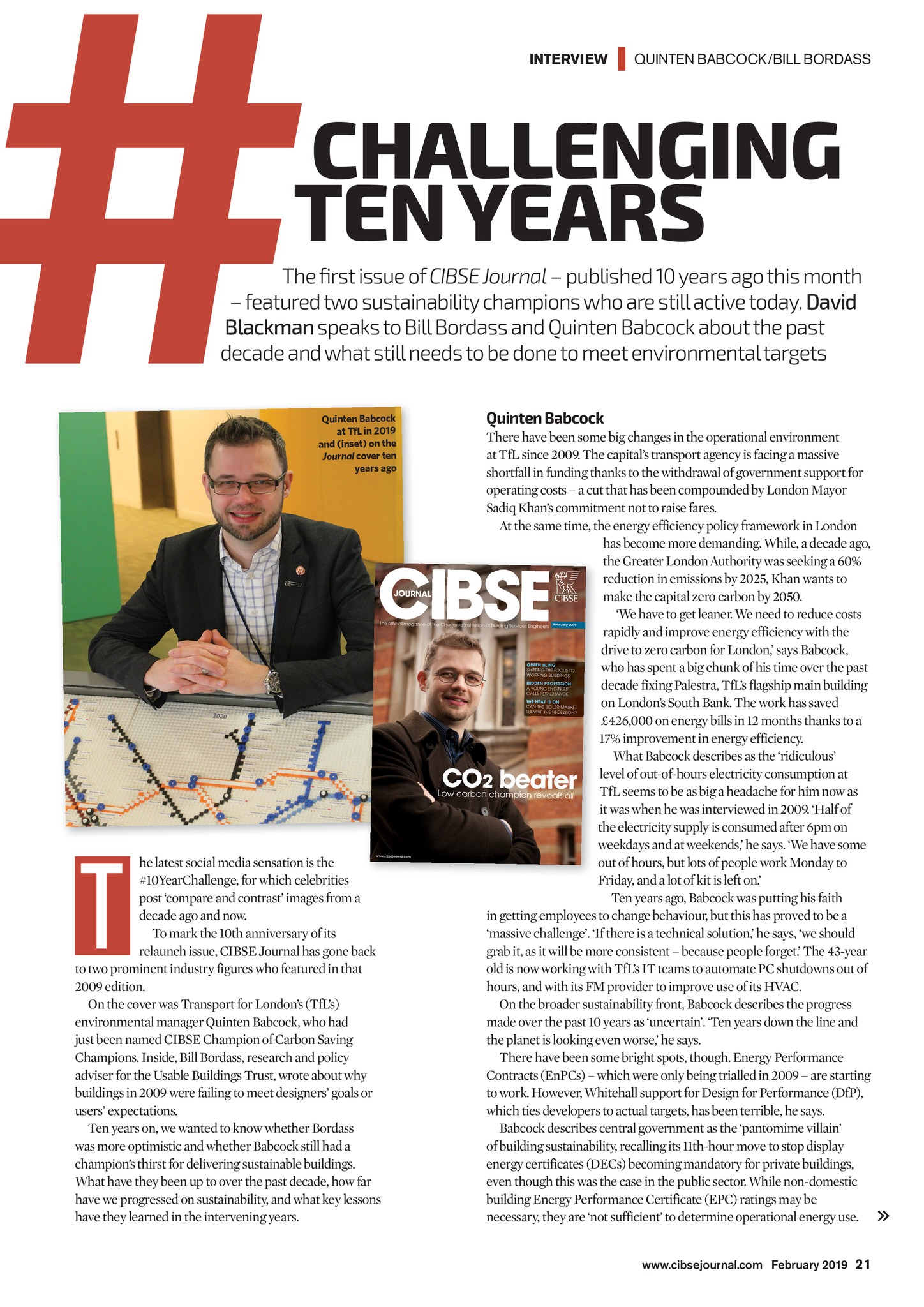

INTERVIEW | QUINTEN BABCOCK/BILL BORDASS CHALLENGING TEN YEARS The first issue of CIBSE Journal published 10 years ago this month featured two sustainability champions who are still active today. David Blackman speaks to Bill Bordass and Quinten Babcock about the past decade and what still needs to be done to meet environmental targets Quinten Babcock at TfL in 2019 and (inset) on the Journal cover ten years ago T he latest social media sensation is the #10YearChallenge, for which celebrities post compare and contrast images from a decade ago and now. To mark the 10th anniversary of its relaunch issue, CIBSE Journal has gone back to two prominent industry figures who featured in that 2009 edition. On the cover was Transport for Londons (TfLs) environmental manager Quinten Babcock, who had just been named CIBSE Champion of Carbon Saving Champions. Inside, Bill Bordass, research and policy adviser for the Usable Buildings Trust, wrote about why buildings in 2009 were failing to meet designers goals or users expectations. Ten years on, we wanted to know whether Bordass was more optimistic and whether Babcock still had a champions thirst for delivering sustainable buildings. What have they been up to over the past decade, how far have we progressed on sustainability, and what key lessons have they learned in the intervening years. Quinten Babcock There have been some big changes in the operational environment at TfL since 2009. The capitals transport agency is facing a massive shortfall in funding thanks to the withdrawal of government support for operating costs a cut that has been compounded by London Mayor Sadiq Khans commitment not to raise fares. At the same time, the energy efficiency policy framework in London has become more demanding. While, a decade ago, the Greater London Authority was seeking a 60% reduction in emissions by 2025, Khan wants to make the capital zero carbon by 2050. We have to get leaner. We need to reduce costs rapidly and improve energy efficiency with the drive to zero carbon for London, says Babcock, who has spent a big chunk of his time over the past decade fixing Palestra, TfLs flagship main building on Londons South Bank. The work has saved 426,000 on energy bills in 12 months thanks to a 17% improvement in energy efficiency. What Babcock describes as the ridiculous level of out-of-hours electricity consumption at TfL seems to be as big a headache for him now as it was when he was interviewed in 2009. Half of the electricity supply is consumed after 6pm on weekdays and at weekends, he says. We have some out of hours, but lots of people work Monday to Friday, and a lot of kit is left on. Ten years ago, Babcock was putting his faith in getting employees to change behaviour, but this has proved to be a massive challenge. If there is a technical solution, he says, we should grab it, as it will be more consistent because people forget. The 43-year old is now working with TfLs IT teams to automate PC shutdowns out of hours, and with its FM provider to improve use of its HVAC. On the broader sustainability front, Babcock describes the progress made over the past 10 years as uncertain. Ten years down the line and the planet is looking even worse, he says. There have been some bright spots, though. Energy Performance Contracts (EnPCs) which were only being trialled in 2009 are starting to work. However, Whitehall support for Design for Performance (DfP), which ties developers to actual targets, has been terrible, he says. Babcock describes central government as the pantomime villain of building sustainability, recalling its 11th-hour move to stop display energy certificates (DECs) becoming mandatory for private buildings, even though this was the case in the public sector. While non-domestic building Energy Performance Certificate (EPC) ratings may be necessary, they are not sufficient to determine operational energy use. www.cibsejournal.com February 2019 21 CIBSE Feb19 pp21-22 10 years of CJ.indd 21 25/01/2019 16:30