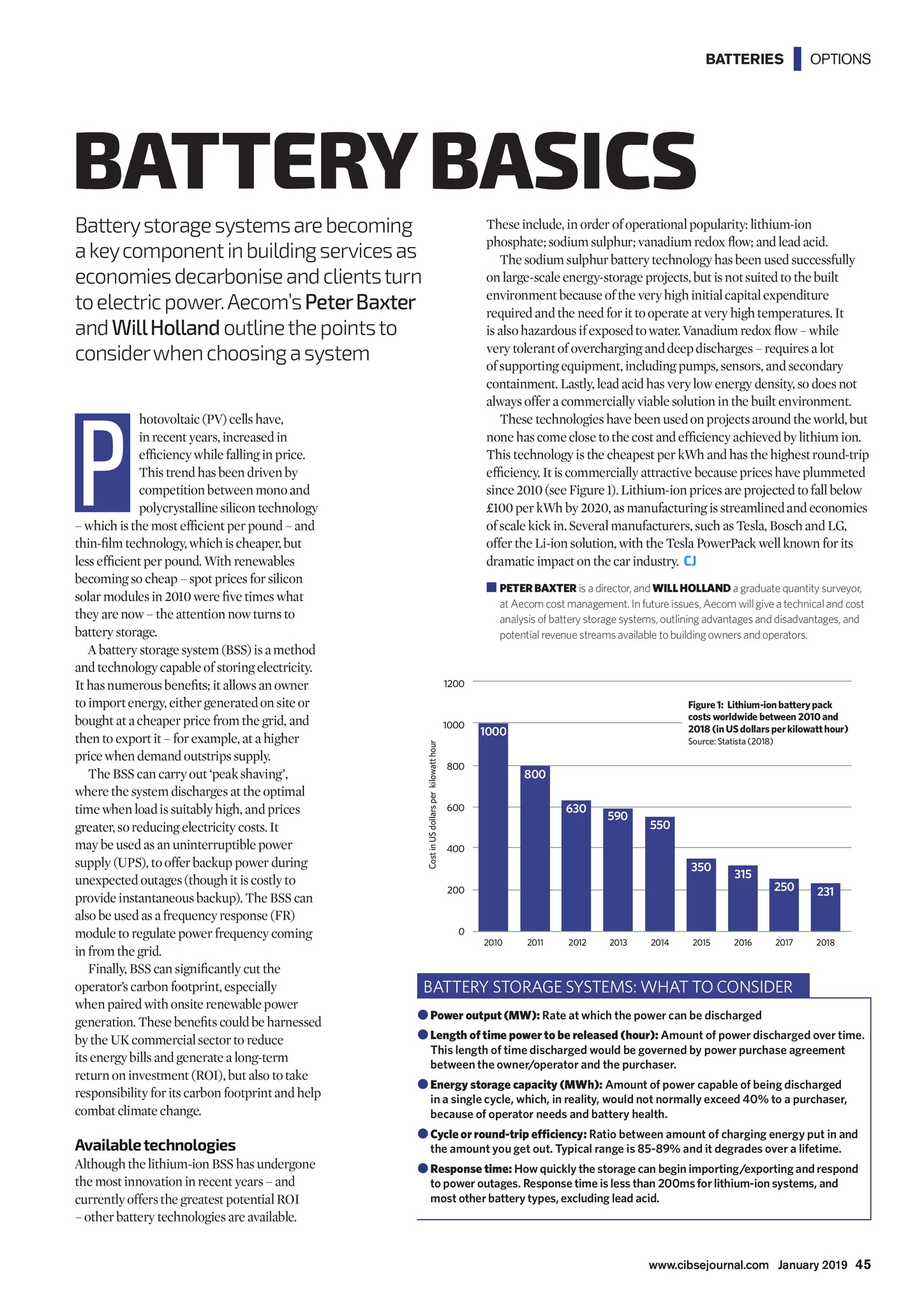

Batteries | Options Battery basics Battery storage systems are becoming a key component in building services as economies decarbonise and clients turn toelectric power. Aecoms Peter Baxter and Will Holland outline the points to consider when choosing a system These include, in order of operational popularity: lithium-ion phosphate; sodium sulphur; vanadium redox flow; and lead acid. The sodium sulphur battery technology has been used successfully on large-scale energy-storage projects, but is not suited to the built environment because of the very high initial capital expenditure required and the need for it to operate at very high temperatures. It is also hazardous if exposed to water. Vanadium redox flow while very tolerant of overcharging and deep discharges requires a lot of supporting equipment, including pumps, sensors, and secondary containment. Lastly, lead acid has very low energy density, so does not always offer a commercially viable solution in the built environment. These technologies have been used on projects around the world, but none has come close to the cost and efficiency achieved by lithium ion. This technology is the cheapest per kWh and has the highest round-trip efficiency. It is commercially attractive because prices have plummeted since 2010 (see Figure 1). Lithium-ion prices are projected to fall below 100 per kWh by 2020, as manufacturing is streamlined and economies of scale kick in. Several manufacturers, such as Tesla, Bosch and LG, offer the Li-ion solution, with the Tesla PowerPack well known for its dramatic impact on the car industry. CJ P Available technologies Although the lithium-ion BSS has undergone the most innovation in recent years and currently offers the greatest potential ROI other battery technologies are available. Peter Baxter is a director, and Will Holland a graduate quantity surveyor, at Aecom cost management. In future issues, Aecom will give a technical and cost analysis of battery storage systems, outlining advantages and disadvantages, and potential revenue streams available to building owners and operators. 1200 1000 Cost in US dollars per kilowatt hour hotovoltaic (PV) cells have, in recent years, increased in efficiency while falling in price. This trend has been driven by competition between mono and polycrystalline silicon technology which is the most efficient per pound and thin-film technology, which is cheaper, but less efficient per pound. With renewables becoming so cheap spot prices for silicon solar modules in 2010 were five times what they are now the attention now turns to battery storage. A battery storage system (BSS) is a method and technology capable of storing electricity. It has numerous benefits; it allows an owner to import energy, either generated on site or bought at a cheaper price from the grid, and then to export it for example, at a higher price when demand outstrips supply. The BSS can carry out peak shaving, where the system discharges at the optimal time when load is suitably high, and prices greater, so reducing electricity costs. It may be used as an uninterruptible power supply (UPS), to offer backup power during unexpected outages (though it is costly to provide instantaneous backup). The BSS can also be used as a frequency response (FR) module to regulate power frequency coming in from the grid. Finally, BSS can significantly cut the operators carbon footprint, especially when paired with onsite renewable power generation. These benefits could be harnessed by the UK commercial sector to reduce its energy bills and generate a long-term return on investment (ROI), but also to take responsibility for its carbon footprint and help combat climate change. Figure 1: Lithium-ion battery pack costs worldwide between 2010 and 2018 (in US dollars per kilowatt hour) 1000 800 Source: Statista (2018) 800 630 600 590 550 400 350 315 200 0 2010 2011 2012 2013 2014 2015 2016 250 2017 231 2018 Battery storage systems: what to consider Power output (MW): Rate at which the power can be discharged Length of time power to be released (hour): Amount of power discharged over time. This length of time discharged would be governed by power purchase agreement between the owner/operator and the purchaser. Energy storage capacity (MWh): Amount of power capable of being discharged in a single cycle, which, in reality, would not normally exceed 40% to a purchaser, because of operator needs and battery health. Cycle or round-trip efficiency: Ratio between amount of charging energy put in and the amount you get out. Typical range is 85-89% and it degrades over a lifetime. Response time: How quickly the storage can begin importing/exporting and respond to power outages. Response time is less than 200ms for lithium-ion systems, and most other battery types, excluding lead acid. www.cibsejournal.com January 2019 45 CIBSE Jan19 pp45 Aecom Battery Res.indd 45 21/12/2018 15:10